Cradle Mountain-Lake St Clair National Park
Tasmania, Australia
Cradle Mountain-Lake St Clair is the best known of the national parks of Tasmania, a highland of jagged dolerite peaks,…
12 tickets & tours
Island Park · Tasmania · Australia
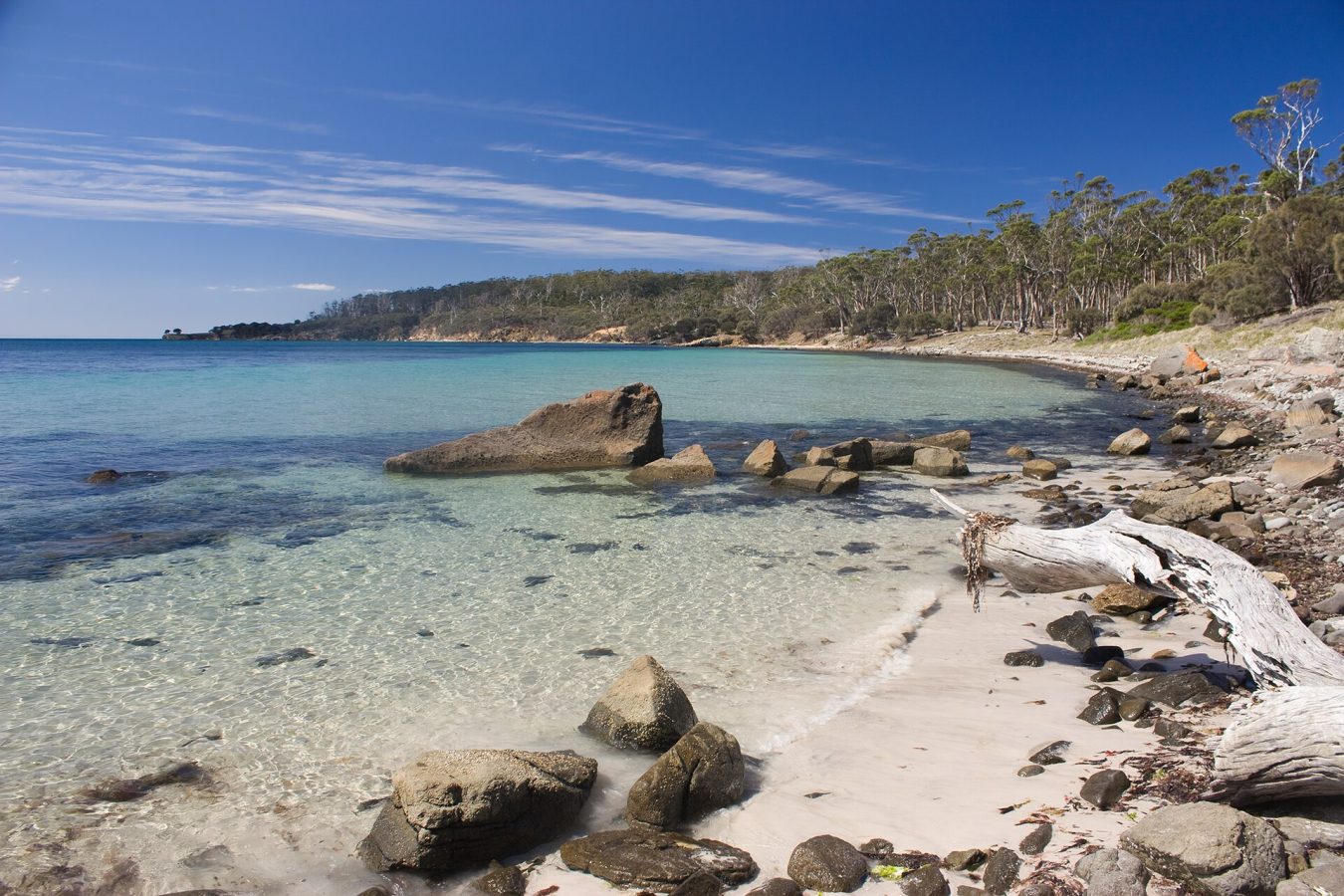
Photo: JJ Harrison (https://www.jjharrison.com.au/), CC BY-SA 3.0
Maria Island lies off the east coast of Tasmania, reached by a half-hour passenger ferry from Triabunna, an hour and a quarter's drive from Hobart, and it has no cars, no shops and no permanent residents, which is the point. The day tours from Hobart bundle the drive, the ferry, the parks pass, a guide and a picnic, walk to the Painted Cliffs and the Fossil Cliffs and through the Darlington convict settlement, and find the wombats, which takes no finding, before the afternoon boat; they are the option for people without a car, and the small-group wildlife versions spend longer with the animals.
The Maria Island Walk, a four-day guided walk with two wilderness camps and a last night in a restored colonial house, is one of the Great Walks of Australia and the luxury way to see the whole island. Independent visitors book the ferry ahead in summer, carry a Tasmanian parks pass, bring all their food and water bottles, and walk or hire a bicycle at Darlington for the track south to the isthmus; the old penitentiary cells are let as bunk rooms through the parks service and the campsites are free or cheap. The cruises and tours sold around the island's name in Florida, the Azores, Cape Verde and Seville's Maria Luisa park have nothing to do with it. Bring a wind jacket, and do not feed or touch the wombats, however willing they seem.
Live dates and prices from GetYourGuide. Free cancellation on most tickets.
The whole of Maria Island, 115 square kilometres, has been a national park since 1972, with a marine reserve on its north-west coast; Abel Tasman named it in 1642 for the wife of the governor of Batavia, and Tasmanians pronounce it Mar-eye-a. It is a figure-of-eight of two mountainous halves joined by a sandy isthmus, with Mount Maria at 711 metres and the twin dolerite peaks of Bishop and Clerk above the northern cliffs. Darlington, where the ferry lands, was a convict probation station twice, from 1825 to 1832 and from 1842 to 1850, and is part of the Australian Convict Sites World Heritage listing, the most intact of them, with the penitentiary, the commissariat store and the mess hall standing in a meadow; after the convicts came an Italian entrepreneur, Diego Bernacchi, who tried silk, wine and then cement, and left the concrete silos by the jetty.
The Painted Cliffs, a short walk south, are sandstone stained by iron oxide into swirls of red, orange and cream, reached at low tide; the Fossil Cliffs to the north are a wall of Permian limestone packed with shells, above a sea where whales pass. The island is a Noah's ark: from the 1960s threatened Tasmanian species were released here, Forester kangaroos, Bennett's wallabies, Cape Barren geese and later a disease-free population of Tasmanian devils, and the common wombats, with no predators and no roads, graze the Darlington lawns by day in numbers found nowhere else. Eleven of Tasmania's twelve endemic birds live on the island, including the forty-spotted pardalote, one of the rarest birds in Australia, in the white gums. The climbs to Bishop and Clerk, four hours return with a scramble at the top, and to Mount Maria are the day hikes, and the marine reserve has kelp forests for divers.
The ferry runs daily all year, several times a day in summer and less often in winter, with the last boat in the late afternoon; miss it and the night is on the island. Summer from December to February is the warm, busy season, with the ferry and the penitentiary bunks booked out; autumn from March to May is settled, clear and the best; winter is cold, quiet and perfectly possible; spring is windy with joeys in every pouch. Check the tide for the Painted Cliffs, which need it low. Allow a full day, two with Bishop and Clerk. Freycinet and Wineglass Bay are an hour and a half north of Triabunna, the Tasman Peninsula an hour south, and Hobart the base.
Yes. GetYourGuide lists 4 tickets and tours for Maria Island National Park, with live dates and prices and free cancellation on most of them.
Allow a full day, two with Bishop and Clerk.
Maria Island National Park covers 115 km².
Maria Island National Park was established in 1972.
Maria Island National Park is in Tasmania, Australia. The map on this page shows the exact spot.
Tasmania, Australia
Cradle Mountain-Lake St Clair is the best known of the national parks of Tasmania, a highland of jagged dolerite peaks,…
12 tickets & tours
Tasmania, Australia
Tasman National Park is the sea-cliff coast of the Tasman Peninsula an hour and a half south-east of Hobart, and it…
10 tickets & tours
Tasmania, Australia
Freycinet is the granite peninsula on the east coast of Tasmania that holds Wineglass Bay, the beach that represents…
4 tickets & tours
Tasmania, Australia
Mount Field is Tasmania's oldest national park, an hour and a quarter north-west of Hobart in the Derwent valley,…
1 ticket or tour
Tasmania, Australia
South Bruny National Park covers the wild southern coast of Bruny Island, off the south-east of Tasmania, a landscape…
1 ticket or tour