Nikko National Park
Japan
Nikko is the mountain park two hours north of Tokyo whose shrines are a World Heritage Site and whose lakes and…
24 tickets & tours
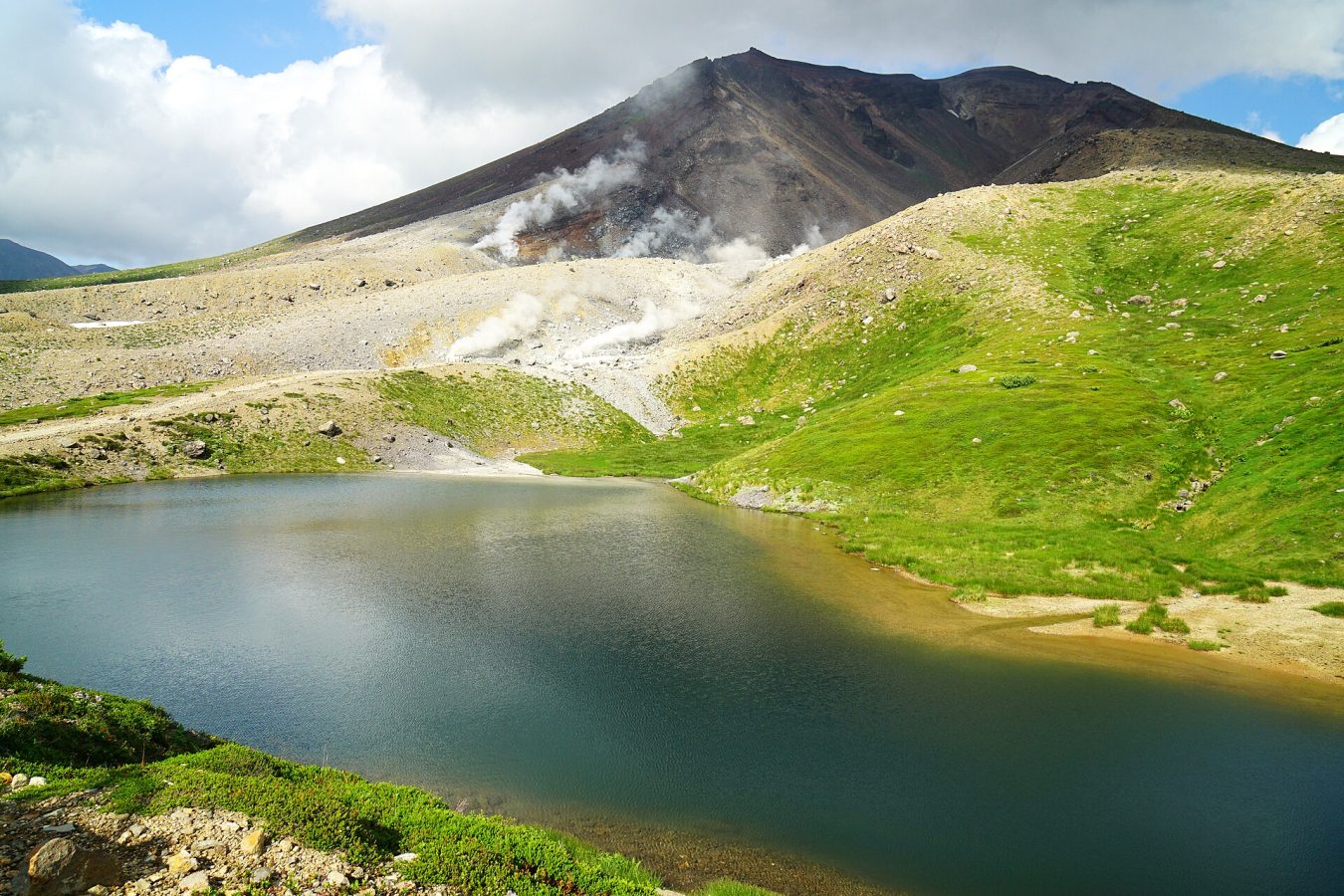
Photo: 663highland, CC BY 2.5
Daisetsuzan is the mountainous heart of Hokkaido, Japan's northern island, a park the size of a small prefecture, and visitors approach it through one of three hot-spring villages, each with a ropeway that lifts them to the alpine zone in minutes, so that the first decision is which. Asahidake Onsen, on the western side, an hour and a half by bus from the city of Asahikawa and its airport, stands at the foot of Asahidake, the highest mountain in Hokkaido; its ropeway climbs to 1,600 metres, from which an easy loop of an hour circles ponds and hissing fumaroles, and a steep path of two to two and a half hours continues over loose volcanic gravel to the summit. Sounkyo Onsen, on the north-eastern side, in a gorge of columnar cliffs with the Ginga and Ryusei waterfalls, has a ropeway and a chairlift up Kurodake, from the top of which the summit is an hour and a quarter's climb;
it is the base for the autumn-colour tours, since the rowan and birch of Kurodake's seventh station are among the very first leaves in Japan to turn. Tokachidake Onsen and Fukiage, in the south-west above the flower fields of Biei and Furano, serve the smoking Tokachi range. The classic day hike for the fit is the traverse from Asahidake to Kurodake, or the reverse, twelve kilometres and seven to nine hours across the volcanic plateau, returning by bus. Guided hiking, and in winter guided snowshoe walks and backcountry skiing in the famously dry powder of Asahidake, can be arranged in Asahikawa, Higashikawa and the villages. There is no entrance fee; only the ropeways charge. Brown bears live throughout, and a bear bell is standard equipment.
Live dates and prices from GetYourGuide. Free cancellation on most tickets.
The park was designated in 1934, one of the first in Japan, and covers 2,268 square kilometres, until 2024 the largest national park in the country. Its name means the great snowy mountains. The Ainu, the indigenous people of Hokkaido, called this highland Kamuy Mintara, the playground of the gods, and the name fits: it is not a range but a volcanic plateau at about 2,000 metres, a cluster of cones, domes and craters around the Ohachidaira caldera, two kilometres across and floored with poisonous hot springs, with sixteen peaks above 2,000 metres, Asahidake, 2,291, the highest, an active volcano whose western flank is a breached crater lined with roaring steam vents that stain the rock yellow. Because of the latitude and the severe climate, the tree line lies at only 1,500 metres or so, and the vegetation above it is comparable with that at 3,000 metres in the Japanese Alps on Honshu: dwarf stone pine, and, as the snow patches melt through July, one of the greatest displays of alpine flowers in Japan, Aleutian avens, mountain heather, bleeding-heart and wedge-leaf primrose, in sheets around the ponds of Sugatami and on the slopes of Kurodake.
It is the first place in Japan to see autumn, in the second half of September, when the rowans turn scarlet and the plateau gold, and the first to see snow, which usually falls on Asahidake before the end of that month. The Ussuri brown bear, the higuma, of which Hokkaido has some ten thousand, is often watched at a safe distance across the valley from the Kogen Onsen marsh trail, where rangers give a compulsory briefing; the northern pika, a relic of the ice age, squeaks among the boulders, and the Ezo red fox, the Ezo deer, the black woodpecker, Blakiston's fish owl and several butterflies found nowhere else in Japan complete the fauna. The Ishikari and Tokachi rivers rise here, the Sounkyo gorge runs for twenty-four kilometres between walls of columnar tuff, and the wild hot spring of Nakadake lies in a gully on the plateau.
The park is open all year, and the ropeways run in every season except for maintenance periods in spring and late autumn. The hiking season is short, from late June or July, when the snow clears from the trails, to late September; the flowers peak from early to late July, the autumn colours on the heights from about 10 to 25 September and in the Sounkyo gorge in early October, when the ropeway queues are long and lodging must be booked well ahead.
The weather on the plateau is severe and changeable, with snow possible in any month; walkers died of hypothermia on Tomuraushi in July 2009. From December to May the park is for skiers and snowshoers, with the ropeway at Asahidake serving ungroomed powder terrain. Allow two to three days. Asahikawa is the gateway city, Biei and Furano an hour south-west, and Sapporo two and a half hours.
Yes. GetYourGuide lists 3 tickets and tours for Daisetsuzan National Park, with live dates and prices and free cancellation on most of them.
There is no entrance fee; only the ropeways charge.
There is no entrance fee; only the ropeways charge.
The park is open all year, and the ropeways run in every season except for maintenance periods in spring and late autumn.
Allow two to three days.
Daisetsuzan National Park covers 2 268 km².
Daisetsuzan National Park was established in 1934.
Daisetsuzan National Park is in Japan. The map on this page shows the exact spot.
Japan
Nikko is the mountain park two hours north of Tokyo whose shrines are a World Heritage Site and whose lakes and…
24 tickets & tours
Japan
Fuji-Hakone-Izu is the most visited national park in Japan, and it is not one place but four, scattered across four…
2 tickets & tours
Japan
Iriomote-Ishigaki National Park covers the Yaeyama islands, the southernmost inhabited islands of Japan, which lie in…
1 ticket or tour
Japan
The Kerama islands are a cluster of some three dozen small, steep, green islands, only four of them inhabited, lying…
1 ticket or tour
Japan
Onuma is a small park of lakes and islets at the foot of a volcano in the south of Hokkaido, the northern island of…
1 ticket or tour
Japan
Shiretoko is a narrow, mountainous peninsula, seventy kilometres long, at the north-eastern extremity of Hokkaido and…
1 ticket or tour