Nikko National Park
Japan
Nikko is the mountain park two hours north of Tokyo whose shrines are a World Heritage Site and whose lakes and…
24 tickets & tours

Photo: jonny-mt, CC BY-SA 3.0
Onuma is a small park of lakes and islets at the foot of a volcano in the south of Hokkaido, the northern island of Japan, about thirty kilometres north of the port city of Hakodate, and it is that city's standard country excursion, easily made in half a day. Limited express trains on the line to Sapporo take twenty to thirty minutes from Hakodate to the station of Onuma-Koen, which stands a few minutes' walk from the lake shore, and only ten minutes from Shin-Hakodate-Hokuto, the terminus of the bullet train from Tokyo; local trains are slower and cheaper, and by car the journey takes forty minutes. Private day tours from Hakodate combine it with the city's own sights. There is no entrance fee and everything is arranged for the casual visitor.
From the little park square by the station, where there are a tourist office, cycle hire shops, restaurants and the shops selling Onuma dango, tiny rice dumplings in sweet soy, sesame or bean sauce, made here since 1905, four signposted walking courses, of fifteen to fifty minutes, lead out over the water from islet to islet by a series of arched bridges, with the cone of the volcano always in view; they are level and suit pushchairs. The favourite activity is to cycle round the larger lake on a quiet road of fourteen kilometres, which takes an hour to an hour and a half, with stops at viewpoints and cafes. Pleasure boats make a circuit of half an hour from the pier, and rowing boats, pedal boats and guided canoe trips are on offer; in winter the same operators provide ice fishing, snowmobile rides and sledges. Fit walkers can climb the volcano from a trailhead reached by car or taxi, during the permitted season. There are hotels and hot-spring inns round the lake.
Live dates and prices from GetYourGuide. Free cancellation on most tickets.
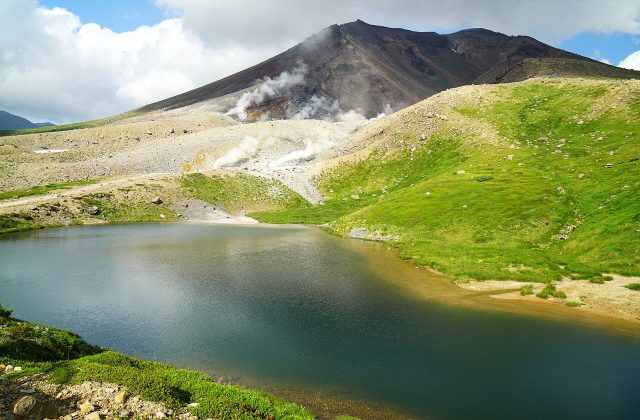
Onuma was designated a quasi-national park in 1958, a category of Japanese protected area one step below a national park and administered by the prefecture, and covers about ninety square kilometres, consisting of Mount Komagatake and the three lakes at its south-western foot, Onuma, the large marsh, Konuma, the small one, and the little Junsainuma, named after the water shield, an aquatic plant whose slippery young shoots are gathered as a delicacy. The lakes are the volcano's creation. Komagatake, 1,131 metres, is an active stratovolcano, which was once a symmetrical cone of perhaps 1,700 metres: in 1640, after a long repose, its summit collapsed in a great eruption, a debris avalanche swept down into Uchiura bay, raising a tsunami that drowned some seven hundred people along the coast, while another lobe flowed south-west, blocked the valleys and impounded the lakes, the hummocks of the avalanche deposit, protruding from the shallow water, forming the 126 islets, covered now with maples, birches and azaleas, that give the landscape its resemblance to a Japanese garden. The jagged, asymmetrical outline that the mountain presents today, a sharp horn at one end and a long saddle, is the broken rim left by that collapse;
its name, the horse mountain, is said to come from its likeness to a horse looking back. It erupted violently again in 1856 and in 1929, when ash and pumice buried the surrounding villages, and had a series of small steam explosions between 1996 and 2000, since when walkers have been allowed only as far as the saddle at about 900 metres, an hour's climb from the sixth-station car park, during daylight hours in the summer months, the summit peaks remaining closed. The beauty of the place was recognised early: foreign residents of Hakodate, one of the first Japanese ports opened to trade, in 1859, made it their summer retreat, the emperor Meiji visited in 1881, and in 1915 it was chosen by public vote as one of the new three views of Japan. In 2012 the lakes were listed under the Ramsar convention. Whooper swans from Siberia winter on the unfrozen patch of water at the channel between the two lakes, with ducks, and white-tailed and Steller's sea eagles are seen; the woods hold red foxes, squirrels, woodpeckers and, in early summer, quantities of wild flowers, while water lilies and lotus cover the shallows in July and August. A monument on one of the islets commemorates a celebrated modern Japanese song about death and consolation, composed by a writer who lived beside the lake.
The park is open all year and has four distinct seasons. The autumn colours, from about the middle to the end of October, when the maples on the islets turn scarlet against the volcano and are reflected in the water, are the high point of the year and draw large crowds at weekends. Late April and May bring fresh green, cherry blossom in early May and skunk cabbage in the marshes; summer, from June to August, is mild, 20 to 25 degrees, green and good for cycling and canoeing;
winter, from December to March, is cold and snowy, the lakes freeze hard from January, and visitors come for ice fishing for smelt, snow activities and the swans, with an ice festival in February. The mountain trail is normally open from June to October, between nine and three, and closes whenever the volcanic alert rises. Trains are infrequent, so check the return times. Allow half a day. Hakodate, with its morning market, star-shaped fort, old foreign quarter and famous night view, is half an hour away.
Yes. GetYourGuide lists one ticket or tour for Onuma Quasi-National Park, with live dates and prices and free cancellation on most of them.
There is no entrance fee and everything is arranged for the casual visitor.
There is no entrance fee and everything is arranged for the casual visitor.
The park is open all year and has four distinct seasons.
Onuma Quasi-National Park covers 90.8 km².
Onuma Quasi-National Park was established in 1958.
Onuma Quasi-National Park is in Japan. The map on this page shows the exact spot.
Japan
Nikko is the mountain park two hours north of Tokyo whose shrines are a World Heritage Site and whose lakes and…
24 tickets & tours
Japan
Daisetsuzan is the mountainous heart of Hokkaido, Japan's northern island, a park the size of a small prefecture,…
3 tickets & tours
Japan
Fuji-Hakone-Izu is the most visited national park in Japan, and it is not one place but four, scattered across four…
2 tickets & tours
Japan
Iriomote-Ishigaki National Park covers the Yaeyama islands, the southernmost inhabited islands of Japan, which lie in…
1 ticket or tour
Japan
The Kerama islands are a cluster of some three dozen small, steep, green islands, only four of them inhabited, lying…
1 ticket or tour
Japan
Shiretoko is a narrow, mountainous peninsula, seventy kilometres long, at the north-eastern extremity of Hokkaido and…
1 ticket or tour