Ranthambore National Park
Rajasthan, India
Ranthambore is India's most famous tiger reserve and the easiest to reach, three hours by train from Jaipur and…
147 tickets & tours
Desert Park · Rajasthan · India

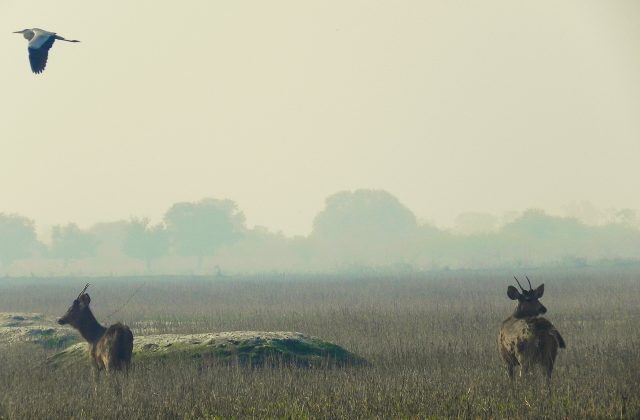
Photo: Mike Prince from Bangalore, India, CC BY 2.0
Desert National Park covers a great tract of the Thar desert in the far west of the Indian state of Rajasthan, beginning some forty kilometres west and south-west of the golden fortress town of Jaisalmer, which is reached by overnight train or by road from Jodhpur, five hours away, and by seasonal flights. Every visitor to Jaisalmer is offered a desert safari, by camel or jeep, to the sand dunes of Sam or Khuri, with a sunset, a folk music show and a night in a tented camp, and it should be understood that these excursions, enjoyable as they are, take place on the fringe of the park and have little to do with it. To visit the national park proper, and above all to look for the great Indian bustard, the bird for which it exists, one must obtain a permit, for a modest fee per person and per vehicle, from the office of the park's deputy conservator in Jaisalmer, which hotels and a few local naturalist guides will arrange, and then go by hired jeep or taxi, there being no official safari vehicles, to the Sudasari area, about fifty to sixty kilometres from the town beyond Sam.
There the forest department maintains a fenced grassland enclosure, a watchtower, a small interpretation hut and a waterhole, and a forest guard accompanies visitors on a slow drive along the tracks inside and outside the enclosures, in the early morning or late afternoon, scanning for bustards, gazelles, foxes and raptors. A knowledgeable local guide makes a great difference, since the birds are few and wary. Parts of the park lie close to the border with Pakistan, where movement is restricted. On the way back most people stop at Sam for the dunes. The Akal fossil park, seventeen kilometres from Jaisalmer on the Barmer road, with a small entry fee, shows the petrified trunks of trees some 180 million years old.
Live prices from GetYourGuide for tours whose route includes this park. Free cancellation on most of them.
The park was notified in 1980 and covers 3,162 square kilometres in the districts of Jaisalmer and Barmer, which makes it one of the largest protected areas in India, though it is a national park of an unusual kind: more than seventy villages and hamlets lie within it, with their fields, wells, cattle, sheep, goats and camels, the rights of their inhabitants have never been settled, and only a number of fenced enclosures, a few square kilometres each, from which livestock are excluded, are strictly protected. It represents the ecosystem of the Thar, the most densely populated desert in the world. Shifting sand dunes, which are what visitors expect, make up only about a fifth of it; the rest is a rolling plain of compact sand and gravel, rocky outcrops, the beds of salt lakes that fill briefly after rain, and, most important, open grassland of the sewan grass, with scattered khejri, rohida and ber trees and thorny shrubs, which supports far more life than its appearance suggests. The great Indian bustard, called godawan in Rajasthan, whose state bird it is, stands a metre tall and weighs up to fifteen kilograms, one of the heaviest birds that can fly, brown above and white below with a black cap, the male inflating a great white pouch of feathers on his neck in display.
It once ranged over the dry grasslands of most of India and was seriously proposed as the national bird, and it has been reduced, by hunting, the ploughing and irrigation of grasslands, feral dogs and, most recently, collisions with the power lines of the vast wind and solar farms built across the Thar, to fewer than a hundred and fifty birds, nearly all of them in and round this park, which makes it one of the most endangered birds on earth. It lays a single egg on the bare ground. Since 2019 a conservation breeding centre at Sam, and a second at Ramdevra, has hatched eggs collected from the wild and reared a captive flock, and India's supreme court has ordered that power lines in the bird's core range be buried or marked. The other animals are those of the desert: the chinkara, or Indian gazelle, which is numerous because the Bishnoi and other communities of the region protect it, the desert fox, the Indian fox, the desert cat, the wolf, the spiny-tailed lizard, which lives in colonies of burrows, the desert monitor and the saw-scaled viper. In winter the park is one of the best places in India for birds of prey, with tawny, steppe and imperial eagles, long-legged buzzards, the laggar falcon and, at carcass dumps, large gatherings of Eurasian griffons and cinereous vultures from central Asia, together with MacQueen's bustard, the cream-coloured courser, several sandgrouse, which fly to the waterholes in flocks at a fixed hour each morning, and the rare Stoliczka's bushchat.
The park can be visited from about October to March, and the best months are November to February, when the days are sunny and pleasant, 20 to 27 degrees, the nights cold, down to five degrees or lower, and the winter migrants, the eagles, vultures, houbara and cranes, are present. The bustards breed during and after the monsoon, from about June to October, when they are most visible in display, but the heat then is severe. From April to June the Thar is one of the hottest places in India, regularly reaching 45 to 49 degrees, with dust storms, and no sensible person goes out by day;
the brief, erratic monsoon, in July and August, turns the grasslands green. Start before dawn, since activity ceases by mid-morning. Bring binoculars, a telescope if possible, warm layers for the early drive, water, a hat and a scarf against the dust, and carry identification for the checkposts. Allow half a day to a day. Jaisalmer fort and its merchants' mansions, the abandoned village of Kuldhara and the royal cenotaphs of Bada Bagh are all within an hour.
Yes. GetYourGuide sells tickets and guided tours whose route includes Desert National Park; live prices are shown on this page.
The Akal fossil park, seventeen kilometres from Jaisalmer on the Barmer road, with a small entry fee, shows the petrified trunks of trees some 180 million years old.
Allow half a day to a day.
The park can be visited from about October to March, and the best months are November to February, when the days are sunny and pleasant, 20 to 27 degrees, the nights cold, down to five degrees or lower, and the winter migrants, the eagles, vultures, houbara and cranes, are present.
Desert National Park covers 3 162 km².
Desert National Park was established in 1981.
Desert National Park is in Rajasthan, India. The map on this page shows the exact spot.
Rajasthan, India
Ranthambore is India's most famous tiger reserve and the easiest to reach, three hours by train from Jaipur and…
147 tickets & tours
Rajasthan, India
Keoladeo, still widely known as the Bharatpur bird sanctuary, lies on the edge of the town of Bharatpur in eastern…
4 tickets & tours