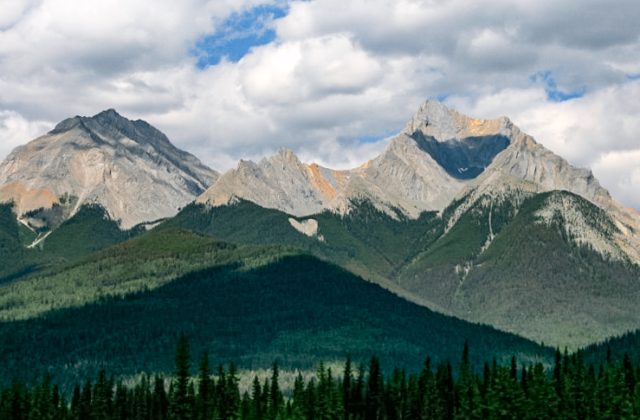
Waterton Lakes National Park
34 km away
Waterton Lakes lies in the south-western corner of the Canadian province of Alberta, against the border of Montana, at…
10 tickets & tours
Glacier Park · Montana · United States

Photo: Please attribute as: "Wikipedia / Tobias Klenze" (user page , CC BY-SA 4.0
Glacier National Park lies in the Rocky Mountains of north-western Montana, against the Canadian border, and should not be confused with the park of the same name in British Columbia. It is remote by American standards: the nearest airport, near Kalispell, is forty minutes from the western entrance at West Glacier, the larger airports of Missoula, Great Falls, Spokane and Calgary are two and a half to five hours away by road, and, unusually, a long-distance train, the Empire Builder between Chicago and Seattle, stops at both West Glacier and East Glacier Park, as it has since the railway created the park's tourism. The entrance fee, per vehicle, is valid for seven days. The experience that nearly every visitor wants is the Going-to-the-Sun Road, eighty kilometres across the park from West Glacier to St Mary by way of Logan Pass, and demand in July and August so far exceeds the road's capacity that in recent summers the park has required an advance reservation, booked online for a small fee, to drive its western part or the North Fork during the main hours of the day;
the rules have changed every year and must be checked before travelling. Those without one may enter before or after the restricted hours, use the free shuttle buses, or take a tour on one of the park's red open-topped buses of the 1930s. From Logan Pass, the boardwalk to the Hidden Lake overlook, an hour and a half return, is the easiest high walk, with mountain goats almost guaranteed, and the Highline trail sets off along a ledge across the road. The Many Glacier valley, on the eastern side, reached by its own road, is the centre for the finest day hikes, to Grinnell glacier and Iceberg lake, and boat trips run on five of the large lakes. The Avalanche Lake trail, on the west, suits families.
Live prices from GetYourGuide for tours whose route includes this park. Free cancellation on most of them.
The park was created in 1910 and covers about 4,100 square kilometres; with Waterton Lakes in Alberta it was declared in 1932 the world's first international peace park, and the two together have been a World Heritage Site since 1995. The mountains here are not volcanic or folded but a single enormous slab of very old sedimentary rock, laid down in a shallow sea as much as one and a half billion years ago, which was pushed eastwards for eighty kilometres up and over much younger rocks along the Lewis overthrust, so that the summits are older than what lies beneath them, and their strata of red and green mudstone, buff limestone and a dark band of igneous rock, with fossil algae and ancient ripple marks perfectly preserved, stand in cliffs thousands of feet high. The ice ages then carved this block into the forms that the geography books illustrate, U-shaped valleys, knife-edged ridges, horns, cirques, hanging valleys with waterfalls, and long, narrow lakes, of which Lake McDonald, sixteen kilometres long, with its bed of brightly coloured pebbles, is the largest. The present glaciers are small remnants, not of the ice age but of a cold period that ended about 1850, when there were some 150 of them;
by 2015 only twenty-six were still large enough to count, all have shrunk since, and their disappearance has made the park an emblem of climate change. At Triple Divide Peak, the waters part for the Pacific, the Gulf of Mexico and Hudson Bay. To the Blackfeet, whose reservation adjoins the park on the east and who sold the land under pressure in 1895, these mountains are the backbone of the world, and the Salish and Kootenai knew the western valleys. The naturalist George Bird Grinnell, who called the region the crown of the continent, campaigned for the park, and the Great Northern Railway under Louis Hill, with the slogan See America First, built the great timber hotels and the Swiss-style backcountry chalets, two of which, Granite Park and Sperry, still operate, reachable only on foot. The Going-to-the-Sun Road, completed in 1932 after eleven years' work and engineered so as to need only a single hairpin bend, is a historic landmark. The park has kept almost all the animals it had before Europeans arrived: about three hundred grizzly bears, one of the largest populations south of Canada, black bears, wolves, cougars, lynx, wolverines, mountain goats, which are its symbol, bighorn sheep, moose and elk. Huckleberries ripen in August, and bear grass, with tall white plumes, flowers in great numbers every few years.
The park is open all year, but the alpine section of the Going-to-the-Sun Road is cleared of snow, which lies up to twenty-five metres deep at the Big Drift, only by late June or early July, and closes again by mid-October, earlier if storms arrive; the season in which everything is open is thus barely three months. July and August have warm days, wild flowers at Logan Pass, the heaviest crowds, car parks full by eight in the morning, and, in many recent years, smoke from forest fires from late July onwards, which can blot out the views;
September is quieter, cool, with golden larches and aspens late in the month, though lodges and shuttles begin to close after Labor Day. Winter is for skiing and snowshoeing on the closed road. All hikers should carry bear spray, walk in groups and make noise. Lodging inside the park is reserved a year ahead. Allow three days at the least. Whitefish is forty-five minutes from West Glacier, Waterton in Canada an hour and a half from St Mary.
34 km away
Waterton Lakes lies in the south-western corner of the Canadian province of Alberta, against the border of Montana, at…
10 tickets & tours
286 km away
Kootenay is the least visited of the four contiguous national parks of the Canadian Rockies, on the British Columbia…
3 tickets & tours
296 km away
Banff is Canada's first and most visited national park, ninety minutes west of Calgary, and it is sold in every…
61 tickets & tours
Yes. GetYourGuide sells tickets and guided tours whose route includes Glacier National Park (Montana); live prices are shown on this page.
The entrance fee, per vehicle, is valid for seven days.
The park is open all year, but the alpine section of the Going-to-the-Sun Road is cleared of snow, which lies up to twenty-five metres deep at the Big Drift, only by late June or early July, and closes again by mid-October, earlier if storms arrive; the season in which everything is open is thus barely three months.
Allow three days at the least.
Glacier National Park (Montana) covers 4 101 km².
Glacier National Park (Montana) was established in 1910.
Glacier National Park (Montana) receives about 3.1 million a year (2025).
Glacier National Park (Montana) is in Montana, United States. The map on this page shows the exact spot.