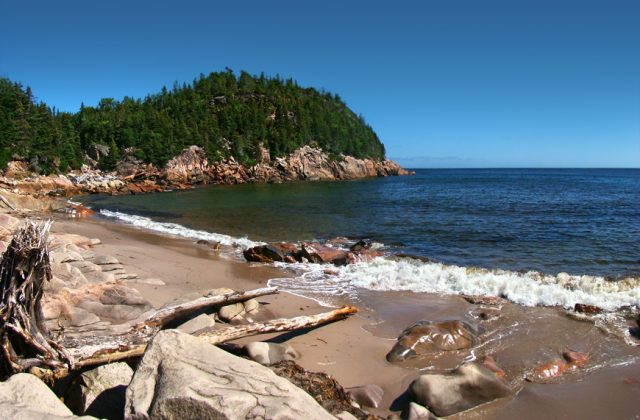
Cape Breton Highlands National Park
395 km away
Cape Breton Highlands is the national park at the northern end of Cape Breton island, in the Canadian province of Nova…
2 tickets & tours
Mountain Park · Newfoundland and Labrador · Canada

Photo: Adavyd, CC BY-SA 4.0
Gros Morne lies on the west coast of the island of Newfoundland, in the far east of Canada, a park of fjords, bare mountains and fishing villages, and it is large and spread out, so that three days are needed to see its principal sights and a car is indispensable. The nearest airport is at Deer Lake, half an hour from the park entrance, with flights from Toronto, Halifax and St John's, which is itself seven hours away by road across the island; those bringing a vehicle from the mainland take the ferry from North Sydney in Nova Scotia to Port aux Basques, six to eight hours, followed by a drive of three and a half hours. A Parks Canada pass is required. The park is divided by the deep inlet of Bonne Bay into a northern and a southern part, an hour or more apart by road.
In the north, based on the villages of Rocky Harbour and Norris Point, the essential excursion is to Western Brook Pond: from a car park on the coast road a level path and boardwalk of three kilometres, forty-five minutes, crosses a bog to a dock, from which boats make a cruise of two hours into the fjord, which must be booked well ahead in summer. Here too are the Lobster Cove Head lighthouse, the coastal trail, the sandy beach of Shallow Bay, and the ascent of Gros Morne mountain itself, a gruelling circuit of sixteen kilometres and seven to eight hours up a gully of loose rock to an arctic plateau. In the south, reached through Woody Point, are the park's discovery centre, the Tablelands, where a level trail of four kilometres return enters a valley of bare orange rock, with guided walks by park interpreters, the fishing hamlet of Trout River with its pond, and the Green Gardens trail, which descends to a coast of sea stacks and meadows. The multi-day traverse of the Long Range is unmarked and needs navigation skills.
Gros Morne was set aside as a national park reserve in 1973, became a full national park in 2005, covers 1,805 square kilometres, and was inscribed as a World Heritage Site in 1987, principally for what its rocks reveal about the workings of the planet. The Tablelands, a flat-topped massif of a startling rusty orange, almost bare of vegetation, which looks like a piece of the Arizona desert dropped beside a green fjord, is a slab of the earth's mantle, the layer that normally lies many kilometres beneath the crust, together with a section of ancient ocean floor above it, which was thrust up and over the edge of the continent some 470 million years ago when an ocean that preceded the Atlantic closed and the continents collided. The rock, peridotite, is rich in magnesium and heavy metals and poor in the nutrients that plants need, which is why almost nothing grows on it except a few specialists and the carnivorous pitcher plant, the emblem of Newfoundland, and it weathers from dark green to orange as its iron rusts. It was the study of these rocks, in the 1960s and 1970s, by geologists among whom Harold Williams of the local university was the leader, that supplied some of the most persuasive evidence for the then new theory of plate tectonics. Near by, at Green Point, a cliff of thinly bedded shales and limestones, tilted on end, has been adopted as the world's reference point for the boundary between the Cambrian and Ordovician periods.
The rest of the park belongs to the Long Range mountains, the worn-down northern end of the Appalachians, a plateau of ancient granite and gneiss at six to eight hundred metres, covered with tundra, bog and stunted, wind-flattened spruce that Newfoundlanders call tuckamore, with Gros Morne, the big lone hill, 806 metres, as its most prominent summit. The glaciers of the ice age gouged into its western edge a series of deep troughs; when the ice melted the land, relieved of its weight, rose, cutting the fjords off from the sea, so that Western Brook Pond is now a freshwater lake, sixteen kilometres long and 165 metres deep, walled by cliffs of six hundred metres over which waterfalls drop from the plateau, its water so pure that it barely conducts electricity. The coastal plain between the mountains and the Gulf of St Lawrence is a mosaic of bog, forest and shore. The moose, introduced to Newfoundland in 1904, has multiplied to such a density that it has prevented the regeneration of the forest and is a serious hazard on the roads, and the park also holds woodland caribou, arctic hares, black bears, red foxes, rock ptarmigan and bald eagles, with whales offshore. People have lived on this coast for nearly five thousand years, Maritime Archaic Indians, Palaeo-Eskimos, and since the eighteenth century the fishing families of English and French origin whose villages, music and speech are a large part of the charm of a visit.
The park is open all year, but the visitor season is short, from about mid-May to mid-October, and the boat tours, visitor centres and most lodgings operate only within it. July and August are the warmest months, 16 to 22 degrees, with the longest days, wild flowers, whales and the fullest programme of guided walks and evening entertainment, and they are busy, so that rooms and the boat should be booked months ahead; June is cool, with lingering snow on the heights, icebergs offshore in some years and clouds of blackflies inland;
September is often the finest month, clear, quiet and coloured by the turning bogs and birches. The Gros Morne mountain trail is closed until about the end of June to protect wildlife in the breeding season. The weather changes quickly, with fog, wind and rain possible on any day, so carry waterproofs and warm clothing. Drive slowly at dawn and dusk because of the moose. In winter there is cross-country skiing and snowmobiling outside the park. Allow three to four days. The Viking site of L'Anse aux Meadows is four to five hours further north.
395 km away
Cape Breton Highlands is the national park at the northern end of Cape Breton island, in the Canadian province of Nova…
2 tickets & tours
No online tour for Gros Morne National Park is listed on GetYourGuide; entry, where it is charged, is paid at the gate or through the park authority. Nearby parks with bookable tours are listed on this page.
The park is open all year, but the visitor season is short, from about mid-May to mid-October, and the boat tours, visitor centres and most lodgings operate only within it.
Gros Morne lies on the west coast of the island of Newfoundland, in the far east of Canada, a park of fjords, bare mountains and fishing villages, and it is large and spread out, so that three days are needed to see its principal sights and a car is indispensable.
Gros Morne National Park covers 1 805 km².
Gros Morne National Park was established in 1973.
Gros Morne National Park is in Newfoundland and Labrador, Canada. The map on this page shows the exact spot.