Torres del Paine National Park
Chile
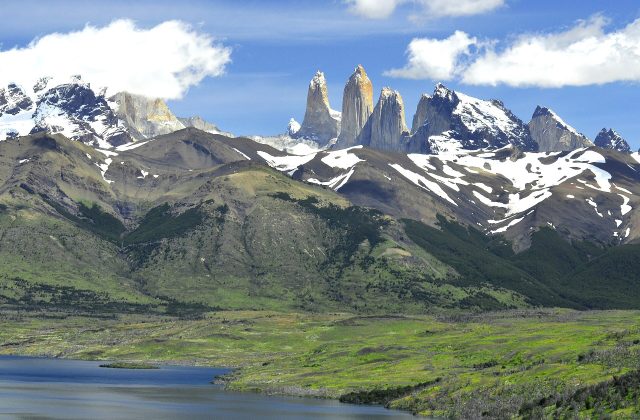
Torres del Paine is the great park of Chilean Patagonia, two hours north of Puerto Natales and five from Punta Arenas,…
59 tickets & tours

Photo: Elemaki, CC BY 3.0
Huerquehue is a small park of ancient forest and mountain lakes thirty-five kilometres, about forty-five minutes, north-east of Pucón, in the Lake District of southern Chile, and it offers what is generally agreed to be the best day hike in the area: a walk in which the volcano, for once, is scenery and not the objective. It is easily done without a tour. A local bus runs from Pucón to the park entrance at the head of Lake Tinquilco two or three times a day in summer, and the road, unpaved for the last stretch, is passable in an ordinary car; entrance tickets must be bought in advance on the forestry corporation's online reservation system, since daily numbers are limited in high season, and are shown at the ranger station, where walkers register.
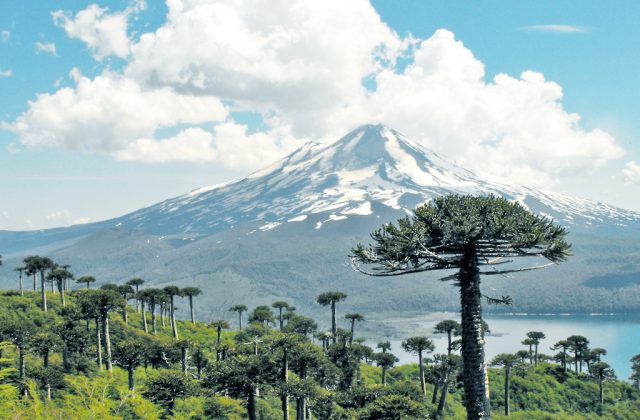
The classic route, Los Lagos, climbs steeply from the lake shore through the forest, past two waterfalls, Nido de Águila and Trafulco, on short side paths, and two viewpoints looking back over Tinquilco to the smoking cone of Villarrica, to reach, after about seven hundred metres of ascent, a plateau with three lakes close together, Chico, Toro and Verde, set among monkey-puzzle trees; out and back it is about fourteen kilometres and five to seven hours, and those with energy to spare can continue to lakes Huerquehue and Los Patos. The harder San Sebastián trail climbs to a bare summit at about 2,000 metres with a panorama of nine volcanoes. The guided hikes from Pucón add transport and a naturalist, and in winter become snowshoe treks among snow-laden araucarias. Simple lodges, cabins and campsites stand on Lake Tinquilco, and the trek to the Río Blanco hot springs takes two days.
Live dates and prices from GetYourGuide. Free cancellation on most tickets.
The land was first set aside in 1912 as part of a larger forest reserve, and the national park was created in 1967; it covers about 125 square kilometres of the Andean foothills east of Lake Caburgua, between 720 and 2,000 metres, within the Araucarias biosphere reserve. Its name is Mapudungun, usually translated as the place of messengers. The relief was shaped by glaciers, which left steep valleys, cirques and some twenty lakes and tarns, large and small, of great clarity. What makes it special is the forest, one of the finest surviving examples of the temperate rainforest of the southern Andes, and its arrangement by altitude, which the Los Lagos trail crosses in a morning: around Tinquilco, a mixed forest of tall coihue, a southern beech, with mañío, tepa and ulmo, festooned with climbing plants, the scarlet bells of the copihue, Chile's national flower, and thickets of quila bamboo; higher up, lenga, the deciduous beech that turns red in April;
and above about 1,000 metres the araucaria, the monkey-puzzle, in stands of trees many centuries old, some of them estimated at over a thousand years, with straight trunks armoured in hexagonal plates and umbrella crowns, reflected in the still, dark water of the lakes. Standing among them, with old man's beard lichen hanging from every branch, is to see a forest of a kind that covered Gondwana when the dinosaurs lived. The araucaria is a protected national monument, and its seeds were the staple of the Pehuenche people. The park's animals are discreet: the pudú, the world's smallest deer, the puma, the kodkod, a tiny spotted wildcat, the monito del monte, a marsupial more closely related to those of Australia than to the opossums, and Darwin's frog, whose males brood the tadpoles in their vocal sacs. Birds are easier, the Magellanic woodpecker, the largest in South America, with the male's crimson head, the chucao tapaculo, whose loud call follows every walker, the austral parakeet, the torrent duck, the condor and the black-chested buzzard-eagle.
The park is open daily from about 8.30 am to 6 pm in summer, with last entry for the lakes trail around midday or early afternoon. December to March is the hiking season, warm and mostly dry, with January and February crowded with Chilean holidaymakers, when tickets and buses fill early; late March and April bring the autumn colours of the lenga and quiet trails;
from June to September the upper part of the trail is under snow, beautiful and for snowshoes. Rain is possible in any month in this region, and the trail is muddy after it. Start early, to have the lakes to yourself and to be sure of the return bus. Allow a full day. Lake Caburgua and the Ojos del Caburgua springs are on the road back, Pucón forty-five minutes away, and the hot springs of Huife and Los Pozones in the next valley.
Yes. GetYourGuide lists 3 tickets and tours for Huerquehue National Park, with live dates and prices and free cancellation on most of them.
The park is open daily from about 8.30 am to 6 pm in summer, with last entry for the lakes trail around midday or early afternoon.
Huerquehue National Park covers 125 km².
Huerquehue National Park was established in 1967.
Huerquehue National Park is in Chile. The map on this page shows the exact spot.
Chile
Torres del Paine is the great park of Chilean Patagonia, two hours north of Puerto Natales and five from Punta Arenas,…
59 tickets & tours
Chile
Rapa Nui National Park is most of Easter Island, and the park ticket, bought online before travel or on arrival at the…
33 tickets & tours
Chile
Bernardo O'Higgins is the largest national park in Chile and one of the largest in the world, an almost…
7 tickets & tours
Chile
Villarrica National Park rises directly behind Pucón, the adventure capital of Chile's Lake District, about nine…
5 tickets & tours
Chile
Conguillío is the park of monkey-puzzle forests, lakes and fresh lava around the Llaima volcano, in the Andes of the…
3 tickets & tours
Chile
La Campana is a park of the coastal range of central Chile, midway between the capital, Santiago, and the port of…
1 ticket or tour