Torres del Paine National Park
Chile
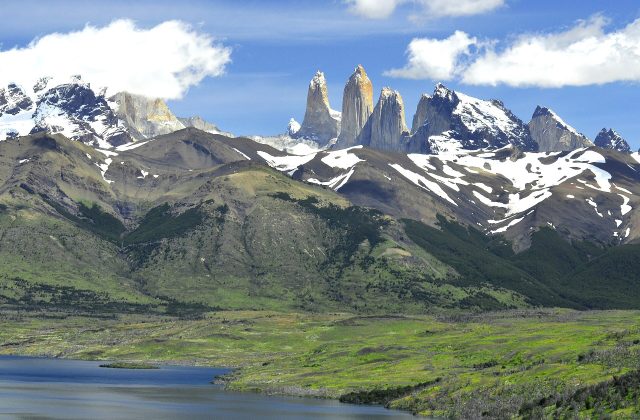
Torres del Paine is the great park of Chilean Patagonia, two hours north of Puerto Natales and five from Punta Arenas,…
59 tickets & tours

Photo: ProfessorX, CC BY-SA 3.0
Rapa Nui National Park is most of Easter Island, and the park ticket, bought online before travel or on arrival at the airport and valid for ten days, is required to enter every moai site; Rano Raraku and Orongo may each be visited only once on it, and since 2018 all the sites must be visited with a local guide or tour, which makes the tours less an option than a requirement. The full-day archaeological tours cover the south coast and the east: Vinapu, the Rano Raraku quarry where the moai were carved, the fifteen statues of Ahu Tongariki and the beach of Anakena, and are the core of any visit; the half-day tours take Orongo and the Rano Kau crater on one morning and the Tahai and Akivi sites on another.
The sunrise tour to Tongariki and the sunset at Tahai are the two photography moments and are sold separately. Hiking tours climb Terevaka, the island's highest point, or walk the north coast to Hanga o Teo, and the cave tours explore the lava tubes at Ana Kakenga and Ana Te Pahu. Boat trips go to the motu islets below Orongo, and the diving sees the clearest water in the Pacific. Private guides are more expensive than shared vans but let you spend an hour at Rano Raraku instead of thirty minutes. Flights from Santiago are the only way in, and the cruise passengers get a compressed version of the highlights.
Live dates and prices from GetYourGuide. Free cancellation on most tickets.
The park was created in 1935 and covers about 67 square kilometres, roughly forty per cent of the island, and since 2017 it has been managed by the Ma'u Henua community of the Rapa Nui people themselves, with the fees staying on the island. Its fame rests on the 887 moai, the monolithic statues carved between roughly 1250 and 1500 from the volcanic tuff of the Rano Raraku quarry, where nearly four hundred remain in every stage of carving, some buried to the shoulders on the slopes, including the largest ever attempted at twenty-one metres; the quarry is the most moving place on the island. Ahu Tongariki below it has fifteen statues restored on their platform after a tsunami scattered them in 1960, and faces the sunrise;
Anakena, the white-sand beach where the first Polynesians are said to have landed, has moai with their red scoria topknots restored. At the south-western tip the Rano Kau crater, a kilometre across with a reed-covered lake, has the ceremonial village of Orongo on its rim, with stone houses and petroglyphs of the birdman cult that succeeded the moai builders. Ahu Akivi has the seven statues that face the sea, and Tahai, at the edge of Hanga Roa, has the only moai with restored coral eyes. The island's story of forest clearance, statue toppling, European contact and slave raids is told at the small museum in Hanga Roa. Wild horses graze among the toppled statues on the coast, and the sea cliffs and the motu below Orongo hold the sooty terns of the birdman legend.
The park sites are open from about 9 am to 6 pm, with Rano Raraku and Orongo closing earlier, and the ticket must be shown at each; sunrise at Tongariki is allowed with a guide. The island is mild all year, with a warmer, drier summer from December to March and cooler, wetter winters from June to August; the Tapati festival in early February fills the flights and hotels. Autumn and spring shoulder months are the quietest. Allow at least three full days on the island, four to include the hikes and a day of rest. Hanga Roa has the hotels, the museum and the harbour, and there is nowhere else.
Yes. GetYourGuide lists 33 tickets and tours for Rapa Nui National Park, with live dates and prices and free cancellation on most of them.
The park sites are open from about 9 am to 6 pm, with Rano Raraku and Orongo closing earlier, and the ticket must be shown at each; sunrise at Tongariki is allowed with a guide.
Allow at least three full days on the island, four to include the hikes and a day of rest.
Rapa Nui National Park covers 66.7 km².
Rapa Nui National Park was established in 1935.
Rapa Nui National Park is in Chile. The map on this page shows the exact spot.
Chile
Torres del Paine is the great park of Chilean Patagonia, two hours north of Puerto Natales and five from Punta Arenas,…
59 tickets & tours
Chile
Bernardo O'Higgins is the largest national park in Chile and one of the largest in the world, an almost…
7 tickets & tours
Chile
Villarrica National Park rises directly behind Pucón, the adventure capital of Chile's Lake District, about nine…
5 tickets & tours
Chile
Conguillío is the park of monkey-puzzle forests, lakes and fresh lava around the Llaima volcano, in the Andes of the…
3 tickets & tours
Chile
Huerquehue is a small park of ancient forest and mountain lakes thirty-five kilometres, about forty-five minutes,…
3 tickets & tours
Chile
La Campana is a park of the coastal range of central Chile, midway between the capital, Santiago, and the port of…
1 ticket or tour