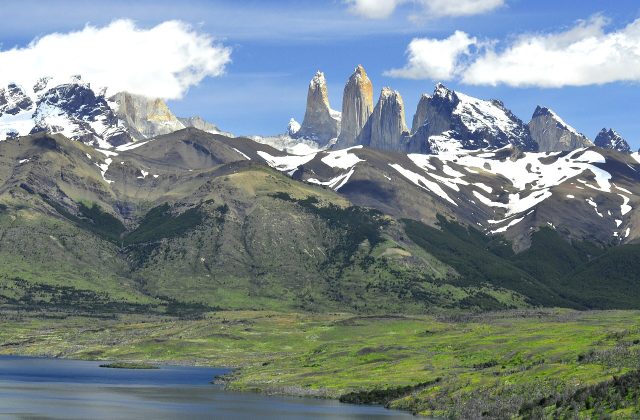
Torres del Paine National Park
Chile
Torres del Paine is the great park of Chilean Patagonia, two hours north of Puerto Natales and five from Punta Arenas,…
59 tickets & tours

Photo: lautaroj, CC BY 2.0
Conguillío is the park of monkey-puzzle forests, lakes and fresh lava around the Llaima volcano, in the Andes of the Araucanía region of southern Chile, about 120 kilometres and two hours east of the regional capital, Temuco, which has flights from Santiago, and it is one of the most beautiful and least internationally known parks in the country. It is a park for a car: there is no public transport beyond the gateway towns, and the full-day tours from Temuco, and a few from Pucón, which is two and a half hours away, exist chiefly for those without one, driving the scenic gravel road through the park from one entrance to the other, with stops at the lava fields, the lakes and viewpoints, and one short walk. There are three entrances, from Melipeuco in the south, the most used, from Curacautín in the north, and from Cherquenco in the west, which leads to the small ski centre of Las Araucarias;
the road between Melipeuco and Curacautín crosses the park and is closed by snow for much of the winter, and a vehicle with good clearance is advisable. The entrance fee is paid to the forestry corporation, CONAF, with tickets bought in advance on its online system, since numbers are limited in high season. Accommodation inside the park, run by a concessionaire, consists of campgrounds and cabins on the shore of Lake Conguillío, booked well ahead for January and February. The great walk is the Sierra Nevada trail, ten kilometres return, four to five hours, climbing from the lake through the araucaria forest to viewpoints over the lake, the volcano and the glaciers; Los Carpinteros, an easy forest trail to a giant tree, is the short alternative.
Live dates and prices from GetYourGuide. Free cancellation on most tickets.
The park was created in 1950, together with the adjoining Los Paraguas park with which it was later merged, and covers about 608 square kilometres; it forms the core of the Araucarias biosphere reserve and of Kütralkura, the first UNESCO global geopark in Chile. Its name comes from a Mapuche expression usually translated as water with pine nuts. At its centre stands the Llaima volcano, 3,125 metres, with a double summit and a cap of glaciers, one of the two most active volcanoes in Chile and among the most active in South America, with some fifty recorded eruptions since 1640; the last major one began on New Year's Day 2008, with lava fountains, an ash column and lahars that cut the roads and forced the evacuation of the park's visitors. The landscape is its work. Successive lava flows have dammed the valleys to make the lakes, Conguillío, the largest, Verde, Captrén and the little Arcoíris, the rainbow lagoon, formed a few decades ago, in whose perfectly clear water the trunks of the drowned forest still stand upright;
and between the patches of forest spread great fields of black and rust-coloured scoria, some of them bare, some sparsely colonised, which gave the BBC a location for its series Walking with Dinosaurs. The forests are the other half of the picture. The araucaria, or pehuén, the monkey-puzzle, a conifer of a lineage two hundred million years old, grows here in its finest stands, umbrella-shaped giants up to fifty metres tall and more than a thousand years old, some of them estimated at twelve hundred, such as the Araucaria Madre on the Carpinteros trail, with a trunk more than two metres across, mixed with southern beeches, coihue, roble, raulí, ñirre and lenga, which turns scarlet in April. Their seeds, the piñones, are the traditional staple of the Pehuenche, the people of the pehuén, who still gather them each autumn. Pumas, the little pudú deer, the monito del monte, Darwin's frog, condors, Magellanic woodpeckers, torrent ducks and the black-throated huet-huet inhabit the park. To the north rises the Sierra Nevada, an extinct, glacier-scoured volcano of 2,554 metres.
The park is open daily from about 8.30 am to 6 pm in summer. December to March is the season, with the through road open, warm days of 20 to 25 degrees, cold nights and the lakes swimmable for the brave; January and February are the Chilean holidays, when cabins and campsites are full. April, when the lenga and ñirre turn red and gold against the dark araucarias and the first snow dusts the volcano, is the most beautiful month of all.
From May or June to October or November snow closes the road across the park, and access is limited to the lower sectors on snowshoes and to the ski centre. Check the volcanic alert level and the road conditions with CONAF before setting out. Allow two days. Melipeuco and Curacautín are the gateway towns, the hot springs of Malalcahuello and the Lonquimay volcano are to the north, and Pucón two and a half hours south.
Yes. GetYourGuide lists 3 tickets and tours for Conguillío National Park, with live dates and prices and free cancellation on most of them.
The entrance fee is paid to the forestry corporation, CONAF, with tickets bought in advance on its online system, since numbers are limited in high season.
The park is open daily from about 8.30 am to 6 pm in summer.
Conguillío National Park covers 608 km².
Conguillío National Park was established in 1950.
Conguillío National Park is in Chile. The map on this page shows the exact spot.
Chile
Torres del Paine is the great park of Chilean Patagonia, two hours north of Puerto Natales and five from Punta Arenas,…
59 tickets & tours
Chile
Rapa Nui National Park is most of Easter Island, and the park ticket, bought online before travel or on arrival at the…
33 tickets & tours
Chile
Bernardo O'Higgins is the largest national park in Chile and one of the largest in the world, an almost…
7 tickets & tours
Chile
Villarrica National Park rises directly behind Pucón, the adventure capital of Chile's Lake District, about nine…
5 tickets & tours
Chile
Huerquehue is a small park of ancient forest and mountain lakes thirty-five kilometres, about forty-five minutes,…
3 tickets & tours
Chile
La Campana is a park of the coastal range of central Chile, midway between the capital, Santiago, and the port of…
1 ticket or tour


