Pantelleria National Park
211 km away
Pantelleria is the volcanic island between Sicily and Tunisia, nearer to Africa than to Europe, reached by a short…
13 tickets & tours
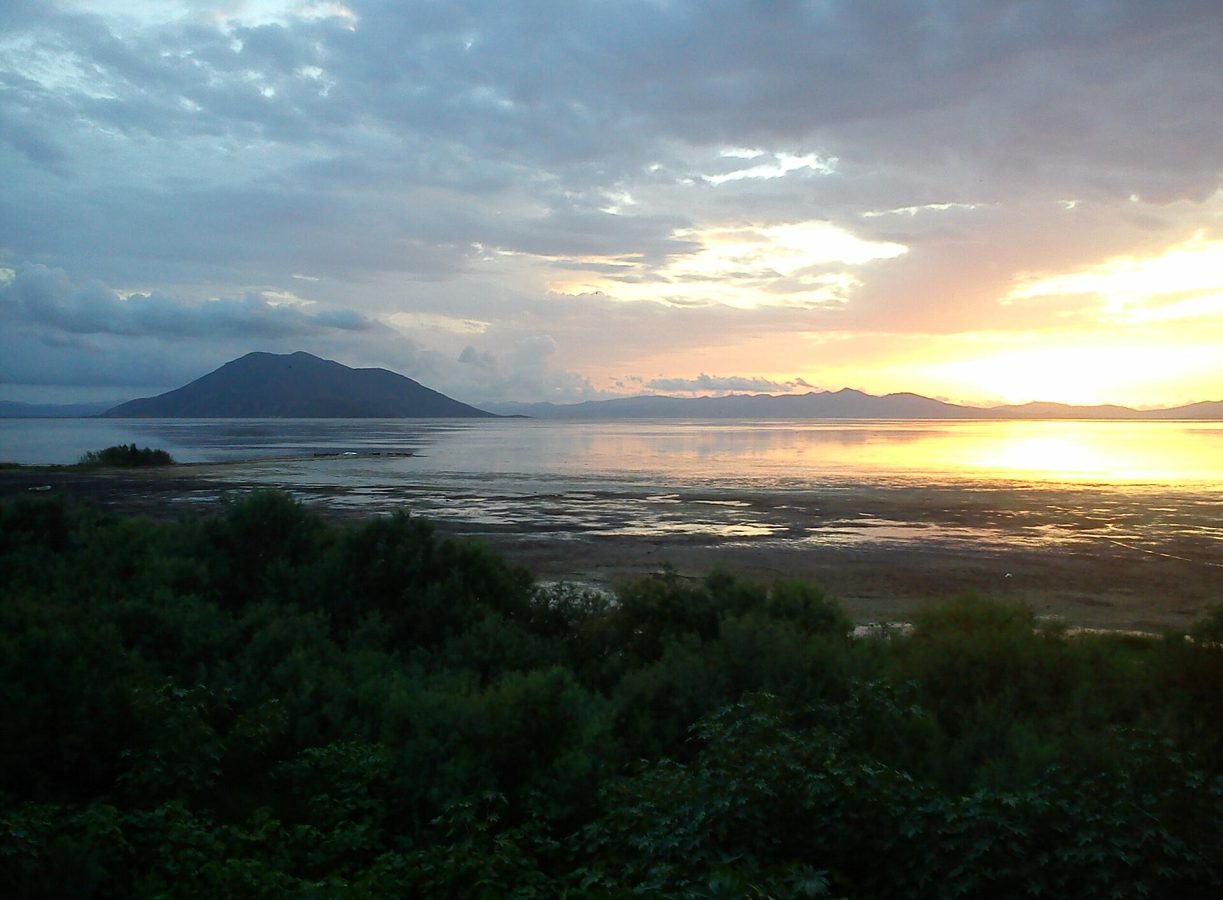
Photo: Jalou111, CC BY-SA 3.0
Ichkeul is a large, shallow lake with a marsh and a solitary mountain beside it, in the far north of Tunisia, about seventy-five kilometres, an hour and a quarter by road, north-west of Tunis and twenty-five kilometres south-west of the port of Bizerte, and it is the most important wetland in North Africa for wintering waterfowl and one of the few places on earth to hold three international designations at once. It is visited as a half-day or day excursion by car from Tunis, from Bizerte or from the beach resorts of the north coast, there being no public transport nearer than the town of Mateur or the village of Tinja, some kilometres from the entrance, and few organised tours, except those of specialist birdwatching companies.
The entrance is on the southern side, off the road between Mateur and Tinja, where a gate, open during the day, gives on to a track that skirts the marsh, with buffalo and cattle grazing on it, and then climbs the flank of the mountain to a car park. From there a short, steep path leads up to the ecomuseum, a modest building with displays, in French and Arabic, on the working of the lake, its birds and its history, and with a terrace that gives a wide view over the water, which is the best place from which to scan the flocks with a telescope. Marked footpaths lead from the car park along the wooded slopes of the mountain, to viewpoints, to old quarries, and, on the northern side, to a number of hot springs, with simple bathing huts used by local people. Entry is free or subject to a nominal charge. There are no refreshments and no accommodation in the park. A local guide is useful, since the birds may be far out and the lake is twelve kilometres across.
Ichkeul was declared a national park in 1980, covers 12,600 hectares, was designated a biosphere reserve in 1977 and a Ramsar wetland in 1980, and was inscribed as a World Heritage Site in the same year; the hunting reserve from which it derives dates back to the Hafsid sultans of the thirteenth century, and later belonged to the beys of Tunis. It consists of three parts, the lake, of about 8,500 hectares and nowhere more than two or three metres deep, the marshes that fringe it on the south and west, of some 2,700 hectares, and the Djebel Ichkeul, a ridge of limestone and marble 511 metres high, clothed in wild olive, mastic and euphorbia, which rises like an island from its southern shore and was indeed an island in antiquity. It is the last survivor of a chain of freshwater lakes that once stretched across the north of Africa, and its peculiar value arises from a double rhythm. In winter, six rivers, swollen by the rains of the Mogod hills, pour fresh water into the lake, which rises and overflows by a narrow channel, the Oued Tinja, into the lagoon of Bizerte and so to the sea; in summer the rivers dry up, evaporation lowers the lake, and the flow in the channel reverses, sea water entering from the lagoon, so that the lake turns from almost fresh in spring to saltier than is usual in autumn. This alternation favours a small number of plants that can tolerate it, above all the fennel pondweed, which grows in vast underwater meadows, and the club-rushes of the marsh, whose seeds and tubers are the food of the birds.
In the 1960s and 1970s between two and three hundred thousand waterfowl wintered here, coming from the whole of Europe and western Siberia: wigeon, pochard, in numbers that represented a large part of the western population, shoveler, teal, coot in tens of thousands, and up to twenty thousand greylag geese, for which this was the principal wintering ground in the Maghreb, together with the rare white-headed duck, the marbled teal, the purple swamphen, flamingos, storks and spoonbills. Then, between 1983 and 1996, three of the six rivers were dammed to supply water for towns and irrigation; deprived of its winter floods, the lake grew steadily saltier, the pondweed and the rushes died, and the birds fell to a small fraction of their former numbers, and in 1996 UNESCO placed the park on its list of World Heritage in danger. The Tunisian government responded by building a sluice on the Tinja channel to keep out the sea and by undertaking to release water from the dams, and, helped by a succession of wet winters from 2002 onwards, the vegetation and the birds recovered to such a degree that the site was removed from the danger list in 2006, one of the rare successes of that kind; its future remains at the mercy of rainfall and of the competing demand for water. A small herd of water buffalo, descended from animals given to a bey in the nineteenth century, lives half wild in the marsh, and the mountain shelters wild boar, jackals, genets, mongooses, porcupines and Bonelli's eagle.
The park is open daily from about 7 am to 6 pm. The season for birds is the winter, from November to February, when the wintering ducks, geese and coots are present in their greatest numbers, the peak being in December and January; the weather is then mild, 12 to 17 degrees, but often wet and windy, the tracks may be muddy, and the light is best in the morning. Spring, from March to May, is beautiful, the mountain covered in flowers and the marsh green, with passage migrants, breeding herons and storks, and a pleasant temperature for walking.
In summer, from June to September, it is hot, above 33 degrees, the marsh dries out, the lake shrinks and few birds remain. Bring binoculars, and a telescope if possible, water, food, a windproof in winter and sun protection at other times. Allow half a day. Bizerte, with its old harbour and kasbah, is half an hour away, the Roman site of Utica forty-five minutes, and Cape Blanc, the northernmost point of Africa, just beyond Bizerte.
211 km away
Pantelleria is the volcanic island between Sicily and Tunisia, nearer to Africa than to Europe, reached by a short…
13 tickets & tours
238 km away
Molentargius is a wetland of lagoons and abandoned salt pans lying inside the urban area of Cagliari, the capital of…
3 tickets & tours
261 km away
The Stagnone is a large, shallow lagoon on the westernmost coast of Sicily, between the wine town of Marsala, ten…
1 ticket or tour
No online tour for Ichkeul National Park is listed on GetYourGuide; entry, where it is charged, is paid at the gate or through the park authority. Nearby parks with bookable tours are listed on this page.
Entry is free or subject to a nominal charge.
The park is open daily from about 7 am to 6 pm.
Ichkeul National Park covers 126 km².
Ichkeul National Park was established in 1980.
Ichkeul National Park is in Tunisia. The map on this page shows the exact spot.