Andasibe-Mantadia National Park
Madagascar
Andasibe-Mantadia is the most visited rainforest in Madagascar, for a simple reason: it lies on the main road from the…
3 tickets & tours
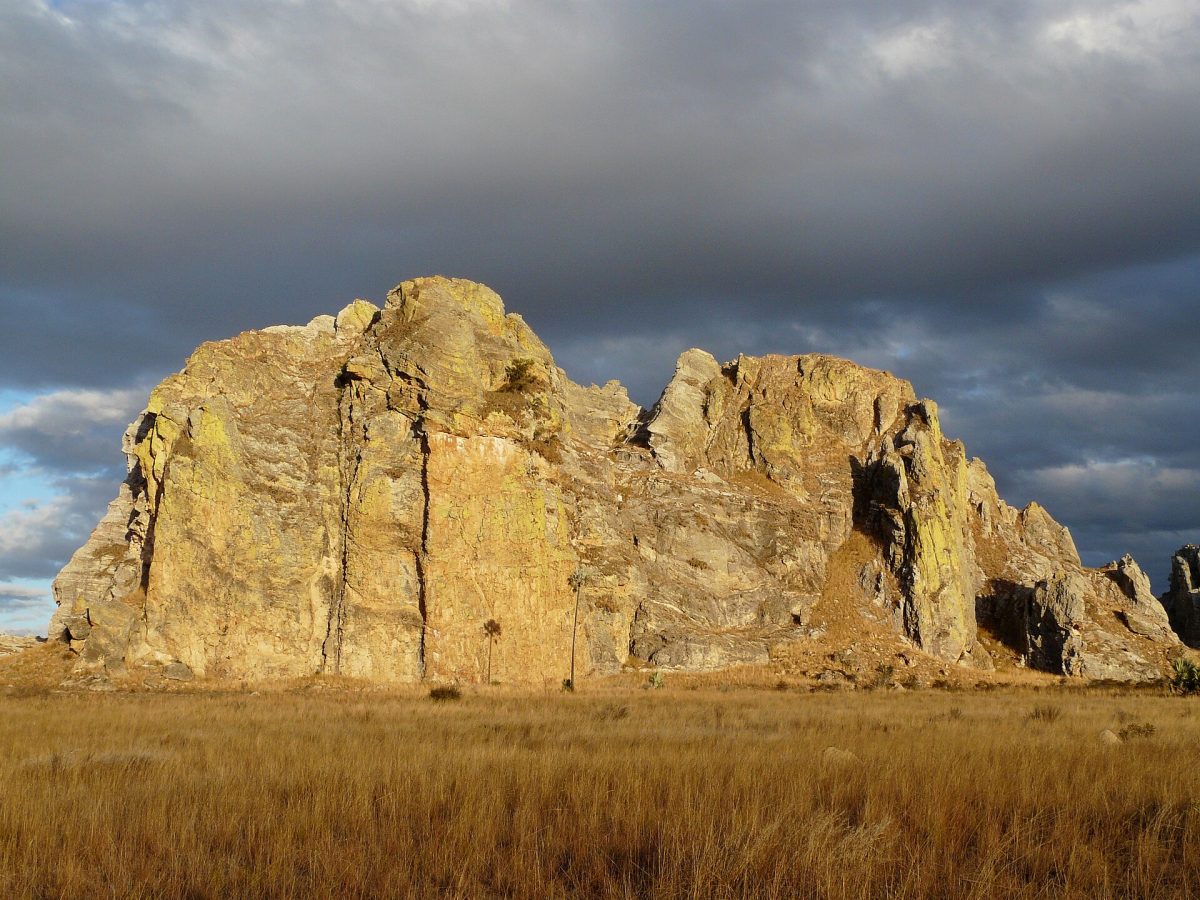
Photo: Zigomar, CC BY-SA 3.0
Isalo is the most visited national park in Madagascar, a massif of eroded sandstone rising out of the grasslands of the south-central part of the island, and it lies directly on the RN7, the main tourist road from the capital Antananarivo to the coast at Toliara, about 700 kilometres and at least two days' driving from the former, and 240 kilometres, four hours, from the latter; almost every overland tour of Madagascar stops here for two nights. The base is the small village of Ranohira, at the park's edge, with the park office, where tickets are bought, and hotels of all grades, some of them built most attractively among the rocks. As in all Malagasy parks, a local guide from the official association is compulsory, engaged and paid at the office, with fixed rates according to the circuit, and visitors need their own vehicle or a hired one to reach the trailheads, which are a few kilometres away along rough tracks.
The classic day combines the Piscine Naturelle, a walk of an hour and a half across the hot, open plateau, among strange rock forms and tombs, to a green pool under pandanus palms fed by a waterfall, in which everybody swims, with the Canyon des Makis, or the Namaza circuit, a shady gorge with a campsite where ring-tailed lemurs and brown lemurs come to look for scraps, leading on to the Cascade des Nymphes and the Blue and Black pools, deep, cold basins between rock walls. Longer routes include the Canyon des Rats, the Portuguese cave, in the remote north, which takes several days, and crossings of the massif with camping. Horse riding and a via ferrata are arranged by the hotels. At sunset everyone drives to the Fenetre de l'Isalo, a natural window in a rock.
Live dates and prices from GetYourGuide. Free cancellation on most tickets.
The park was created in 1962 and covers 815 square kilometres of the Isalo massif, a range of continental sandstone of Jurassic age, some 180 kilometres long, which wind and water have cut into a ruiniform landscape of towers, domes, walls, balanced rocks and canyons up to two hundred metres deep, stained orange, ochre, grey and green by iron and by lichens, and rising to 1,268 metres. It is often compared to the American south-west, and the comparison is fair, except that the open plateau here is a tropical grassland, burned each year by cattle herders, dotted with the fire-resistant tapia tree, on which a native silkworm feeds whose cocoons were spun into burial shrouds, while the canyon floors, watered by permanent streams, hold ribbons of lush forest with pandanus, palms and ferns. The rocks carry a flora adapted to drought and found nowhere else: the elephant's foot, Pachypodium rosulatum, a squat, bottle-shaped, silver-grey plant that clings to bare rock and bears yellow flowers in the dry season; an endemic aloe; and the Isalo kalanchoe.
Wildlife is sparser than in the rainforests, but includes fourteen species of lemur, of which three are readily seen by day, the ring-tailed lemur, the red-fronted brown lemur and Verreaux's sifaka, the white dancing lemur that crosses open ground in sideways leaps; some eighty species of birds, among them Benson's rock thrush, which is virtually confined to this massif, and the Madagascar hoopoe; and chameleons, boas, the colourful Malagasy rainbow frog, found only in these canyons, and stick insects. The massif is the sacred land of the Bara, a people of cattle herders, among whom a young man traditionally had to prove himself by stealing zebu: they place their dead temporarily in caves low in the cliffs, and, after some years, move the bones in a ceremony to a permanent tomb in a hole high on a rock face, sealed with stones, which the guides point out and which must not be pointed at with an outstretched finger. Sapphires were discovered near by at Ilakaka in 1998, and the village beside the road grew within months into a lawless boom town of tens of thousands, which is still there.
The park is open all year, daily from about 6.30 am. The dry season, from April to November, is the time to come: days are sunny and warm, nights cool, even cold in June and July, and the pachypodiums flower from August to October, the most beautiful period; September to November is hot, above 35 degrees on the plateau. The rainy season, from December to March, brings violent afternoon storms, great heat, flooded canyons and occasional cyclones, though the landscape is green.
There is no shade on the plateau, so start at opening time, carry two litres of water each, a hat and sunscreen, and bring swimming things. Allow a full day, two for the longer canyons. The Zombitse-Vohibasia forest park, for birds and sifakas, is an hour and a half west on the road to Toliara, the Anja community reserve and the paper-making town of Ambalavao four hours north-east, and the beaches of Ifaty beyond Toliara.
Yes. GetYourGuide lists 2 tickets and tours for Isalo National Park, with live dates and prices and free cancellation on most of them.
The park is open all year, daily from about 6.30 am.
Allow a full day, two for the longer canyons.
Isalo National Park covers 815 km².
Isalo National Park was established in 1962.
Isalo National Park is in Madagascar. The map on this page shows the exact spot.
Madagascar
Andasibe-Mantadia is the most visited rainforest in Madagascar, for a simple reason: it lies on the main road from the…
3 tickets & tours
Madagascar
Marojejy is a steep, wild massif clothed in rainforest in the north-east of Madagascar, in the Sava region, the vanilla…
2 tickets & tours
Madagascar
Ranomafana is a park of steep, misty mountain rainforest in the south-east of Madagascar, on the edge of the central…
No online ticket