Isalo National Park
259 km away
Isalo is the most visited national park in Madagascar, a massif of eroded sandstone rising out of the grasslands of the…
2 tickets & tours
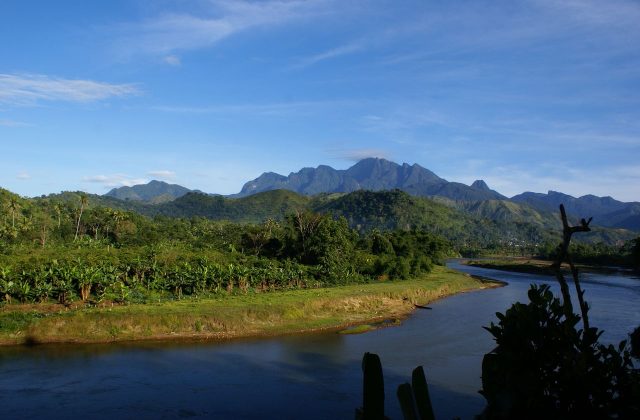
Photo: User:Hardscarf, CC BY-SA 3.0
Ranomafana is a park of steep, misty mountain rainforest in the south-east of Madagascar, on the edge of the central highlands, and it is one of the best and most accessible places in the country to see lemurs, of which it has a dozen species, including some of the rarest. It lies on a good tarred road that branches from the RN7, the main tourist route of the island, about sixty kilometres, an hour and a half, north-east of the university town of Fianarantsoa, and some four hundred kilometres, a long day of nine to ten hours, from the capital, Antananarivo, so that almost every overland tour of Madagascar stops here for two nights on its way south. The village of Ranomafana, in the valley of the Namorona river, has hotels and lodges of all grades, and the park entrance, at the hamlet of Ambodiamontana, is six kilometres above it. As in all the parks of Madagascar, visitors may enter only with an official local guide, engaged and paid, with the entrance fee, at the park office by the gate, the rates being fixed according to the circuit chosen;
many guides speak English or French well and are excellent naturalists, and they work with young spotters, who go ahead at dawn to find the animals. The usual visit is a morning walk of three to four hours in the Talatakely sector, a network of steep, stepped and often muddy trails through secondary forest and bamboo, beginning with a bridge over the rapids of the river, where most of the habituated lemur groups live; longer circuits of six to eight hours continue into the primary forest of Vohiparara, which is better for birds, and treks of two or three days, with camping, cross the park. In the evening, the guides lead a walk along the road outside the park, by torchlight, to look for mouse lemurs, chameleons and frogs. The thermal baths in the village, fed by the hot springs that give it its name, which means hot water, make a pleasant end to a wet day.
Live prices from GetYourGuide for tours whose route includes this park. Free cancellation on most of them.
The park owes its existence to a discovery. In 1986 the American primatologist Patricia Wright, searching these forests for the greater bamboo lemur, a species then thought to be extinct, found not only that animal but, in the same year and with a German colleague, a lemur entirely unknown to science, with russet-gold fur, which was named the golden bamboo lemur. Loggers were then at work in the forest, and she devoted the following years to persuading the government and foreign donors to protect it, with the result that the national park was inaugurated in 1991, the fourth in Madagascar, covering 416 square kilometres; in 2007 it was inscribed, with five others, as part of the World Heritage Site of the Rainforests of the Atsinanana. It occupies the escarpment by which the high plateau of the island falls to the eastern coastal plain, between about five hundred and fifteen hundred metres, a country of ridges and deep ravines drained by the Namorona, which drops through it in rapids and waterfalls, harnessed by a small hydroelectric station. The forest, fed by some three metres of rain a year, passes from lowland rainforest through mid-altitude to cloud forest, with tree ferns, palms, pandanus, orchids in great variety, mosses and lichens, and with thickets of the giant bamboo on which three of its lemurs depend. The golden bamboo lemur feeds on the young shoots and leaf bases of that bamboo, which contain cyanide, and eats each day about twelve times the dose that would kill an animal of its size, by what means it survives being still not understood;
it numbers perhaps a few hundred and is found only here and in one neighbouring forest. The greater bamboo lemur, one of the rarest primates in the world, of which a single small group has survived in the park, specialises in the woody stems, which it tears open with its teeth. The other lemurs include Milne-Edwards' sifaka, large, black with a cream saddle, which leaps upright from trunk to trunk, the red-bellied lemur, the red-fronted brown lemur, the black and white ruffed lemur, and, at night, the rufous mouse lemur, the greater dwarf lemur, the woolly lemur, the sportive lemur and, very rarely seen, the aye-aye. There are some 115 species of birds, among them the ground rollers, the velvet asity, the pitta-like ground roller and the Henst's goshawk, more than a hundred kinds of frogs, of which many are found nowhere else and new ones are described almost every year, a dozen chameleons, leaf-tailed geckos of astonishing camouflage, the giraffe-necked weevil and the comet moth. Beside the entrance stands the Centre ValBio, a large and well-equipped international research station founded by Wright, which has made Ranomafana one of the most intensively studied rainforests in the world and works with the surrounding villages of the Tanala, the people of the forest, and the Betsileo on health, education and reforestation, since slash-and-burn cultivation of rice on the park's margins remains the principal threat.
The park is open all year, and it rains in every month, which is to be expected in a rainforest that receives up to three metres annually; the wettest period, with cyclones possible, runs from December to March, when trails are very slippery, leeches are abundant and the road may be damaged, though reptiles and frogs are at their most active and many lemurs have young. The drier and cooler season, from April or May to November, is the more comfortable, with September to November generally considered the best time, warm, relatively dry, with birds breeding and lemur infants appearing from October;
June to August can be cold, down to five degrees at night, and misty. Wear long trousers tucked into socks against the leeches, shoes with a good grip, and bring a waterproof, a warm layer, a torch for the night walk, and binoculars. The trails are steep and tiring in the humidity, so a reasonable level of fitness is needed. Allow two nights. Fianarantsoa, with its old upper town, the wine estates and the tea plantation of Sahambavy, is an hour and a half away, and the wood-carving town of Ambositra three hours north.
259 km away
Isalo is the most visited national park in Madagascar, a massif of eroded sandstone rising out of the grasslands of the…
2 tickets & tours
287 km away
Andasibe-Mantadia is the most visited rainforest in Madagascar, for a simple reason: it lies on the main road from the…
3 tickets & tours
Yes. GetYourGuide sells tickets and guided tours whose route includes Ranomafana National Park; live prices are shown on this page.
The drier and cooler season, from April or May to November, is the more comfortable, with September to November generally considered the best time, warm, relatively dry, with birds breeding and lemur infants appearing from October; June to August can be cold, down to five degrees at night, and misty.
Ranomafana National Park covers 416 km².
Ranomafana National Park was established in 1991.
Ranomafana National Park is in Madagascar. The map on this page shows the exact spot.
Madagascar
Andasibe-Mantadia is the most visited rainforest in Madagascar, for a simple reason: it lies on the main road from the…
3 tickets & tours
Madagascar
Isalo is the most visited national park in Madagascar, a massif of eroded sandstone rising out of the grasslands of the…
2 tickets & tours
Madagascar
Marojejy is a steep, wild massif clothed in rainforest in the north-east of Madagascar, in the Sava region, the vanilla…
2 tickets & tours