Kenai Fjords National Park
222 km away
Kenai Fjords is the ice-and-ocean park at the edge of the small port of Seward, two and a half hours south of Anchorage…
6 tickets & tours
Volcano Park · Alaska · United States

Photo: Ovedc, CC BY-SA 4.0
Lake Clark lies on the western side of Cook Inlet, in south-western Alaska, only about 160 kilometres from Anchorage, the state's largest city, and yet it is one of the least visited of the American national parks, because no road leads to it or into it and every visit begins with a small aircraft. There is no entrance fee. It is visited in three ways. The commonest is a day trip to watch brown bears on the coast. From Anchorage, and more often from Homer and Kenai on the Kenai peninsula, light aircraft on wheels fly in an hour or less across the inlet and land on the beach at Chinitna Bay or Silver Salmon Creek, where guides lead small groups on foot, or pull them on trailers behind all-terrain vehicles, to watch the bears grazing in the salt marshes, digging for razor clams on the tidal flats and, later in the season, fishing for salmon in the creeks, at distances of fifty metres and sometimes much less;
a few small lodges on private land at these places offer stays of several nights, which are expensive and are booked a year ahead. The second way is to fly by scheduled air taxi, an hour from Anchorage through a spectacular mountain pass, to the little settlement of Port Alsworth, on the southern shore of Lake Clark itself, where the park has its field headquarters and a visitor centre, and where several family lodges provide rooms, boats and guides; from there one can walk the only maintained trail in the park, to the Tanalian falls and Kontrashibuna lake, five to eight kilometres, or up Tanalian mountain, a stiff day, and fly on by floatplane to Twin Lakes to visit the cabin of Richard Proenneke. The third is a wilderness expedition, backpacking across the tundra or rafting the Chilikadrotna, Mulchatna or Tlikakila, all designated wild rivers, arranged with a bush pilot and, for most people, a guide.
Live prices from GetYourGuide for tours whose route includes this park. Free cancellation on most of them.
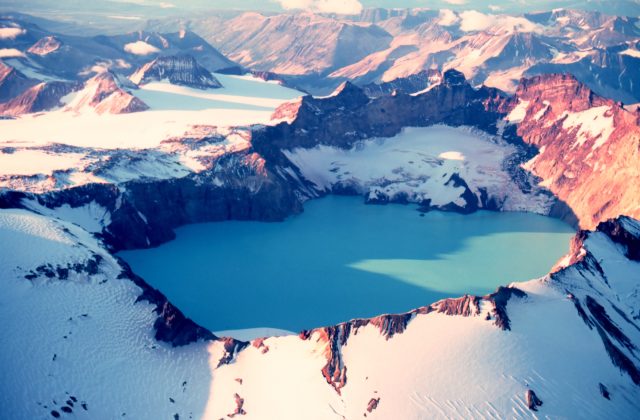
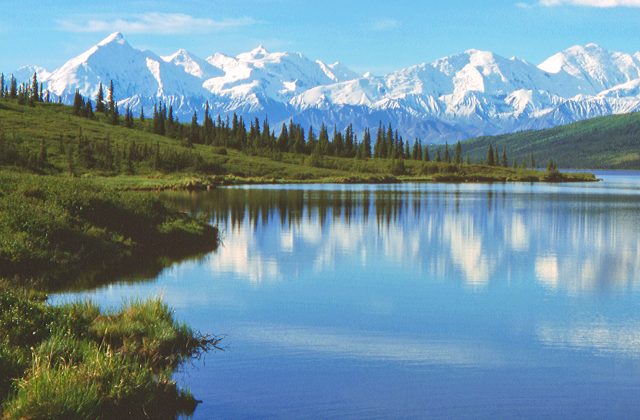
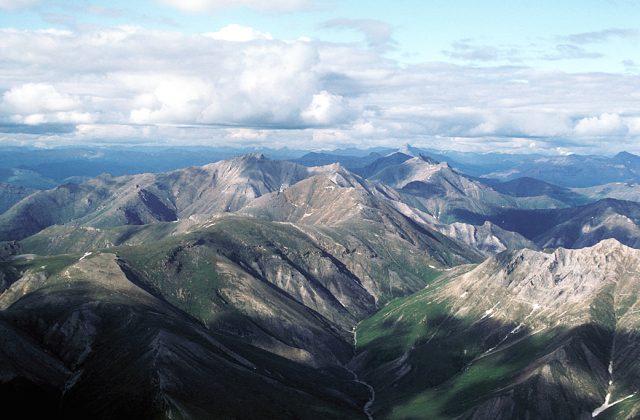
Lake Clark was proclaimed a national monument in 1978 and became a national park and preserve in 1980, covering about 16,300 square kilometres, and it is often described as the essence of Alaska, because almost every kind of landscape the state possesses is found within it. Two great mountain ranges, the Alaska range from the north and the Aleutian range from the south, meet here in a jumble of jagged, heavily glaciated granite peaks called the Chigmit mountains, among which rise two active volcanoes, Iliamna, 3,053 metres, which steams constantly, and Redoubt, 3,108 metres, which erupted in 1989 and 1990, when its ash stopped all four engines of a passing airliner, which fell four thousand metres before they could be restarted, and again in 2009. To the east the mountains drop to the rainy coast of Cook Inlet, with tidal marshes, spruce forest and rivers full of salmon; to the west they descend through foothills to a chain of long, deep, turquoise glacial lakes, of which Lake Clark, some sixty-five kilometres long, is the largest, and beyond them to open tundra. The lake and its rivers are the spawning ground of a large share of the sockeye salmon of Bristol Bay, the greatest wild salmon fishery on earth, and the protection of that nursery was the chief reason for the park's creation;
the young fish spend a year or two in the lakes before going to sea, and the adults return in July, turning the streams red. The salmon feed the bears, of which the coast holds one of the densest populations in Alaska, as well as wolves, eagles and people. The Dena'ina Athabascans have lived round the lake for thousands of years, calling it Qizhjeh Vena, the lake where people gather, and their descendants, in the villages of Nondalton and elsewhere, still fish and hunt within the park as of right. Dall sheep, caribou, moose, black bears, lynx, wolverines, trumpeter swans and beluga whales, in the inlet, are among its other animals. The park's most celebrated inhabitant was a man. In 1968 Richard Proenneke, a retired mechanic from Iowa, then fifty-one, arrived at Upper Twin Lake, and with hand tools alone, many of which he made himself, built a log cabin of remarkable craftsmanship, with a stone fireplace, wooden hinges and a moss-covered roof; he lived in it, alone, for most of the next thirty years, until he was eighty-two, keeping a detailed journal and filming himself at work, from which a book and a much-loved television documentary were made. He left the cabin to the park, which maintains it exactly as it was, and volunteers show it to those who fly in.
The park is open all year, but the season for visitors runs from about early June to mid-September. Bear watching on the coast begins in late May and June, when the bears, newly out of their dens, mate and graze on the sedge meadows, continues through July with clam digging at low tide, and reaches a second peak in August and early September, when the silver salmon run; the lodges close by mid-September.
At Port Alsworth and the inland lakes, June and July have the longest days and the most mosquitoes, July and August the returning sockeye and the warmest weather, 12 to 20 degrees, and late August and September autumn colours on the tundra and the first snow on the peaks. The weather on both sides of the mountains is changeable, and flights are frequently delayed for hours or days by low cloud in the passes, so that a tight schedule is unwise. Bring full rain gear, warm layers, rubber boots for the coast, a head net and repellent. Follow the guides' instructions about bears exactly. Allow a day for a bear flight, three to five days for Port Alsworth.
222 km away
Kenai Fjords is the ice-and-ocean park at the edge of the small port of Seward, two and a half hours south of Anchorage…
6 tickets & tours
289 km away
Katmai lies at the base of the Alaska Peninsula, in the south-west of the state, and no road leads to it or into it, so…
1 ticket or tour
296 km away
Denali is the subarctic wilderness around the highest mountain in North America, four hours north of Anchorage and two…
10 tickets & tours
Yes. GetYourGuide sells tickets and guided tours whose route includes Lake Clark National Park and Preserve; live prices are shown on this page.
There is no entrance fee.
There is no entrance fee.
The park is open all year, but the season for visitors runs from about early June to mid-September.
Allow a day for a bear flight, three to five days for Port Alsworth.
Lake Clark National Park and Preserve covers 16 309 km².
Lake Clark National Park and Preserve was established in 1980.
Lake Clark National Park and Preserve receives about 19 778 a year (2025).
Lake Clark National Park and Preserve is in Alaska, United States. The map on this page shows the exact spot.
Alaska, United States
Denali is the subarctic wilderness around the highest mountain in North America, four hours north of Anchorage and two…
10 tickets & tours
Alaska, United States
Kenai Fjords is the ice-and-ocean park at the edge of the small port of Seward, two and a half hours south of Anchorage…
6 tickets & tours
Alaska, United States
Glacier Bay lies in the panhandle of south-eastern Alaska, west of the state capital, Juneau, a fjord more than a…
1 ticket or tour
Alaska, United States
Katmai lies at the base of the Alaska Peninsula, in the south-west of the state, and no road leads to it or into it, so…
1 ticket or tour
Alaska, United States
Gates of the Arctic, in the central Brooks Range of northern Alaska, lies wholly north of the Arctic Circle, and it is…
No online ticket
Alaska, United States
Wrangell-St Elias, in the south-east of Alaska against the Canadian border, is the largest national park in the United…
No online ticket