Los Glaciares National Park
Argentina
Los Glaciares is the park of the Perito Moreno glacier and the Fitz Roy massif in Argentine Patagonia, and it is…
52 tickets & tours
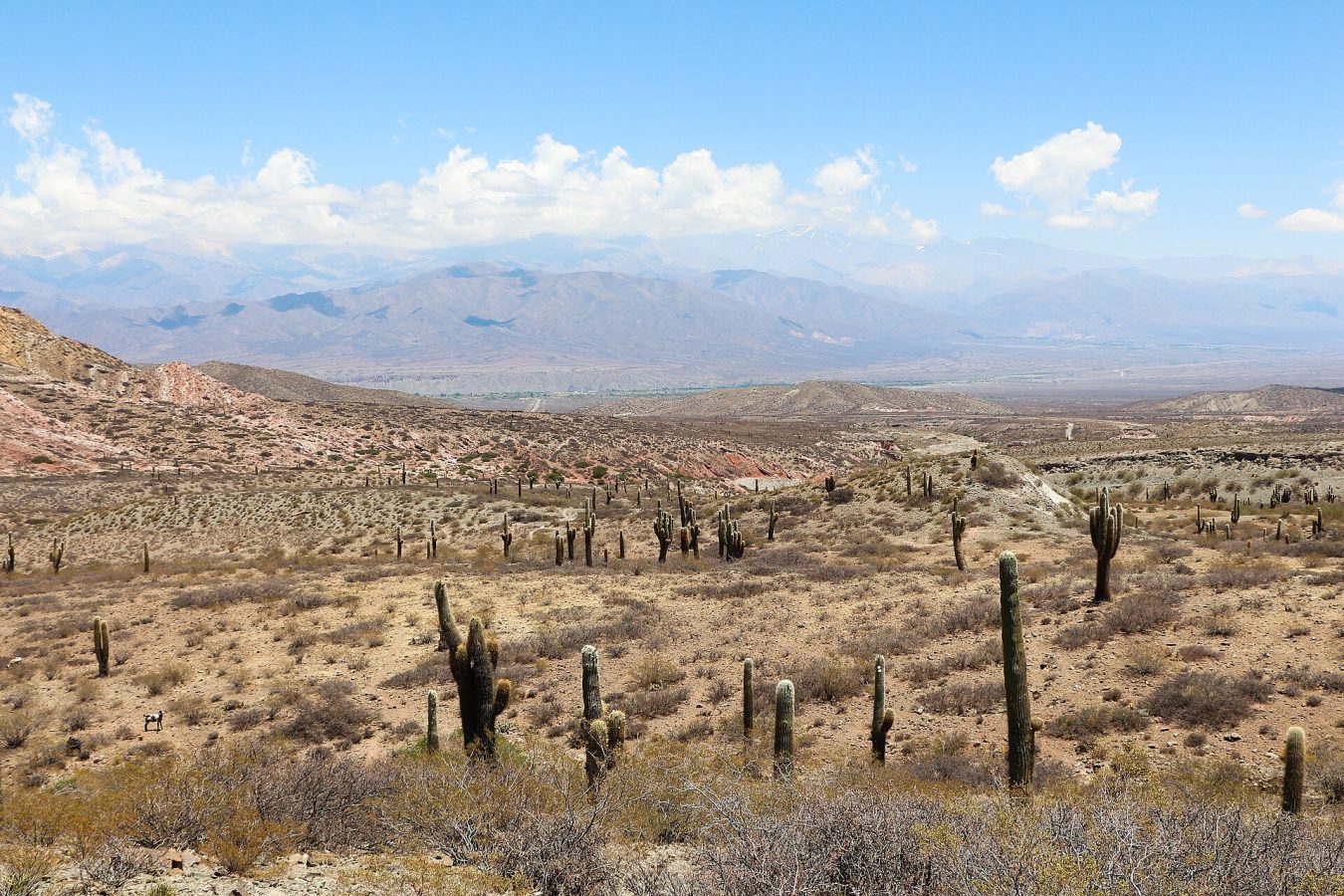
Photo: Bernard Gagnon, CC BY-SA 4.0
Los Cardones is a high desert park in the province of Salta, in the north-west of Argentina, and nearly everyone sees it in the same way, from the road, in the course of the classic day excursion from the city of Salta to the white colonial village of Cachi, in the Calchaqui valleys. Provincial route 33 crosses the park from one side to the other, and the journey of 157 kilometres, four hours each way with stops, is one of the great drives of the country, since it passes within a morning through three worlds. It begins in the green subtropical valley of Lerma, enters the Escoipe gorge, damp and wooded, then climbs the Cuesta del Obispo, the bishop's slope, twenty kilometres of unsurfaced hairpins up a mountainside of red and green rock, often into the clouds, to the pass of Piedra del Molino, at 3,348 metres, marked by a millstone and a tiny chapel, where the park begins.
Beyond it the air is suddenly dry and clear, and the road runs across a high plain and then along the Recta del Tin Tin, a dead-straight stretch of eighteen kilometres through the densest of the cactus forests, before descending to Cachi. The coach and minibus tours, and the many travellers who do the same in a hired car, stop at the pass, at several roadside viewpoints with short interpretive trails, a few hundred metres to a kilometre or two in length, among the cacti, and sometimes at the Valle Encantado, a side valley of eroded rocks and summer flowers reached by a rough track near the pass. There is no gate, no fee and no visitor centre beyond a ranger post, no fuel, food or water, and no place to stay in the park; the rangers, based at Piedra del Molino and in the village of Payogasta, can advise on longer walks. Condors are very often seen soaring above the Cuesta del Obispo.
Live dates and prices from GetYourGuide. Free cancellation on most tickets.
The national park was created in 1996, when the state bought the land from private estates, and covers about 650 square kilometres of dry mountains and basins between 2,700 and more than 5,000 metres, on the eastern edge of the Andes. It takes its name from the cardon, a giant columnar cactus of the high valleys of north-western Argentina and Bolivia, which grows here in tens of thousands, scattered over the stony slopes like an army of figures with raised arms. The cardon is a plant of extreme slowness. A seedling survives only in the shade of a nurse shrub, usually a jarilla, which protects it from frost, sun and grazing animals; it grows a few centimetres a year, does not put out its first side arm until it is fifty years old or more, reaches ten or twelve metres, and lives for two and a half or three centuries, storing in its ribbed trunk the water of the brief summer rains. In spring it bears large white flowers, which open at night, and then a sweet fruit. In a country without trees its light, strong, porous timber, patterned with holes, was the only wood available, and it was used for the beams, doors, altars, pulpits and confessionals of the colonial churches of the valleys, that of Cachi being the best example, and for furniture and crafts, until the species was protected by law.
The native people regarded the cacti as the guardians of the hills, and legend has it that they are Indian warriors who, waiting in ambush for the Spaniards, were turned to plants. The Recta del Tin Tin follows the line of a road laid out by the Incas, who conquered these valleys in the fifteenth century, and astonishes engineers by its straightness, achieved, it is said, with fires lit at night as sighting points. The park protects four distinct environments, the high Andean steppe, the puna, the dry scrub of the monte and, on its wet eastern rim, a strip of cloud-fed grassland, and its animals include the guanaco, in one of its most northerly populations in Argentina, the taruca, or north Andean deer, an endangered species and a national natural monument, the puma, the Andean and grey foxes, the mountain vizcacha, the armadillo, the Andean condor, the red-backed hawk, the giant hummingbird and the elegant crested tinamou. Dinosaur footprints some seventy million years old have been found in its rocks, with the fossils of marine creatures, and rock paintings in its caves.
The park is open at all times, the road permitting. The dry season, from April to November, offers cloudless skies, deep blue against the red rock, mild days and cold nights, with frost and the occasional snowfall at the pass in July and August; October and November, when the cardones flower, are especially attractive. The summer, from December to March, is the rainy season: storms break in the afternoons, the Escoipe gorge and the Cuesta del Obispo are regularly cut by landslides and swollen streams, sometimes for days, and fog often hides the climb, though the high valleys turn green and the Valle Encantado is full of flowers.
Set out from Salta early, since cloud tends to build on the slope by midday. The altitude at the pass may cause mild headache or breathlessness, so move slowly and drink water. Carry water, food, sun protection and a warm layer. Allow a full day from Salta, or, better, spend a night in Cachi, forty minutes beyond the park, and continue down the Calchaqui valley by Molinos to Cafayate.
Yes. GetYourGuide lists one ticket or tour for Los Cardones National Park, with live dates and prices and free cancellation on most of them.
The park is open at all times, the road permitting.
Allow a full day from Salta, or, better, spend a night in Cachi, forty minutes beyond the park, and continue down the Calchaqui valley by Molinos to Cafayate.
Los Cardones National Park covers 650 km².
Los Cardones National Park was established in 1996.
Los Cardones National Park is in Argentina. The map on this page shows the exact spot.
Argentina
Los Glaciares is the park of the Perito Moreno glacier and the Fitz Roy massif in Argentine Patagonia, and it is…
52 tickets & tours
Argentina
The park is twelve kilometres west of Ushuaia and is the standard half-day excursion for everyone passing through the…
36 tickets & tours
Argentina
Iguazú National Park is the Argentine side of the falls, twenty minutes from Puerto Iguazú, and it is entered with a…
11 tickets & tours
Argentina
Nahuel Huapi is the lake-and-mountain park of northern Patagonia, and the city of San Carlos de Bariloche, two hours by…
5 tickets & tours
Argentina
Villavicencio is a private nature reserve in the dry foothills of the Andes, its entrance about forty-five kilometres,…
4 tickets & tours
Argentina
Ansenuza is one of the newest national parks of Argentina and protects Mar Chiquita, an immense salt lake in the…
1 ticket or tour