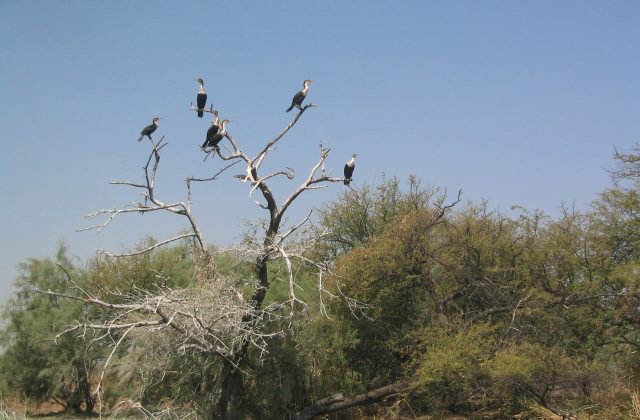
Bandia Wildlife Reserve
Senegal
Bandia is the private game reserve an hour south of Dakar on the road to Saly and the Petite Côte, and it is…
14 tickets & tours

Photo: COD photographer, CC BY-SA 4.0
Niokolo-Koba, in the south-east of Senegal near the borders of Guinea and Mali, is the largest national park in the country and one of the last refuges of big game in West Africa, and it must be approached with modest expectations: this is not East Africa, the animals are thinly spread, shy and hidden for much of the year by tall grass and dense woodland, and the pleasure of a visit lies in the wild, empty landscape, the river, the birds and the occasional sighting that feels truly earned. It lies about 550 kilometres from Dakar, a long day of eight to ten hours by the main road to Mali through Kaolack and Tambacounda, the regional capital, which has basic hotels and is the usual staging post, eighty kilometres from the main entrance at Dar Salam; most visitors come on organised tours of several days from Dakar or the coastal resorts, often combined with the Bassari country beyond.
At Dar Salam the entrance and vehicle fees are paid and an official guide, who is compulsory, is engaged, and there is a small museum. A four-wheel-drive vehicle is needed for the tracks inside the park, and must be brought, since none can be hired at the gate. The focus of all visits is Simenti, in the centre, thirty-five kilometres from the entrance, on a bluff above the Gambia river, where a large hotel built in the 1960s has operated intermittently and in varying states of repair, and where a hide overlooks a pool frequented by antelope, warthogs, baboons and birds; more reliable are the simple tented camps, such as the Camp du Lion, a few kilometres away on the river bank, and lodges just outside the park at Dar Salam and on the Gambia at Wassadou. From these, guides lead game drives in the early morning and late afternoon along the river and to the pools, walks, and trips by pirogue on the Gambia to see hippos, crocodiles and birds.
A hunting reserve from 1926, Niokolo-Koba was declared a national park in 1954 and successively enlarged to 9,130 square kilometres, and in 1981 it was inscribed as a World Heritage Site and designated a biosphere reserve. It lies on the upper course of the Gambia river, which with its tributaries the Niokolo Koba and the Koulountou winds across it, their banks lined with tall gallery forest and their flood plains dotted with seasonal pools, between low plateaus of laterite and sandstone, rising to 311 metres at Mount Assirik in the south-east, which are covered with Sudanian wooded savanna, bamboo thickets and, on the shallow ironstone soils, open grassy clearings called bowe. It stands at the meeting of the dry savannas of the Sahel and the humid forests of Guinea, and therefore holds a greater variety of plants and animals than any other reserve in the region, some 1,500 species of plants, 80 of mammals and 330 of birds. It is the last stronghold of the western giant eland, or Derby eland, the largest and most magnificent of all antelopes, the bulls standing nearly one and eight tenths of a metre at the shoulder, with massive spiral horns and a black neck, which is critically endangered and of which only a hundred or two survive in the wild, nearly all of them here; a small breeding herd, founded from animals caught in the park, is kept in the Bandia reserve near Dakar as an insurance.
The hills of Assirik hold the most north-westerly chimpanzees in Africa, a population living at the dry limit of the species' range, which researchers have observed sheltering in caves from the heat and, remarkably, sharpening sticks to spear bushbabies in their holes. The park also shelters the last lions of Senegal, a few dozen, a population that conservation work since 2011 has helped to double, leopards, a remnant of wild dogs, spotted hyenas, buffalo, roan antelope, hartebeest, kob, waterbuck, bushbuck, oribi, duikers, red colobus, patas and green monkeys, Guinea baboons in large troops, hippos, and all three African crocodiles. The elephants, which numbered several hundred in the 1970s, were wiped out by ivory poachers, and it is doubtful whether more than one or two individuals remain. When the park was enlarged in the 1960s and 1970s the villages within it were removed, and relations with the surrounding population have been difficult ever since. Commercial poaching, the grazing of cattle, bush fires, the drying up of the pools, invaded by a spiny mimosa, a basalt quarry, and plans for a dam on the Gambia upstream and for gold mining near by led UNESCO to place the park on the list of World Heritage in danger in 2007, from which it was removed in 2024, after improved surveillance and management.
The park is officially open from mid-December to the end of April or, for parts of it, to June, and is closed during the rains, from about June to November, when the tracks are flooded and impassable. The best time for seeing animals is from February to May, the late dry season, when the grass has been burned, the pools have shrunk and the wildlife is forced to concentrate along the Gambia and at the remaining water; December and January are cooler and greener, but the vegetation is still high and the animals dispersed.
It is extremely hot from March onwards, 38 to 42 degrees at midday in April and May, and activity is confined to the first hours after dawn and the last before dusk. This is a malarial area, tsetse flies bite along the rivers, and a yellow fever certificate is required for Senegal. Carry ample water, fuel and spare tyres, and do not swim in the river. Allow two to three nights. The Bassari and Bedik villages round Kedougou, a World Heritage cultural landscape, and the Dindefelo waterfall lie three hours further south-east.
No online tour for Niokolo-Koba National Park is listed on GetYourGuide; entry, where it is charged, is paid at the gate or through the park authority. Nearby parks with bookable tours are listed on this page.
The park is officially open from mid-December to the end of April or, for parts of it, to June, and is closed during the rains, from about June to November, when the tracks are flooded and impassable.
Allow two to three nights.
Niokolo-Koba National Park covers 9 130 km².
Niokolo-Koba National Park was established in 1954.
Niokolo-Koba National Park is in Senegal. The map on this page shows the exact spot.
Senegal
Bandia is the private game reserve an hour south of Dakar on the road to Saly and the Petite Côte, and it is…
14 tickets & tours
Senegal
Djoudj is a wetland in the delta of the Senegal river, in the far north of Senegal on the Mauritanian border, about…
2 tickets & tours