
Virunga National Park
Democratic Republic of the Congo
Virunga lies in the east of the Democratic Republic of the Congo, along the borders of Uganda and Rwanda, and it is the…
1 ticket or tour
Rainforest Park · Democratic Republic of the Congo
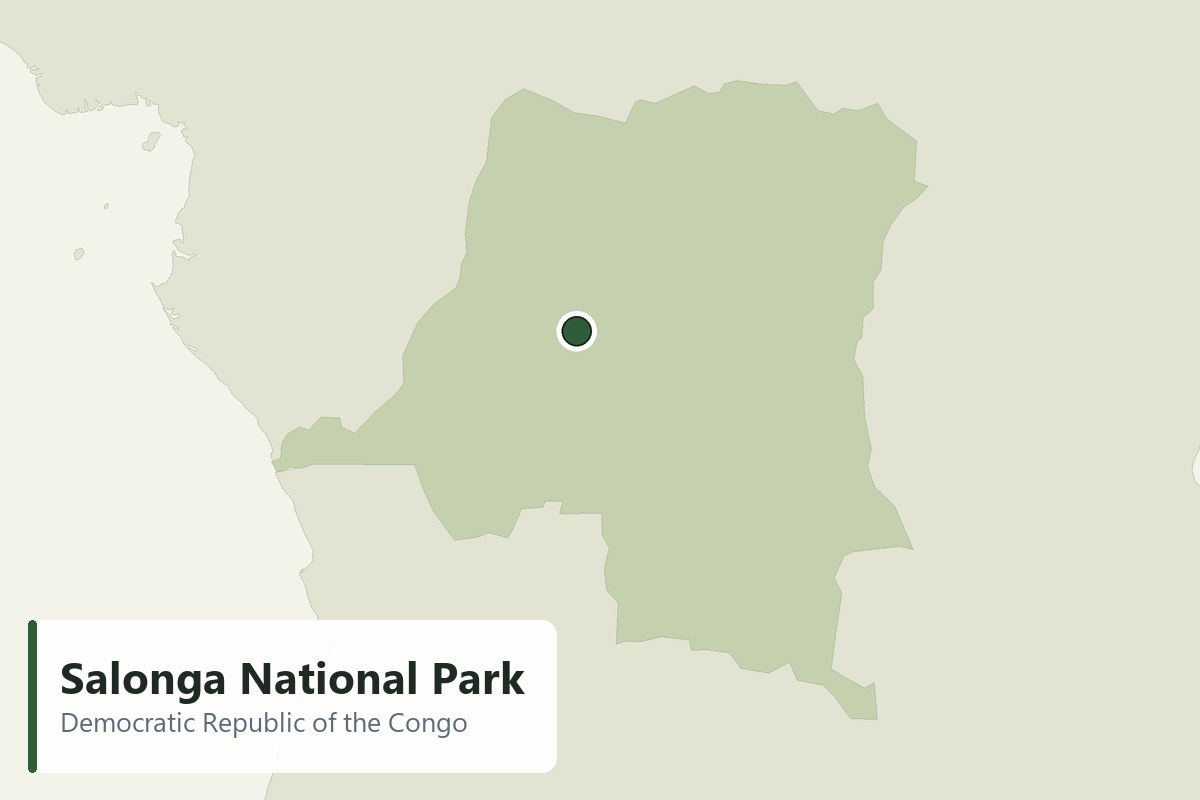
Salonga lies in the very centre of the Congo basin, in the Democratic Republic of the Congo, and it is the largest protected area of tropical rainforest in Africa and the second largest in the world, a block of forest the size of Belgium or of the state of Maryland, without a single road. It is also one of the least visited national parks on the planet, and should be understood as a place of scientific and conservation importance and not as a tourist destination. There are no lodges, no tourist trails, no habituated animals available for viewing and no regular means of access; the park can be approached only by river, by dugout canoe with an outboard motor, on journeys of several days from the river port of Mbandaka, on the Congo, itself reached by air from Kinshasa, or by chartered light aircraft to one of the grass airstrips at the park's stations, at Monkoto, between the two blocks, Anga, Mondjoku or Watsi Kengo.
Those who go are researchers, conservation staff, film crews and, very occasionally, expedition travellers, and everything, permits from the Congolese wildlife authority, boats, fuel, food, guides and security, must be organised months ahead through the organisations that work in the park, chiefly the World Wide Fund for Nature, which co-manages it, and the research institutes that have field stations there. Travel in the interior of the Congo is slow, uncomfortable, expensive and unpredictable, and most foreign governments advise against all but essential travel to much of the country. Travellers who wish to see bonobos, the animal for which Salonga is famous, do so far more easily at the sanctuary of Lola ya Bonobo, on the outskirts of Kinshasa, which cares for orphans of the bushmeat trade and releases them into a forest reserve elsewhere.
The national park was created in 1970 by President Mobutu, who was then establishing a network of parks across what was called Zaire, and covers about 36,000 square kilometres, in two separate blocks, a northern and a southern, divided by a corridor some forty kilometres wide in which people live; it was inscribed as a World Heritage Site in 1984, was placed on the list of World Heritage in danger in 1999, during the Congo wars, and was removed from it in 2021, after the government undertook that oil concessions which overlapped it would not be developed and the monitoring of its wildlife showed stable numbers. It lies at three to seven hundred metres in the great shallow bowl of the central basin, a gently undulating country of low plateaus and wide, marshy river valleys, drained by large, meandering blackwater rivers, the Lomela, the Salonga, the Luilaka, the Yenge and others, tributaries of the Congo, which are its only highways. Almost the whole of it is covered by dense equatorial rainforest, evergreen on the plateaus, seasonally flooded and swampy along the rivers, with scattered natural clearings, called bais or botoka-djoku, where forest elephants come to dig for minerals, and the forest, together with the deep peat that underlies the swamps of the central basin, holds an immense store of carbon, which gives the park a significance beyond its wildlife.
Its most celebrated inhabitant is the bonobo, the fourth great ape, a close relative of the chimpanzee, slighter, darker-faced and with hair parted in the middle, which was recognised as a distinct species only in 1929, and which is found nowhere in the world except in the forests south of the great bend of the Congo river, the river having separated its ancestors from those of the chimpanzee more than a million years ago. Bonobos are of particular interest because their societies are dominated by females and are, by comparison with those of chimpanzees, remarkably peaceful, tensions being resolved by sexual contact of every kind. The park is thought to hold some fifteen thousand of them, perhaps two fifths of all that survive, and long-term studies at the station of LuiKotale, on its southern edge, have provided much of what is known of their life in the wild. Salonga also shelters the forest elephant, in numbers much reduced by ivory poaching, the bongo, the sitatunga, forest buffalo, the giant pangolin, the slender-snouted crocodile, several monkeys found only in this part of the basin, among them the dryas monkey and Thollon's red colobus, the leopard, the golden cat, the African grey parrot and the Congo peacock, a bird found only in these forests, discovered in 1936, which is the country's national bird. The park's guards, few and poorly equipped for such an area, face commercial hunters of bushmeat and ivory who come up the rivers, and their conduct towards local people has at times been the subject of serious complaint; some villages of the Iyaelima people remain inside the southern block, and have traditionally protected the bonobo, which they regard as kin.
The climate is equatorial, hot, 24 to 32 degrees, and very humid all the year round, with some two metres of rain, falling in every month; there are two somewhat drier periods, from June to August and, more briefly, in January and February, when the rivers fall, sandbanks appear, some of the smaller channels become too shallow for canoes, and walking in the forest is easier, and these are the times generally chosen for field work.
In the wettest months, from September to November and from March to May, the valleys flood widely. Malaria, sleeping sickness, river blindness and other diseases are present, a yellow fever certificate is compulsory, and the nearest hospital is days away, so that any visit requires full medical preparation and evacuation insurance. No journey should be attempted without the backing of an organisation established in the park. Allow two to three weeks from Kinshasa.
No online tour for Salonga National Park is listed on GetYourGuide; entry, where it is charged, is paid at the gate or through the park authority. Nearby parks with bookable tours are listed on this page.
Allow two to three weeks from Kinshasa.
Salonga National Park covers 36 000 km².
Salonga National Park was established in 1970.
Salonga National Park is in Democratic Republic of the Congo. The map on this page shows the exact spot.
Democratic Republic of the Congo
Virunga lies in the east of the Democratic Republic of the Congo, along the borders of Uganda and Rwanda, and it is the…
1 ticket or tour
Democratic Republic of the Congo
Garamba lies in the far north-eastern corner of the Democratic Republic of the Congo, against the border of South…
No online ticket
Democratic Republic of the Congo
Kahuzi-Biega lies in the east of the Democratic Republic of the Congo, in the province of South Kivu, in the mountains…
No online ticket

