Garamba National Park
Democratic Republic of the Congo
Garamba lies in the far north-eastern corner of the Democratic Republic of the Congo, against the border of South…
No online ticket
Volcano Park · Democratic Republic of the Congo

Photo: Ad Meskens, CC BY-SA 3.0
Virunga lies in the east of the Democratic Republic of the Congo, along the borders of Uganda and Rwanda, and it is the oldest national park in Africa and, by the variety of what it contains, one of the most remarkable on earth, with mountain gorillas, a volcano holding the world's largest lava lake, savannas, swamps, rainforest and the glaciers of the Rwenzori. It has also been, for thirty years, a war zone. Its tourism has opened and closed repeatedly: it was suspended in 2018 after the murder of a ranger and the kidnapping of two British visitors, reopened in 2019, was closed by the pandemic and by the killing of rangers and of the Italian ambassador near by in 2021, and since then the advance of the M23 rebel army, which took the city of Goma in January 2025 and occupies much of the park's southern and central sectors, has made visits impossible; virtually every government advises against all travel to the region.
What follows therefore describes how the park was visited when it was open, in the hope that it will be again, and anyone interested must look at the park's own website, which announces its status, and at current official advice. In those periods, visitors arrived through Rwanda, driving three hours from Kigali to the border at Gisenyi and walking across to Goma, with a Congolese visa obtained in advance through the park, which also sold, online, the permits, transport and accommodation as a single package. Gorilla tracking started from the ranger posts of Bukima or Djomba, a drive of two to three hours from Goma, where simple tented camps stood, and followed the usual rules: groups of at most eight, an hour with the animals, surgical masks, a permit costing far less than in Rwanda. The other great excursion was the ascent of Nyiragongo, a steep climb of five to six hours from the Kibati post, with a night in huts on the crater rim. The park's own lodge at Rumangabo, and a tented camp on an island in Lake Kivu, completed the circuit.
Live dates and prices from GetYourGuide. Free cancellation on most tickets.
The park was founded on 21 April 1925, by decree of King Albert I of the Belgians, as the Albert National Park, the first in Africa, on the advice of the American naturalist Carl Akeley, who had come to the Virunga volcanoes to shoot gorillas for a museum and ended by pleading for their protection, and who is buried there; it was enlarged to its present extent of about 7,800 square kilometres by 1935, renamed after independence, and inscribed as a World Heritage Site in 1979, to which the status of site in danger was added in 1994. It is a strip of land some three hundred kilometres long and nowhere more than fifty wide, lying in the Albertine rift, the western branch of the Great Rift valley, and it spans an altitude from 680 metres on the Semliki river to 5,109 at the summit of Mount Stanley in the Rwenzori, the third highest mountain in Africa, so that it contains a greater diversity of habitats than any other park on the continent, and more species of birds, mammals and reptiles than any other protected area in Africa, more than seven hundred birds and two hundred mammals. In the south stand the eight Virunga volcanoes, six of them extinct, on whose forested slopes, shared with Rwanda and Uganda, live about a third of the world's thousand or so mountain gorillas, and two of them among the most active in Africa. Nyamulagira erupts every few years, and Nyiragongo, 3,470 metres, holds in its summit crater, more than a kilometre across, a lake of molten lava, which for most of the last century was the largest in the world, a red, seething, crusted surface that lit the clouds at night;
its lava is exceptionally fluid, and when the crater wall has fractured, in 1977, in January 2002 and in May 2021, it has poured down the mountain at the speed of a car, in 2002 cutting the city of Goma in two and destroying the homes of more than a hundred thousand people. The central sector, round Lake Edward, consists of savanna, where in the 1950s the density of large animals, hippos above all, some twenty-seven thousand of them, was the highest recorded anywhere in Africa; they were reduced by poaching to a few hundred, and have partly recovered, together with elephants, buffalo, kob, topi, lions and the chimpanzees of the Tongo forest. The north has the rainforest of the Semliki, the home of the okapi, and the snows of the Rwenzori, the mountains of the moon. Since 1994, when a million refugees from the Rwandan genocide camped on its borders, the park has never known peace: armed groups finance themselves from its charcoal, fish and ivory, oil exploration was licensed within it and then halted after an international campaign, and more than two hundred of its rangers have been killed on duty. Under Emmanuel de Merode, its director since 2008, who was himself shot and wounded in 2014, it has built hydroelectric plants, a chocolate factory and other enterprises to give the four million people round it an alternative to the militias, and runs at Rumangabo the only centre in the world for orphaned mountain gorillas.
When the park has been open, gorilla tracking and the volcano have been possible all year. The region has two drier seasons, from June to September and from mid-December to February, when the forest trails are less muddy and the crater rim of Nyiragongo is more often clear at night, and two rainy seasons, from March to May and from October to November, with heavy showers most afternoons. The climate is mild at the altitude of the gorilla sectors, 15 to 24 degrees, and cold, near freezing, on the summit of Nyiragongo, for which warm clothing, gloves and a good sleeping bag are needed.
A yellow fever certificate is compulsory, malaria precautions are necessary, and visitors with infectious illnesses are not admitted to the gorillas. No journey should be planned without confirmation from the park that the sector concerned is open and escorted, and without checking government advice, which has for some years been unequivocal. Rwanda's Volcanoes park and Uganda's Bwindi and Mgahinga offer gorilla tracking in safety.
Yes. GetYourGuide lists one ticket or tour for Virunga National Park, with live dates and prices and free cancellation on most of them.
No journey should be planned without confirmation from the park that the sector concerned is open and escorted, and without checking government advice, which has for some years been unequivocal.
Virunga National Park covers 7 800 km².
Virunga National Park was established in 1925.
Virunga National Park is in Democratic Republic of the Congo. The map on this page shows the exact spot.
Democratic Republic of the Congo
Garamba lies in the far north-eastern corner of the Democratic Republic of the Congo, against the border of South…
No online ticket
Democratic Republic of the Congo
Kahuzi-Biega lies in the east of the Democratic Republic of the Congo, in the province of South Kivu, in the mountains…
No online ticket
Democratic Republic of the Congo
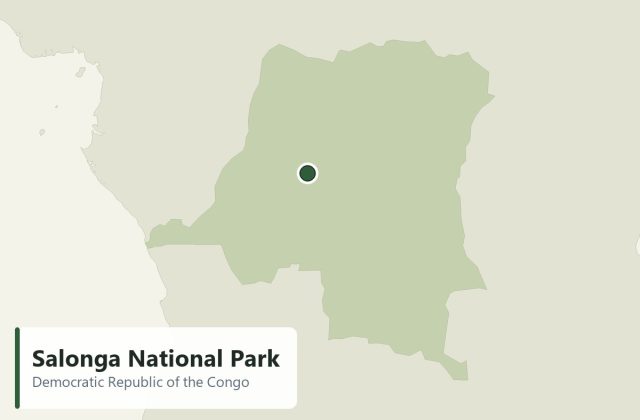
Salonga lies in the very centre of the Congo basin, in the Democratic Republic of the Congo, and it is the largest…
No online ticket