Murchison Falls National Park
354 km away
Murchison Falls is Uganda's largest park and the one closest to Kampala for a proper savanna safari, about five…
35 tickets & tours
Safari Park · Democratic Republic of the Congo
Garamba lies in the far north-eastern corner of the Democratic Republic of the Congo, against the border of South Sudan, and it is one of the oldest national parks in Africa and one of the hardest to reach, a place that figures in the history of conservation far more than in the itineraries of travellers. It should be understood from the outset that this is not a tourist destination in any ordinary sense. The region has for decades been afflicted by armed groups, ivory poachers and the overspill of the wars of its neighbours, virtually all foreign governments advise their citizens against travelling to this part of the Congo, and there are no roads that a visitor could sensibly use from any city. Since 2005 the park has been managed, in partnership with the Congolese wildlife authority, by African Parks, a non-profit conservation organisation, which maintains at the headquarters at Nagero, on the Dungu river at the park's southern edge, a small, comfortable camp of thatched chalets, used chiefly by donors, researchers, officials and a very few adventurous paying guests.
Everything must be arranged through that organisation well in advance, and guests arrive by chartered light aircraft, usually from Entebbe in Uganda, by way of a Congolese point of entry, landing on the park's own airstrip. A stay consists of game drives in open vehicles on the tracks of the southern sector, with armed rangers, walks, visits to the ranger training centre and the law enforcement operations room, which give an insight into what protecting a park in such a place involves, and an excursion to the old elephant domestication station at Gangala-na-Bodio. The income from these visits is insignificant; the point of going is to see, and to support, one of the most determined conservation efforts on the continent.
Garamba was created by the Belgian colonial administration in 1938, covers about 5,100 square kilometres, and with three adjoining hunting reserves forms a protected complex of nearly 15,000; it was inscribed as a World Heritage Site in 1980 and has been on the list of World Heritage in danger from 1984 to 1992 and continuously since 1996. It lies where the rainforests of the Congo basin give way to the savannas of the Sudan, a gently rolling plateau at 700 to 1,000 metres covered with a sea of grass that after the rains stands two metres and more in height, broken by gallery forests along the rivers, papyrus swamps and scattered granite outcrops. For most of its history it was known for one animal. It was the last refuge of the northern white rhinoceros, a subspecies once found across central Africa, of which about a thousand lived here in 1960; poaching reduced them to fifteen by 1984, a celebrated rescue project doubled that number, the civil wars of the 1990s and the arrival of heavily armed horsemen from Sudan undid the work, a plan to fly the last survivors to safety in Kenya was blocked by local politics in 2005, and the last animals were seen in about 2006. The subspecies is now represented on earth by two females in a Kenyan conservancy. Garamba's elephants, which are of unusual interest as a population intermediate between the forest and savanna forms, fell from some 22,000 in the 1970s to little more than a thousand.
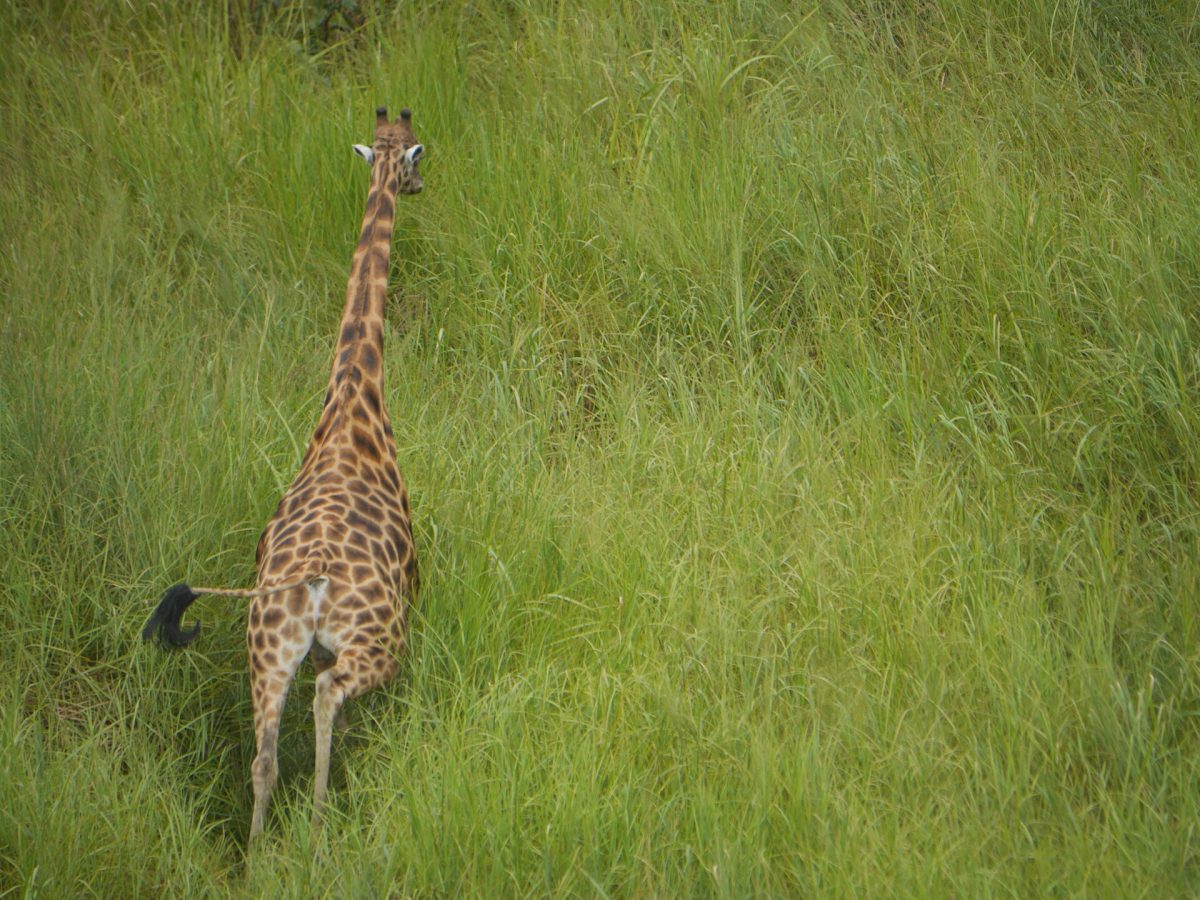
Its giraffes, of the Kordofan subspecies, the only giraffes in the Congo, were reduced to about forty. The poachers ranged from local hunters to rebel groups and, at times, men shooting from military helicopters; in January 2009 fighters of the Lord's Resistance Army, which had established itself in the park's forests, attacked the headquarters, killing ten staff and burning the buildings, and more than twenty rangers have been killed in the years since. From about 2016 a complete overhaul of the ranger force, with new training, aircraft, a communications network, collars on elephants and work with the surrounding communities, brought elephant poaching down by more than nine tenths, the giraffes have increased to more than seventy, and in 2023 sixteen southern white rhinoceroses were flown in from South Africa, to restore the species' ecological role. The park also holds buffalo in large herds, hippos in great numbers in the Dungu and Garamba rivers, lions, leopards, spotted hyenas, Lelwel's hartebeest, Uganda kob, waterbuck, roan antelope, chimpanzees in the forest fringes, and more than three hundred species of birds. At Gangala-na-Bodio, from the 1920s, the Belgians ran the only sustained attempt ever made to tame the African elephant, capturing young animals and training them, with the help of Indian mahouts at first, to pull carts and ploughs and to carry riders; the station and a few elderly elephants survived into recent times.
The park has a long rainy season, from about March or April to November, when the grass grows to its full height, the tracks become impassable and animals are almost impossible to see, and a dry season from December to March, when the grass is burned by the management in a planned mosaic, the ground dries, and game concentrates along the rivers on the fresh green regrowth; January and February are the practical months for a visit.
It is hot, 30 to 36 degrees, in the dry season, with dusty haze from the harmattan. The area is malarial, a yellow fever certificate is required for the country, and sleeping sickness is present, carried by tsetse flies in the gallery forests. No independent travel should be contemplated, and the security situation must be confirmed with the park's management immediately before any journey. Allow four to five days including the flights.
354 km away
Murchison Falls is Uganda's largest park and the one closest to Kampala for a proper savanna safari, about five…
35 tickets & tours
363 km away
Semuliki is a flat, steamy lowland forest on the floor of the western Rift Valley in the far west of Uganda, on the…
2 tickets & tours
No online tour for Garamba National Park is listed on GetYourGuide; entry, where it is charged, is paid at the gate or through the park authority. Nearby parks with bookable tours are listed on this page.
Allow four to five days including the flights.
Garamba National Park covers 5 000 km².
Garamba National Park was established in 1938.
Garamba National Park is in Democratic Republic of the Congo. The map on this page shows the exact spot.
Democratic Republic of the Congo
Virunga lies in the east of the Democratic Republic of the Congo, along the borders of Uganda and Rwanda, and it is the…
1 ticket or tour
Democratic Republic of the Congo
Kahuzi-Biega lies in the east of the Democratic Republic of the Congo, in the province of South Kivu, in the mountains…
No online ticket
Democratic Republic of the Congo
Salonga lies in the very centre of the Congo basin, in the Democratic Republic of the Congo, and it is the largest…
No online ticket