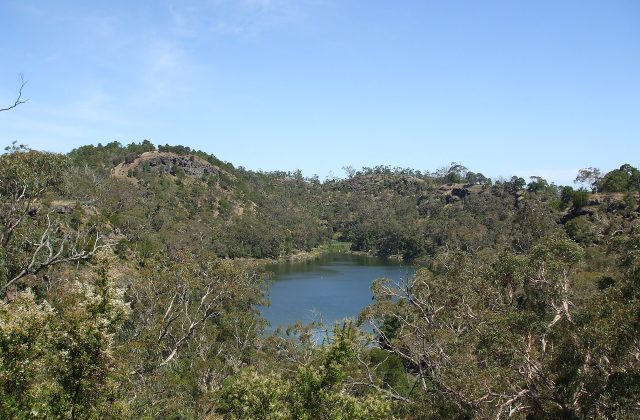
Budj Bim National Park
47 km away
Budj Bim, known until 2017 as Mount Eccles, is a small park round an extinct volcano in the basalt plains of…
1 ticket or tour
Volcano Park · Victoria · Australia
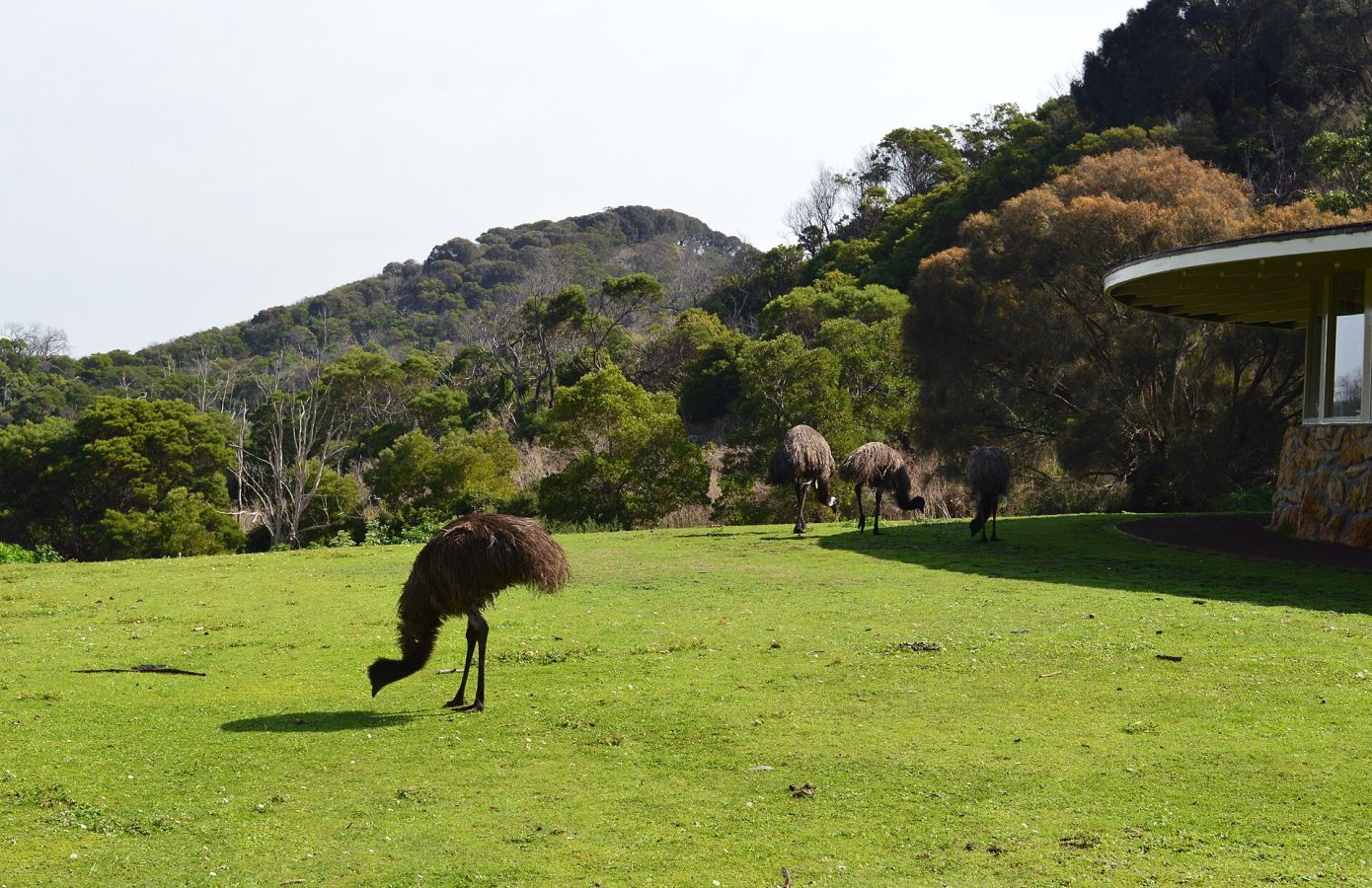
Photo: Mattinbgn (talk · contribs), CC BY 3.0
Tower Hill is an extinct volcano on the coast of south-western Victoria, fifteen kilometres west of the city of Warrnambool, at the far end of the Great Ocean Road, about 275 kilometres, three and a quarter hours by the inland highway, from Melbourne, and it is one of the best places in southern Australia to see koalas, emus and kangaroos living wild, at close quarters and without effort. The Princes Highway runs along the rim of its crater, from which a lookout gives the classic view down into it, and a one-way sealed road descends the inner wall, crosses a causeway over the crater lake, and ends at a car park and picnic ground on the central island, beside a small circular visitor centre. Entry is free, and the reserve is open during daylight. It makes a natural stop of two hours on the journey between the Twelve Apostles, an hour to the east, and the fishing village of Port Fairy, fifteen minutes to the west, and many of the Great Ocean Road tours of two or three days include it.
The visitor centre is run by a cooperative of the local Aboriginal community, which has a shop selling crafts and, at set times each day, offers guided walks of an hour or more, in which a guide points out the animals, explains the plants that were used for food and medicine and the way of life of the people of the district, and demonstrates the throwing of the boomerang; evening walks to look for nocturnal animals are also run. Five self-guided walking tracks start from the picnic ground, all short: the Peak climb, half an hour return up a steep path to the top of a cone, for a view over the crater, the farmland and the sea; the Lava Tongue boardwalk, through a reed swamp, for water birds; the Wagon Bay loop round an arm of the lake; the Journey to the Last Volcano; and the Hat Island habitat track. Emus stalk about the picnic tables hoping for scraps, and should not be fed.
Live prices from GetYourGuide for tours whose route includes this park. Free cancellation on most of them.
Tower Hill is one of the youngest and best preserved volcanoes of the newer volcanic province of western Victoria, a field of some four hundred vents scattered across the plains between Melbourne and the South Australian border. It is a maar, a broad, shallow crater blasted out about thirty-two to thirty-five thousand years ago, when molten rock rising beneath the coastal plain met water-saturated ground and produced a series of violent steam explosions; the debris, fine ash and fragments of the underlying limestone, fell back round the vent to form a low rim, whose layers, laid down by surge after surge, are beautifully exposed in the road cuttings, and the crater so formed, more than three kilometres long and two wide, is among the largest of its type in Australia. Later, quieter eruptions built a cluster of small scoria cones in its centre, which now stand as hilly islands in the shallow lake that fills the crater floor. People saw it happen: in the 1940s stone tools were found buried beneath the volcanic ash near by, and the Gunditjmara and their neighbours, in whose country it lies, have an oral tradition of the land on fire. When Europeans arrived, the crater was densely wooded with manna gum, blackwood, wattles, she-oaks and tea-tree, and it was set aside as a public park as early as 1866 and declared Victoria's first national park in 1892;
but the protection was nominal, and over the following sixty years it was stripped of its timber, grazed by cattle and goats, quarried for scoria, used as a rubbish tip and burned, until it was a bare, eroded hollow infested with rabbits and weeds. Its restoration is one of the earliest and most remarkable projects of its kind in the country. In 1855 the Viennese-born painter Eugene von Guerard, commissioned by a local landowner, had made a large and meticulously detailed oil painting of the crater as it then was, in which individual species of trees and plants can be identified; a century later, when the state's wildlife department took the reserve over, in 1961, botanists used the painting as their guide to what should be planted where, and over the following decades schoolchildren, volunteers and staff put in some three hundred thousand trees and shrubs. The forest has grown up, and koalas, emus, eastern grey kangaroos, swamp wallabies, echidnas, sugar gliders, brushtail and ringtail possums, which were reintroduced from the 1960s, and magpie geese and Cape Barren geese have all established themselves, while the lake and its reed beds attract black swans, chestnut teal, musk ducks, spoonbills, ibis, swamp harriers and many migratory waders, more than 160 species of birds having been recorded. The painting hangs in the art gallery at Warrnambool. The crater walls supply the rich volcanic soil of the surrounding potato and dairy farms, settled largely by Irish immigrants, whose village of Koroit lies on the northern rim.
The reserve is open every day from early morning until late afternoon or dusk, the visitor centre keeping shorter hours. It can be visited at any season. The animals are most active early in the morning and in the last two hours of the afternoon, when kangaroos come out to graze on the open slopes and koalas stir in the manna gums, and the low light shows up the layers of the crater wall; in the middle of a hot day the koalas are asleep in the forks of the trees and hard to spot. Spring, from September to November, brings wild flowers, emu chicks striped like humbugs, and nesting water birds;
summer, from December to February, is warm, 22 to 28 degrees, with the lake sometimes drying to mud in a drought and a risk of fire on hot, windy days, when the reserve may close; winter is cool, wet and green, with the lake full, and is the season when southern right whales calve off Logans Beach at Warrnambool, from June to September. Keep a respectful distance from emus and kangaroos, and do not feed anything. Allow two hours. Port Fairy is fifteen minutes away, Warrnambool and its maritime village fifteen, and the Budj Bim World Heritage landscape an hour to the north-west.
47 km away
Budj Bim, known until 2017 as Mount Eccles, is a small park round an extinct volcano in the basalt plains of…
1 ticket or tour
73 km away
Port Campbell National Park is a narrow strip of cliff-top heath along the south-west coast of Victoria, Australia, and…
1 ticket or tour
77 km away
The Twelve Apostles are the limestone sea stacks on the south-west coast of Victoria that serve as the climax of the…
5 tickets & tours
Yes. GetYourGuide sells tickets and guided tours whose route includes Tower Hill Wildlife Reserve; live prices are shown on this page.
Entry is free, and the reserve is open during daylight.
Entry is free, and the reserve is open during daylight.
Tower Hill Wildlife Reserve covers 6.2 km².
Tower Hill Wildlife Reserve was established in 1892.
Tower Hill Wildlife Reserve is in Victoria, Australia. The map on this page shows the exact spot.
Victoria, Australia
The Twelve Apostles are the limestone sea stacks on the south-west coast of Victoria that serve as the climax of the…
5 tickets & tours
Victoria, Australia
Alpine National Park is the largest park in Victoria, the high country of the Australian Alps between Mount Hotham,…
2 tickets & tours
Victoria, Australia
Budj Bim, known until 2017 as Mount Eccles, is a small park round an extinct volcano in the basalt plains of…
1 ticket or tour
Victoria, Australia
French Island lies in the middle of Western Port, the large, shallow, tidal bay seventy kilometres south-east of…
1 ticket or tour
Victoria, Australia
Port Campbell National Park is a narrow strip of cliff-top heath along the south-west coast of Victoria, Australia, and…
1 ticket or tour


