
Twelve Apostles Marine National Park
Victoria, Australia
The Twelve Apostles are the limestone sea stacks on the south-west coast of Victoria that serve as the climax of the…
5 tickets & tours
Volcano Park · Victoria · Australia
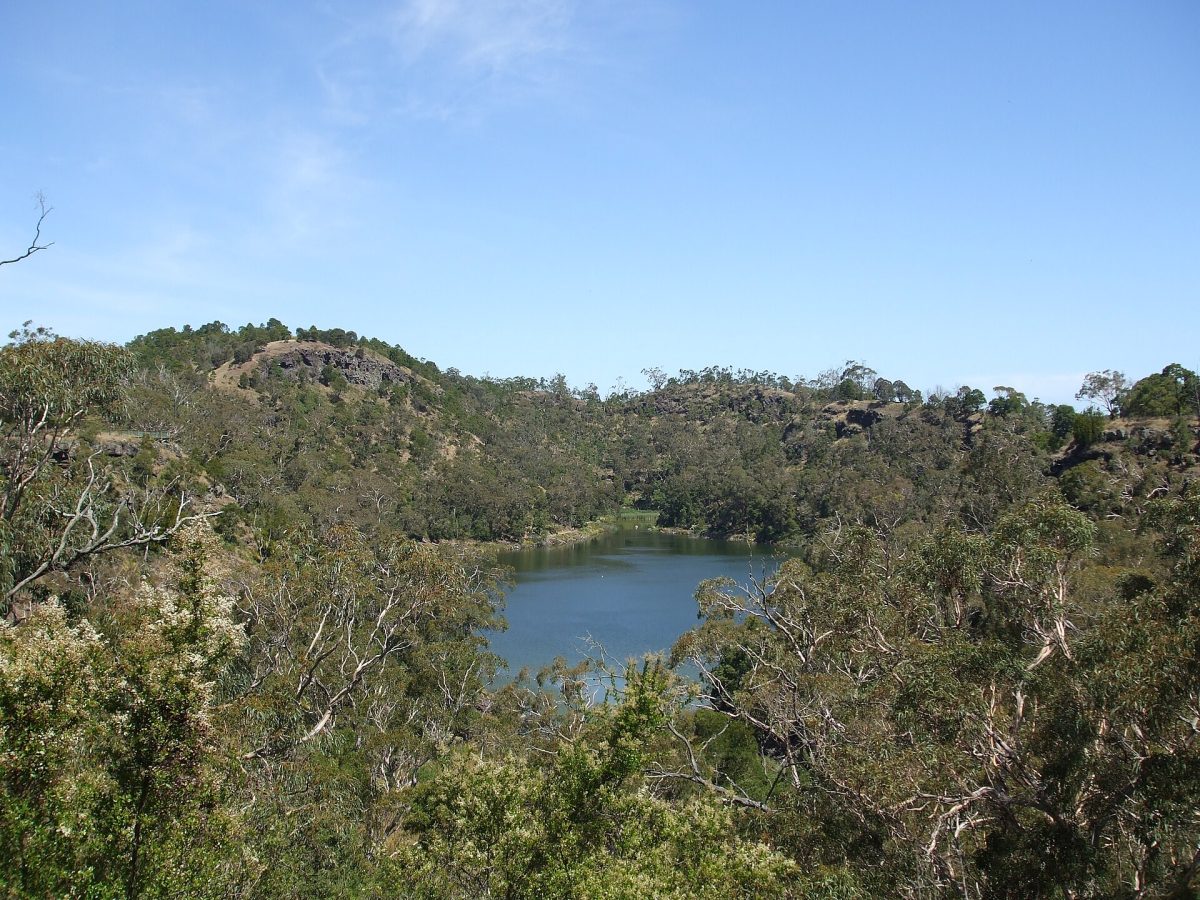
Budj Bim, known until 2017 as Mount Eccles, is a small park round an extinct volcano in the basalt plains of south-western Victoria, and it stands at the head of one of the most remarkable cultural landscapes in Australia, which since 2019 has been a World Heritage Site. It lies near the hamlet of Macarthur, about forty kilometres south of the country town of Hamilton, forty-five minutes inland from the fishing village of Port Fairy, and three and a half to four hours by road west of Melbourne, so that it fits naturally at the far end of a journey along the Great Ocean Road. There is no public transport. Entry to the national park is free, and it has a pleasant campground among the trees, picnic shelters and an information board, from which several short walks start. The crater rim walk, 2.6 kilometres, circles above the lake with views into the crater and over the plains;
the lake walk, two kilometres, descends by steps to the water's edge and goes round it; and the lava canal walk, a loop of about six kilometres, follows a trench left by a river of molten rock to the Natural Bridge, a roofed section of the channel, and returns past Tunnel cave, a lava tube into which one can walk some sixty metres with a torch. Koalas are seen in the trees on almost every visit. The park itself, however, shows only the natural half of the story. To understand the World Heritage landscape one should visit the Tae Rak aquaculture centre at Lake Condah, about twenty minutes' drive to the south-west, opened in 2022 and run by the Gunditjmara traditional owners, which has a cafe serving smoked eel and offers guided tours of two hours to a full day, booked in advance, to the ancient stone channels, fish traps and house sites on their land.
Live dates and prices from GetYourGuide. Free cancellation on most tickets.
The national park was created in 1960, as Mount Eccles, and covers 5,470 hectares, some fifty-five square kilometres, not the far larger figure found in some databases; it is jointly managed by the state and the Gunditjmara people, in whose language Budj Bim means high head, and with the adjoining Aboriginal-owned properties it forms the Budj Bim cultural landscape, the first place in Australia to be inscribed on the World Heritage list purely for its Aboriginal cultural values. The volcano is one of about four hundred in the newer volcanic province of western Victoria, the youngest volcanic field in Australia. It is a line of scoria cones and three overlapping craters, in which lies Lake Surprise, seven hundred metres long, deep, green and enclosed by wooded walls. Its eruption, which dating published in 2020 placed at about 37,000 years ago, sent a flow of basalt lava, the Tyrendarra flow, fifty kilometres south-west to the sea and beyond the present coast, blocking and rearranging the drainage of the whole district and creating a mosaic of swamps, lakes and stony rises. The Gunditjmara tell of an ancestral creator being who revealed himself in the landscape, his forehead forming the mountain and his teeth the scattered scoria, and the blood that flowed from them the lava; since people had already lived here for thousands of years when the eruption occurred, some scholars regard it as possibly the oldest surviving oral tradition in the world.
On the lava flow, beginning at least 6,600 years ago, the Gunditjmara built and maintained for thousands of years one of the oldest and largest aquaculture systems on earth. Using the abundant basalt blocks, they dug channels, some hundreds of metres long, to lead water from the swamps and Lake Condah into a series of ponds and holding basins, and constructed weirs and stone traps, fitted with long woven baskets, in which they caught, held and fattened the kooyang, the short-finned eel, which migrates up these streams from the sea; the eels were smoked in hollow trees and traded across the region. The reliable food supply supported a large, settled population, living in villages of circular stone huts with roofs of branches and turf, whose foundations survive in clusters of up to sixteen, which overturned the long-held assumption that all Aboriginal people had been wandering hunters. From the 1830s the Gunditjmara resisted the squatters who took their land in a guerrilla conflict of two decades, the Eumeralla wars, using the impassable stony rises as their refuge, and the survivors were gathered on a mission at Lake Condah; they won back title to parts of their country from the 1980s. A bushfire in the summer of 2019 to 2020 burned off the vegetation and revealed further channels not previously recorded. The park's manna gum woodland supports one of the densest populations of koalas in Victoria, together with eastern grey kangaroos, wallabies, echidnas, gliders and many birds.
The park is open all year. Spring, from September to November, with wild flowers and mild days, and autumn, from March to May, which is settled and clear, are the most pleasant seasons. The channels and traps of the aquaculture system are easiest to understand in winter and spring, from about June to October, when water is flowing through them, and the eels migrate downstream to the sea in autumn. Summer, from December to February, can be hot, up to 35 degrees, and dry, with a risk of grass and bush fires, on the worst days of which the park is closed;
winter is cool, wet and windy. The tours run by the traditional owners operate on fixed days and should be booked online ahead of a visit. Take a torch for Tunnel cave, watch for snakes in warm weather, and carry water on the lava canal walk. Allow two hours for the park and half a day for a cultural tour. Port Fairy is forty-five minutes away, the Tower Hill crater reserve near Warrnambool an hour, and the Grampians an hour and a half north.
Yes. GetYourGuide lists one ticket or tour for Budj Bim National Park, with live dates and prices and free cancellation on most of them.
Entry to the national park is free, and it has a pleasant campground among the trees, picnic shelters and an information board, from which several short walks start.
The park is open all year.
Allow two hours for the park and half a day for a cultural tour.
Budj Bim National Park covers 54.7 km².
Budj Bim National Park was established in 1960.
Budj Bim National Park is in Victoria, Australia. The map on this page shows the exact spot.
Victoria, Australia
The Twelve Apostles are the limestone sea stacks on the south-west coast of Victoria that serve as the climax of the…
5 tickets & tours
Victoria, Australia
Alpine National Park is the largest park in Victoria, the high country of the Australian Alps between Mount Hotham,…
2 tickets & tours
Victoria, Australia
French Island lies in the middle of Western Port, the large, shallow, tidal bay seventy kilometres south-east of…
1 ticket or tour
Victoria, Australia
Port Campbell National Park is a narrow strip of cliff-top heath along the south-west coast of Victoria, Australia, and…
1 ticket or tour
Victoria, Australia
Tower Hill is an extinct volcano on the coast of south-western Victoria, fifteen kilometres west of the city of…
No online ticket


