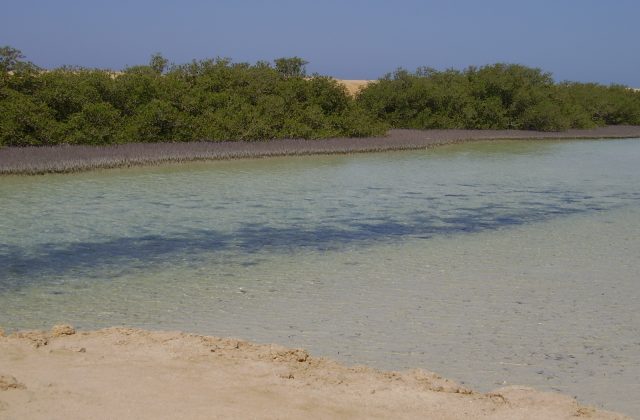
Ras Muhammad National Park
Egypt
Ras Muhammad is the headland at the very southern tip of the Sinai peninsula, in Egypt, where the gulfs of Suez and…
20 tickets & tours

Photo: Roland Unger, CC BY-SA 3.0
Wadi Al-Hitan, the valley of the whales, is a fossil site in the Western Desert of Egypt, in the governorate of Fayoum, about 150 kilometres, three to three and a half hours by road, south-west of Cairo, and it lies inside the larger protected area of Wadi El Rayan, of which it forms a special zone. No public transport goes anywhere near it, and the last thirty-five kilometres or so, beyond the Rayan lakes, are a graded desert track, corrugated, sandy in places and unsigned, which ordinary cars do manage with care but for which a four-wheel drive is wiser; nearly everyone therefore comes on a day tour by 4×4 from Cairo or from the lodges of Tunis village on Lake Qarun, leaving the capital at about seven in the morning and returning after dark.
The usual programme takes in, on the way, the two lakes of Wadi El Rayan and the low waterfalls between them, the viewpoint of Mudawara mountain and the so-called Magic Lake among the dunes, where people sandboard and swim, and reaches the whales for the middle or the end of the afternoon. An entrance fee for the protected area, and another for the site, are paid at the gates. At Wadi Al-Hitan there is a small, well-designed complex of domed, sand-coloured buildings, with a ticket office, a cafe, toilets, a museum and a shaded seating area, from which a marked walking trail, a loop of about three kilometres on firm sand and gravel, bordered with lines of stones, leads from one fossil to the next, each left where it was found and explained by a panel; it takes an hour and a half to two hours, in full sun. Vehicles are not allowed beyond the car park. Camping is permitted at a designated place near by, by arrangement with the rangers, and a night here, under a sky without any artificial light, is memorable.
Live dates and prices from GetYourGuide. Free cancellation on most tickets.
The site was inscribed on the World Heritage list in 2005, for the simple reason that nowhere else on earth shows so clearly one of the great transitions in the history of life, the return of the mammals to the sea. Between about forty and thirty-seven million years ago, in the late Eocene, this desert was a shallow bay of the Tethys, the ocean that then covered northern Egypt, fringed with mangroves, and in its quiet, warm water lived early whales, the archaeocetes, whose carcasses sank into the mud and sand and were buried. The wind has now stripped away the overlying rock, exposing them on the surface in extraordinary numbers, more than four hundred skeletons having been recorded, many of them complete and still articulated. Two species predominate. Basilosaurus isis was a serpentine giant, up to eighteen metres and more in length, with a small head, saw-edged teeth and an immensely elongated body, a top predator, whose name, king lizard, records the fact that its first discoverers, in America in the 1830s, took it for a reptile; Dorudon atrox was a compact, dolphin-like animal of about five metres, whose young, to judge by the tooth marks on their skulls, Basilosaurus hunted in what seems to have been a calving ground.
The bones were first noticed by Hugh Beadnell of the Geological Survey of Egypt in the winter of 1902 to 1903, but the place was so remote that it was barely visited again until the 1980s, when Philip Gingerich of the University of Michigan began the work that made it famous. In 1989 his team found what nobody had seen before, the hind limbs of Basilosaurus: tiny but perfectly formed legs, with a thigh bone, a knee with a kneecap, an ankle, a foot and toes, on an animal the length of a bus, useless for walking and long since functionless, or at most an aid in mating, and proof, as clear as could be wished, that whales descend from four-legged land mammals. With the whales are the remains of three kinds of sea cow, of sawfish, sharks, rays, bony fish, turtles, crocodiles and sea snakes, and the fossilised roots of the mangroves themselves, together with the primitive elephant relative Moeritherium. The Fossils and Climate Change Museum, a low dome half sunk in the sand, opened in 2016, has as its centrepiece a complete Basilosaurus skeleton eighteen metres long, the only one on display in the world with its hind legs in place. The setting is as fine as the fossils, a landscape of golden sand, cream and yellow cliffs, and rocks carved by the wind into mushrooms, domes and balls.
The site is open daily from about 8 am to sunset. The season is from October to April, when days are warm, 20 to 28 degrees, and nights cold, near freezing in January; from May to September the desert is extremely hot, above 40 degrees, there is no shade on the trail, and a visit should be made only in the first hours of the morning or the last of the afternoon, which is in any case when the low light brings out the forms of the rocks and the bones.
The khamsin, a hot, sand-laden wind, blows on some days in March and April. Fridays and Egyptian holidays bring crowds from Cairo to the Rayan waterfalls, though far fewer reach the whales. Bring plenty of water, a hat, sunscreen, closed shoes and a jacket for the evening, and do not touch or step over the stone borders. Allow a full day. The Rayan lakes are forty-five minutes away, the potters' village of Tunis and Lake Qarun an hour and a half, and the pyramids of Meidum and Hawara on the way back.
Yes. GetYourGuide lists 2 tickets and tours for Wadi Al-Hitan (Whale Valley), with live dates and prices and free cancellation on most of them.
An entrance fee for the protected area, and another for the site, are paid at the gates.
The site is open daily from about 8 am to sunset.
Wadi Al-Hitan (Whale Valley) covers 200 km².
Wadi Al-Hitan (Whale Valley) was established in 2005.
Wadi Al-Hitan (Whale Valley) is in Egypt. The map on this page shows the exact spot.
Egypt
Ras Muhammad is the headland at the very southern tip of the Sinai peninsula, in Egypt, where the gulfs of Suez and…
20 tickets & tours
Egypt
Wadi El Gemal, the valley of the camels, is a large protected area on the Red Sea coast of southern Egypt, beginning…
1 ticket or tour
