Cape Point Nature Reserve
Western Cape, South Africa
Cape Point and the Cape of Good Hope form the southern tip of the Cape Peninsula, the mountainous finger of land that…
154 tickets & tours
Desert Park · Western Cape · South Africa
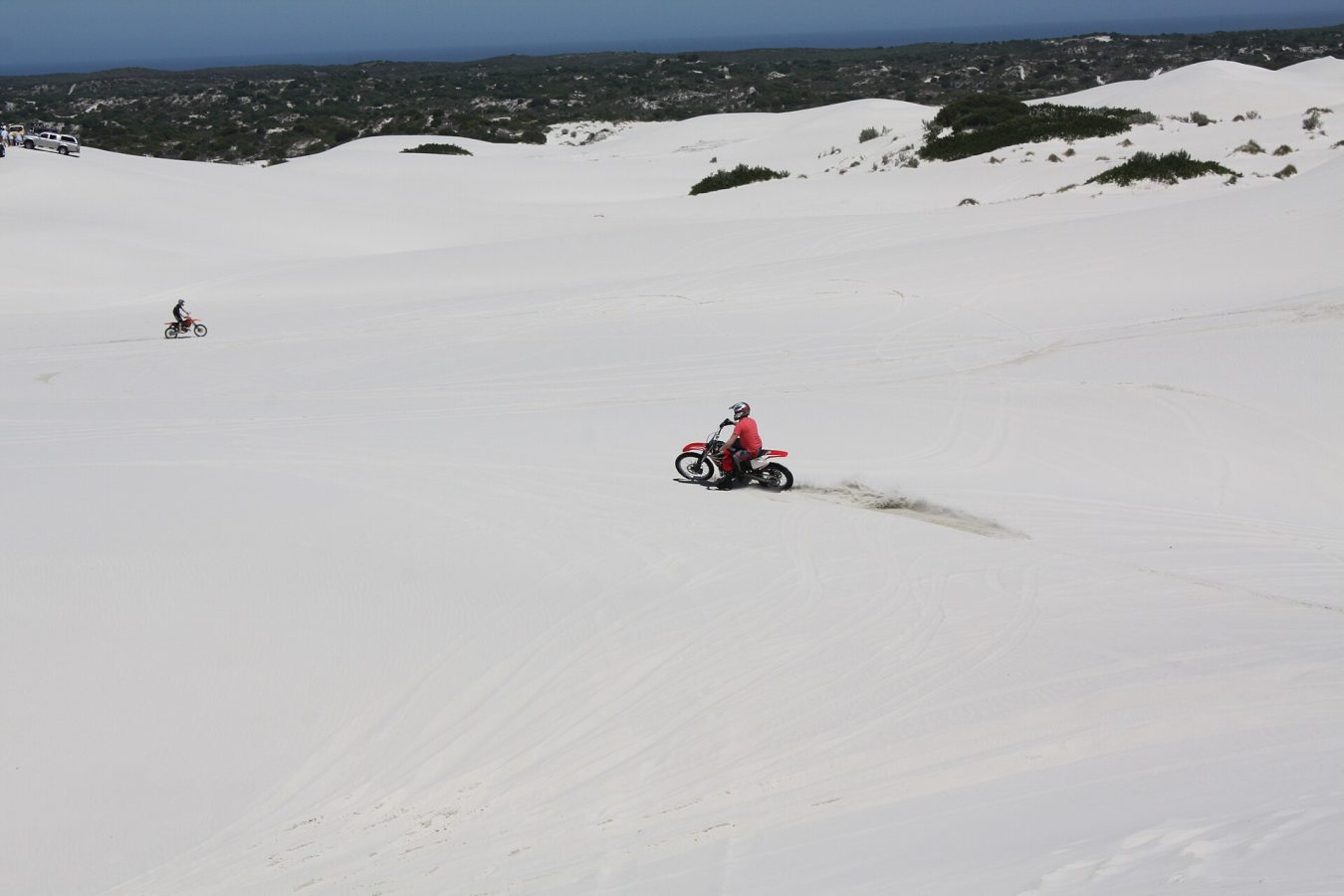
Photo: AntonieJ, CC BY-SA 3.0
Witzands is a municipal nature reserve on the Atlantic coast about forty-five kilometres north of the centre of Cape Town, beside the town of Atlantis, and to almost everyone who goes there it means one thing, the Atlantis dunes, a field of tall, bare, brilliantly white sand dunes, with Table Mountain on the horizon, which has become the city's playground for sandboarding, quad biking and four-wheel driving, and a favourite location for photographers and for the makers of films and advertisements. It is reached in forty-five minutes to an hour by the R27, the West Coast road, turning inland towards Atlantis and then off on Dassenberg Drive to the reserve gate; there is no public transport, and the great majority of visitors come on a half-day excursion from Cape Town, which includes transport, the permit, equipment and an instructor. The activities on offer are these.
Sandboarding, the most popular, is done on boards like snowboards, standing up, or lying down on a bodyboard for those who prefer, on slopes chosen to suit beginners or the more confident, there being no lifts, so that every descent is paid for by a climb on foot back up the soft sand; sessions last two to three hours. Guided quad bike tours of an hour or two ride in convoy over the dunes, with a minimum age for drivers and with children carried as passengers, and the two are often combined. Drivers of their own four-wheel-drive vehicles and off-road motorcycles may use the designated dune area with a permit, which must be bought in advance from the City of Cape Town's offices or online and is not sold at the gate, and they should let down their tyres, carry recovery equipment and go in company. Permits are likewise needed for private sandboarding and for any commercial photography. The rest of the reserve, including the coastal resort of Silwerstroomstrand, with a tidal pool, campsite and picnic areas, has walking paths through the dune vegetation and along the shore.
Live dates and prices from GetYourGuide. Free cancellation on most tickets.
All 213 park tours in the Western Cape → · 31 tours from Cape Town →
The reserve, which belongs to the City of Cape Town, covers some three thousand hectares and takes its name, the white sands aquifer, from its original and still its chief purpose, which is not recreation or even conservation but water. Beneath the dunes lies the Atlantis aquifer, a body of groundwater held in the deep sands, which has supplied the town of Atlantis and its industries since the 1970s. Atlantis was founded in that decade by the apartheid government as a new industrial town for people classified as coloured, removed from Cape Town, far from the city and from any river, and the engineers who planned its water supply devised a system that was decades ahead of its time and is still studied abroad: the town's storm water and its treated waste water are led to large basins among the dunes, from which they seep down through the sand, which filters and purifies them, to recharge the aquifer, from which the water is pumped up again through boreholes for use, a closed cycle that has carried the town through droughts, including the severe one of 2015 to 2018, when Cape Town came within weeks of running dry. The dunes and the vegetation round them protect the recharge area, which is why they were reserved. The dune field itself, about five hundred hectares of shifting, unvegetated sand, in crescent-shaped dunes up to some fifty metres high, is a natural feature, formed of fine quartz and shell sand blown inland from the beach by the strong south-westerly and southerly winds, and it has been moving slowly north-eastwards for thousands of years;
its whiteness, which dazzles in sunlight and turns gold and pink at the ends of the day, comes from the purity of the sand. Round it grow two of the most threatened types of vegetation in the Cape floral kingdom, the Atlantis sand fynbos, a low heath of restios, ericas and proteas on acid sand, of which very little survives outside this reserve, and the Cape Flats dune strandveld, a dense, fragrant coastal scrub on limy sand, most of which has been built over by the expansion of Cape Town; between them they hold several hundred species of plants, a number of them found nowhere else, which flower mainly from August to October. The reserve adjoins the larger Koeberg nature reserve, which surrounds South Africa's only nuclear power station, and with it forms a corridor of natural coast. Its animals include the steenbok, the grysbok, the common duiker, the caracal, the Cape fox, the porcupine, the honey badger, the angulate tortoise, the puff adder, the Cape cobra and the mole snake, and its birds the black harrier, a rare raptor of the fynbos, the southern black korhaan, the Cape francolin, the African black oystercatcher on the shore, and terns and cormorants. Southern right whales and dolphins are seen from Silwerstroomstrand, and shell middens along the coast testify to the thousands of years during which the Khoi and the San gathered shellfish here.
The dunes are open daily during the day, the permit office and the operators keeping their own hours, and the activities run all year. The Cape has dry, warm, windy summers, from November to March, and cool, wet winters, from June to August. In summer the sand becomes very hot by midday and the south-easter can blow hard in the afternoon, driving sand into eyes and equipment, so that morning sessions are much the better; in winter the sand, dampened by rain, is firmer and faster for boarding, the air is clear, and the days between the cold fronts are often calm and bright.
Spring, from August to October, adds the wild flowers of the surrounding fynbos and the whales offshore. The light is best, and the heat least, in the first two hours after sunrise and the last before sunset. Bring sunglasses, sunscreen, a hat, plenty of water, a scarf or buff against blowing sand, and a sealed bag for cameras and telephones; wear socks for boarding. Do not drive or walk outside the designated area. Allow half a day. Cape Town is an hour away, and the West Coast National Park forty-five minutes further north.
Yes. GetYourGuide lists 32 tickets and tours for Witzands Aquifer Nature Reserve, with live dates and prices and free cancellation on most of them.
The dunes are open daily during the day, the permit office and the operators keeping their own hours, and the activities run all year.
Witzands Aquifer Nature Reserve covers 30 km².
Witzands Aquifer Nature Reserve is in Western Cape, South Africa. The map on this page shows the exact spot.
Western Cape, South Africa
Cape Point and the Cape of Good Hope form the southern tip of the Cape Peninsula, the mountainous finger of land that…
154 tickets & tours
Western Cape, South Africa
Aquila is the Big Five game reserve two hours from Cape Town in the Karoo hills above Worcester, and it exists for one…
16 tickets & tours
Western Cape, South Africa
Jonkershoek is a mountain valley that begins ten kilometres, fifteen minutes'
4 tickets & tours
Western Cape, South Africa
The West Coast National Park lies on the Atlantic coast of South Africa about a hundred and twenty kilometres north of…
3 tickets & tours
Western Cape, South Africa
Helderberg is a small municipal nature reserve on the mountain slope directly above the town of Somerset West, at the…
2 tickets & tours
Western Cape, South Africa
Stony Point is a small rocky headland in the seaside village of Betty's Bay, on the coast of the Overberg, east of…
2 tickets & tours