Cape Point Nature Reserve
Western Cape, South Africa
Cape Point and the Cape of Good Hope form the southern tip of the Cape Peninsula, the mountainous finger of land that…
154 tickets & tours
Marine Park · Western Cape · South Africa
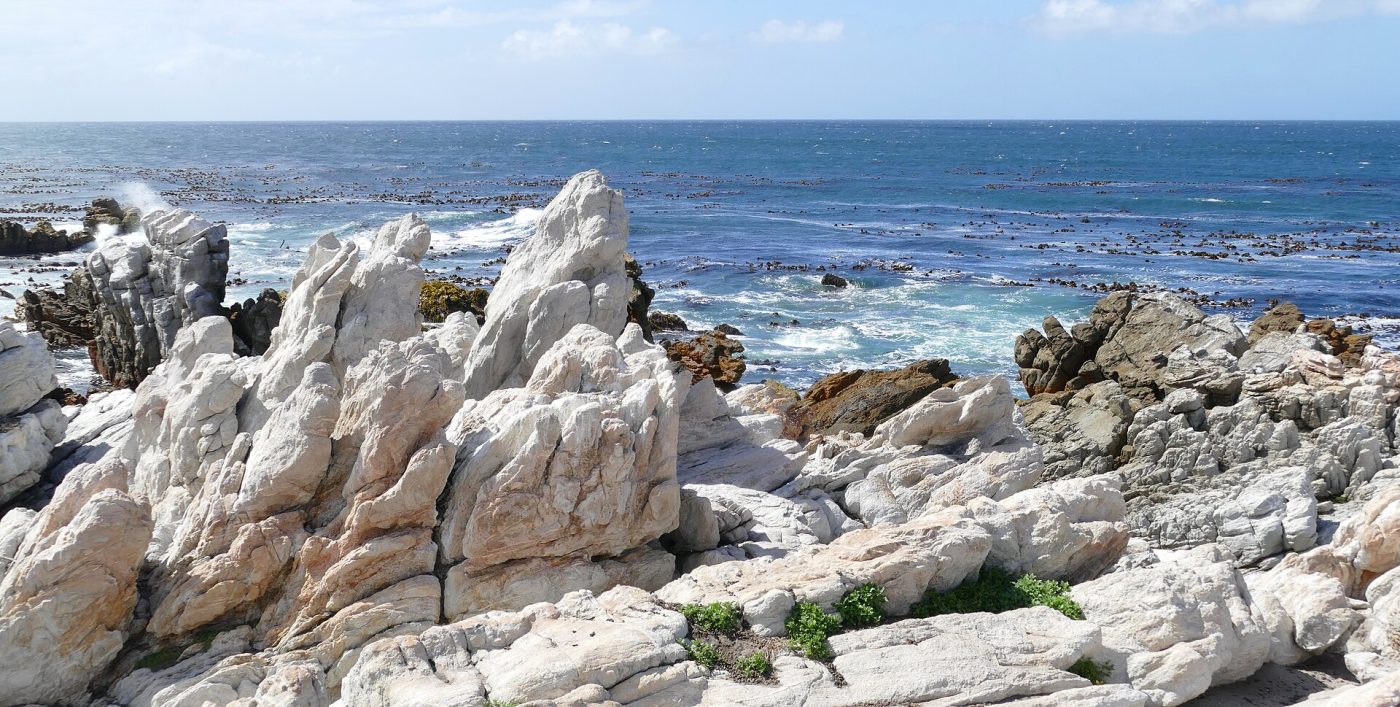
Photo: Bernard DUPONT from FRANCE, CC BY-SA 2.0
Stony Point is a small rocky headland in the seaside village of Betty's Bay, on the coast of the Overberg, east of Cape Town, and it is the home of one of only two colonies of African penguins on the mainland of South Africa, the other, far better known and far more crowded, being at Boulders beach on the Cape Peninsula. It lies about ninety kilometres, an hour and a half by road, from the centre of Cape Town, and half the pleasure of going is the way there: beyond Gordon's Bay the coast road, Clarence Drive, runs for some twenty kilometres along a ledge between the mountains of the Kogelberg and the open sweep of False Bay, one of the finest coastal drives in the country, from whose lay-bys whales are watched in season. There is no public transport, and visitors come by hire car or on day tours of the whale coast, which commonly combine the penguins with the botanical garden near by and the town of Hermanus, forty minutes further on.
The reserve is managed by CapeNature, the provincial conservation agency, which charges a small entrance fee at a kiosk beside the car park, where there are toilets and, in the old whaling station buildings, a community-run restaurant. The visit is simple and takes about an hour. A raised wooden boardwalk, a few hundred metres long and suitable for wheelchairs and pushchairs, runs out along the point through the middle of the colony, so that the birds, which have no fear of people on the walkway, nest, preen, quarrel, bray and waddle to and from the sea within arm's length on either side, while signboards explain their lives; visitors may not leave the boardwalk or touch the birds, whose beaks are sharp. The rocks at the end of the point are crowded with cormorants, and rock hyraxes sun themselves on the boulders.
Live dates and prices from GetYourGuide. Free cancellation on most tickets.
The African penguin, the only penguin that breeds on the African continent, is a bird of the cold, fish-rich Benguela current, black and white, with a black band across the chest, a pattern of spots as individual as a fingerprint, and a patch of bare pink skin above the eye that helps it to lose heat; its loud, donkey-like bray gave it the older name of jackass penguin. It normally breeds on offshore islands, where it is safe from land predators, and the founding of a colony on the mainland was unexpected: a few pairs settled at Stony Point in 1982, at about the same time as the first arrived at Boulders, perhaps because the fish on which they depend had shifted eastwards, and the colony grew over the following decades to become one of the largest anywhere, at its height some two thousand breeding pairs. Its early years were precarious, since a leopard from the mountains behind killed dozens of birds in a single night on more than one occasion, and fences, and the presence of people, now keep leopards, caracals, mongooses and dogs at bay. The penguins dig their nest burrows in the sandy soil under the bushes, or use the artificial nest boxes of fibreglass and ceramic that conservationists have set out in rows, since the deep beds of guano in which the species used to burrow were scraped from its breeding islands in the nineteenth century for fertiliser. The story of the species as a whole is a grim one. There were perhaps a million and a half African penguins at the beginning of the twentieth century;
the collecting of their eggs as a delicacy, the removal of guano, oil spills, and, above all in recent decades, the collapse of the stocks of sardine and anchovy, through overfishing and changes in the ocean, have reduced them by some ninety-seven per cent, to fewer than ten thousand breeding pairs, and in 2024 the species was classified as critically endangered, with predictions that it could be extinct in the wild within a decade or so unless fishing round its colonies is restricted, a matter that has been fought over in the South African courts. Stony Point is one of six colonies round which fishing closures have been ordered. The headland is also the only place in the world where three species of cormorant found only in southern Africa, the Cape, the bank and the crowned cormorant, breed side by side, together with the white-breasted cormorant, and kelp gulls, Hartlaub's gulls, African black oystercatchers and terns are always about. Between 1913 and 1930 the point was the site of the Waaygat whaling station, a Norwegian enterprise, to which catcher boats towed southern right, humpback and other whales to be flensed and boiled down; the concrete slipway, the rusting boilers and the hull of a whale catcher wrecked on the rocks are still there, and the whales, protected since 1935, have returned to calve in these bays. Behind the village rise the mountains of the Kogelberg biosphere reserve, the heart of the Cape floral kingdom, with some sixteen hundred species of plants, more than in any area of comparable size on earth.
The reserve is open daily, from about eight in the morning to half past four in the afternoon. Penguins are present throughout the year, but their numbers on land vary with their annual cycle: breeding takes place mainly from about February to September, with the greatest activity and the most chicks from March to June; from about November to January the adults come ashore to moult, standing about for three weeks, scruffy and unable to feed, while they replace their feathers;
and at other times many birds are away at sea by day, leaving at first light and returning in the late afternoon, so that the early morning and the last hour before closing are the best times to see them in numbers. Southern right whales are in the bay from about June to November, with the peak in September and October. The Cape summer, from November to March, is warm, dry and windy, the south-easter blowing hard across the point; winter is cool, with rain and storms but also many fine days. The colony smells strongly of fish. Bring a windproof and binoculars. Allow an hour. The Harold Porter botanical garden is five minutes away, Kleinmond fifteen, and Hermanus forty.
Yes. GetYourGuide lists 2 tickets and tours for Stony Point Nature Reserve, with live dates and prices and free cancellation on most of them.
The reserve is managed by CapeNature, the provincial conservation agency, which charges a small entrance fee at a kiosk beside the car park, where there are toilets and, in the old whaling station buildings, a community-run restaurant.
The reserve is open daily, from about eight in the morning to half past four in the afternoon.
Stony Point Nature Reserve is in Western Cape, South Africa. The map on this page shows the exact spot.
Western Cape, South Africa
Cape Point and the Cape of Good Hope form the southern tip of the Cape Peninsula, the mountainous finger of land that…
154 tickets & tours
Western Cape, South Africa
Witzands is a municipal nature reserve on the Atlantic coast about forty-five kilometres north of the centre of Cape…
32 tickets & tours
Western Cape, South Africa
Aquila is the Big Five game reserve two hours from Cape Town in the Karoo hills above Worcester, and it exists for one…
16 tickets & tours
Western Cape, South Africa
Jonkershoek is a mountain valley that begins ten kilometres, fifteen minutes'
4 tickets & tours
Western Cape, South Africa
The West Coast National Park lies on the Atlantic coast of South Africa about a hundred and twenty kilometres north of…
3 tickets & tours
Western Cape, South Africa
Helderberg is a small municipal nature reserve on the mountain slope directly above the town of Somerset West, at the…
2 tickets & tours