Scandola Nature Reserve
France
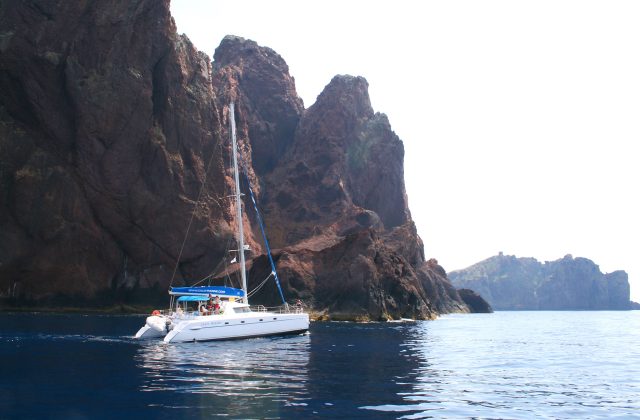
Scandola is the red-rock peninsula on the west coast of Corsica, and the reserve is closed to walkers and to anchoring,…
17 tickets & tours

Photo: Vi..Cult..., CC BY-SA 3.0
The Alpilles are a small range of jagged white limestone hills in the heart of Provence, rising abruptly from the plain between Avignon, half an hour to the north, and Arles, twenty minutes to the south-west, and their regional park is a lived-in landscape of olive groves, vineyards, pine woods and famous villages, with no gates and nothing to pay. It is explored by car, bicycle or on foot from Saint-Rémy-de-Provence, on the northern side, or from Les Baux, Maussane and Eygalières, and there is little public transport beyond a few buses from Avignon and Arles to Saint-Rémy. A sensible day takes in Saint-Rémy, with the Roman arch and mausoleum of the Antiques standing beside the road, the excavated Greco-Roman town of Glanum next to them, and the monastery asylum of Saint-Paul-de-Mausole, where Van Gogh was a patient;
then the road over the crest to Les Baux-de-Provence, a ruined citadel on a rock spur, and the Carrières des Lumières, an immense disused quarry in which digital art shows are projected onto the walls, for which tickets should be reserved in summer. The 4×4 tours from Arles follow farm and forest tracks closed to ordinary traffic, with stops at an olive mill or a vineyard. Guided walks from Saint-Rémy follow the traces of Van Gogh into the hills behind the asylum, past the quarries and olive groves he painted. Walkers have a good network of waymarked paths, including the long-distance GR6 along the crest, the ascent of La Caume and the loop round the lake of Peiroou; electric bicycles are hired in Saint-Rémy. In summer, read the fire notices before setting out.
Live dates and prices from GetYourGuide. Free cancellation on most tickets.
The Parc naturel régional des Alpilles was created in 2007 and covers about 510 square kilometres, sixteen communes of the department of Bouches-du-Rhône, with some 45,000 inhabitants. The range itself is small, about twenty-five kilometres long from west to east and eight wide, and low, its highest point, the Tour des Opies, reaching only 498 metres, but it looks far more mountainous than it is, a crest of bare, pale, fretted Cretaceous limestone, like a miniature Alps, which is what its name means, standing over a sea of silvery olive trees and dark cypress windbreaks, under the hard light and the mistral of the lower Rhône. The garrigue of its slopes, kermes oak, rosemary, thyme, rockrose and Aleppo pine, shelters some of the rarest birds of prey in France: Bonelli's eagle, of which a few of the country's thirty or so pairs nest here, the Egyptian vulture, the eagle owl and the short-toed eagle, with rollers and bee-eaters in the farmland, ocellated lizards and scores of orchids.
At Les Baux, the lords of the Middle Ages claimed descent from Balthazar, one of the Magi, held a court famous for its troubadours, and terrorised the country until Louis XI had the castle dismantled; in 1821 the geologist Pierre Berthier identified, in the red rock nearby, the aluminium ore that he named bauxite after the village. The valley below produces olive oil with a protected designation, from the mills of Maussane and Mouriès, and wines of the Baux appellation. Vincent van Gogh arrived at the asylum of Saint-Paul on 8 May 1889 and stayed a year, in which he painted about a hundred and fifty canvases, among them The Starry Night, the Irises, the wheat fields, olive groves and cypresses, with the ragged line of the Alpilles in the background of many; reproductions stand along a marked walk at the places where he set up his easel. Nostradamus was born at Saint-Rémy in 1503, Alphonse Daudet set his Letters from My Windmill at Fontvieille, and the Roman aqueduct and sixteen-wheeled flour mill of Barbegal, the largest known industrial complex of the ancient world, lie at the range's southern foot.
The park is open at all times. April to June and September to October are the best months, with wild flowers, mild temperatures and clear light; July and August are very hot, crowded at Les Baux and Saint-Rémy, and above all subject to fire regulations: from 1 June to 30 September access to the massif is governed by a daily risk level published the evening before by the prefecture, and on the many days of high risk the paths are closed from late morning or altogether.
Winter is quiet, bright and, when the mistral blows, bitterly cold, with the olive harvest in November and December and, at Christmas, the shepherds' midnight mass at Les Baux. Wednesday is market day in Saint-Rémy. Allow one to two days. Arles and its Roman monuments are twenty minutes away, Avignon half an hour, the Camargue forty-five minutes, and the Pont du Gard an hour.
Yes. GetYourGuide lists 2 tickets and tours for Alpilles Regional Natural Park, with live dates and prices and free cancellation on most of them.
The park is open at all times.
Allow one to two days.
Alpilles Regional Natural Park covers 510 km².
Alpilles Regional Natural Park was established in 2007.
Alpilles Regional Natural Park is in France. The map on this page shows the exact spot.
France
Scandola is the red-rock peninsula on the west coast of Corsica, and the reserve is closed to walkers and to anchoring,…
17 tickets & tours
France
The national park covers the mountainous interior of Réunion, the French island in the Indian Ocean east of Madagascar,…
15 tickets & tours
France
The Camargue is the Rhône delta south of Arles, an hour from Avignon and Montpellier, and its regional park is visited…
14 tickets & tours
France
The Verdon gorge is the deepest and most spectacular river canyon in France, in the hills of Haute-Provence between the…
4 tickets & tours
France
Port-Cros is one of the three Îles d'Hyères, the Golden Isles, off the coast of the Var between Toulon and…
3 tickets & tours
France
The nature reserve of the Bouches de Bonifacio covers the waters, islands and coast of the extreme south of Corsica, on…
1 ticket or tour