Sydney Harbour National Park
New South Wales, Australia
Sydney Harbour National Park is not one place but a scatter of headlands, beaches and islands around Port Jackson, and…
19 tickets & tours
Canyon Park · New South Wales · Australia

Photo: Adam.J.W.C., CC BY-SA 3.0
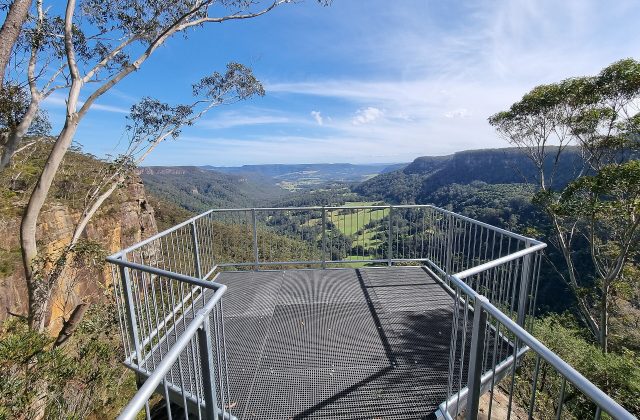
The Blue Mountains begin about sixty kilometres west of the centre of Sydney, and their national park, a vast wilderness of sandstone cliffs, forested valleys and waterfalls, is the most visited in New South Wales and the classic day excursion from the city. They are reached by car along the Great Western Highway in an hour and a half to two hours, by countless coach tours, or, very conveniently, by the electric trains that leave Sydney's Central station about every hour and take two hours to Katoomba, the chief town, stopping at all the villages strung along the ridge; at Katoomba a hop-on hop-off bus links the station with the lookouts. The park is free, apart from a vehicle fee in the Glenbrook section. It must be understood that the towns lie on top of a narrow plateau and the park lies below and around them, so that every visit begins at a cliff edge.
At Katoomba, Echo Point gives the celebrated view of the Three Sisters and the Jamison valley, and from it the Giant Stairway, some nine hundred steps cut and bolted into the cliff, descends to the valley floor, where a track through rainforest leads to the foot of the Scenic Railway, by which, or by a cable car, one can ride back up; the railway, skyway and cableway belong to a private attraction with its own ticket. Easier cliff-top walks run along the rim in both directions, and at Wentworth Falls a circuit of tracks visits the falls and the ledges cut into the cliff face. Blackheath, twenty minutes further west, is the centre for the grander northern side: Govetts Leap and Evans lookouts over the Grose valley, and the Grand Canyon track, a loop of six kilometres and three to four hours down through a fern-filled slot and back, the finest half-day walk in the mountains. Guided canyoning and abseiling are local specialities.
Live dates and prices from GetYourGuide. Free cancellation on most tickets.
All 119 park tours in New South Wales → · 45 tours from Sydney →
The national park was reserved in 1959 and has grown to about 2,690 square kilometres; since 2000 it has been the centrepiece of the Greater Blue Mountains World Heritage area, eight adjoining reserves covering more than a million hectares. They are not mountains but a plateau of Triassic sandstone, tilted gently up to about 1,100 metres, into which the rivers have cut valleys up to 760 metres deep, walled by vertical orange cliffs, so that the scenery is below the visitor, not above him. The blueness is real: the forests consist almost entirely of eucalypts, whose leaves give off fine droplets of volatile oil, which with dust and water vapour scatter the short wavelengths of light and veil the distance in a blue haze. The World Heritage listing rests on those trees. The area holds more than ninety species of eucalypt, about a seventh of all that exist, growing in every form from tall wet forest in the gorges to stunted mallee on the exposed ridges, and illustrates how the genus diversified as Australia dried out; with them grow relict species from the age of Gondwana, above all the Wollemi pine, a tree known only from fossils up to two hundred million years old until a bushwalker, David Noble, abseiled into a remote canyon of the neighbouring Wollemi park in 1994 and found fewer than a hundred of them alive, whose location remains secret and which were saved from the fires of 2019 by a special firefighting operation.
The Three Sisters, three pinnacles of weathered sandstone more than nine hundred metres above sea level, are in the story usually told three sisters of the Katoomba people, turned to stone by a sorcerer to protect them in a tribal battle, who was killed before he could reverse the spell, though the legend's authenticity is doubted; the mountains are the country of the Gundungurra and Darug peoples, whose hand stencils can be seen at Red Hands cave near Glenbrook. To the first colonists at Sydney the range was an impassable barrier, since every valley they followed ended in a cliff, until in 1813 Blaxland, Lawson and Wentworth succeeded by keeping to the ridge tops, the route still followed by road and railway. Coal and oil shale were mined in the Jamison valley from the 1870s, and the Scenic Railway, with an incline of fifty-two degrees the steepest passenger railway in the world, was the miners' haulage. From the 1880s the mountains became Sydney's hill station, and the walking tracks, stairways and lookouts, many cut by hand into the cliffs, date from that era. In 1931 a group of bushwalkers raised the money to buy out a lease and save the Blue Gum forest in the Grose valley from the axe, an act regarded as the beginning of the conservation movement in New South Wales. The fires of the summer of 2019 to 2020 burned some four fifths of the World Heritage area. Lyrebirds, yellow-tailed black cockatoos, king parrots, swamp wallabies, grey kangaroos, wombats, spotted-tailed quolls and glow-worms inhabit the park.
The park is open all year, and the climate is cooler than Sydney's by five to eight degrees. Spring, from September to November, with wild flowers and the gardens of Leura in bloom, and autumn, from March to May, with clear air and the colours of the introduced trees in the villages, are the best seasons for walking. Summer, from December to February, is warm, up to 30 degrees, with thunderstorms and, in dry years, a serious danger of bushfire, when the park may be closed entirely on days of extreme risk;
winter, from June to August, is cold, often close to freezing at night, with occasional snow and the sharpest views, and the hotels celebrate a mock Christmas in July. Mist frequently fills the valleys or hides them, particularly in the mornings. Echo Point is crowded from about ten to three, when the coaches are there. Tracks are closed from time to time by rockfalls and landslips, so check the parks website before setting out. Carry water and warm clothing. Allow a day, better two. The Jenolan caves are an hour and a half beyond Katoomba.
Yes. GetYourGuide lists 92 tickets and tours for Blue Mountains National Park, with live dates and prices and free cancellation on most of them.
The park is open all year, and the climate is cooler than Sydney's by five to eight degrees.
Allow a day, better two.
Blue Mountains National Park covers 2 693 km².
Blue Mountains National Park was established in 1959.
Blue Mountains National Park receives about 8.4 million a year (2018).
Blue Mountains National Park is in New South Wales, Australia. The map on this page shows the exact spot.
New South Wales, Australia
Sydney Harbour National Park is not one place but a scatter of headlands, beaches and islands around Port Jackson, and…
19 tickets & tours
New South Wales, Australia
The Royal National Park lies on the southern edge of Sydney, its northern boundary only about thirty kilometres, under…
5 tickets & tours
New South Wales, Australia
Ku-ring-gai Chase is a large park of sandstone bushland and drowned river valleys on the northern edge of Sydney, only…
2 tickets & tours
New South Wales, Australia
Worimi National Park forms part of the Worimi Conservation Lands, which protect the Stockton Bight dunes, an immense…
1 ticket or tour
New South Wales, Australia
Budderoo lies on and beneath the sandstone escarpment of the Illawarra, on the south coast of New South Wales, about…
No online ticket
New South Wales, Australia
Morton is a very large park of sandstone plateaus, deep forested gorges and waterfalls on the escarpment of the…
No online ticket