Blue Mountains National Park
New South Wales, Australia
The Blue Mountains begin about sixty kilometres west of the centre of Sydney, and their national park, a vast…
92 tickets & tours
Marine Park · New South Wales · Australia

Photo: Oliver Revis, CC BY-SA 4.0
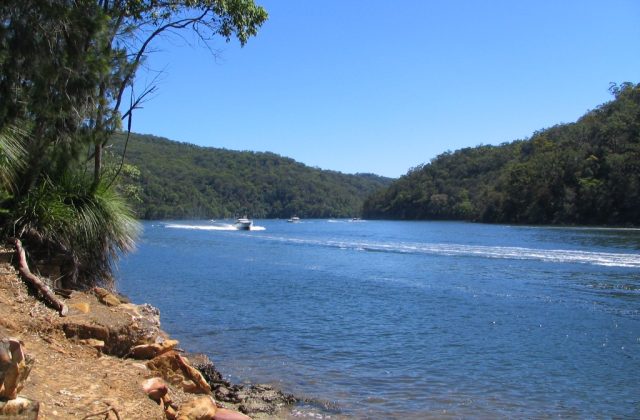
The Royal National Park lies on the southern edge of Sydney, its northern boundary only about thirty kilometres, under an hour by road or train, from the centre of the city, and it is the second oldest national park in the world, a broad tract of sandstone heath, forested valleys, rivers and magnificent sea cliffs, which Sydneysiders simply call the Nasho or the Royal. It is unusually easy to reach without a car: trains on the Illawarra line stop at Loftus, Engadine, Heathcote, Waterfall and Otford, all of which have walking tracks leading directly into the park, and a small ferry crosses from the suburb of Cronulla, which also has a railway station, to the village of Bundeena, on the park's north-eastern corner, in half an hour. Motorists pay a daily fee per vehicle; walkers and cyclists enter free. The park's hub is Audley, on the Hacking river, fifteen minutes from the northern entrance, with the main visitor centre, a restored dance hall and cafe of the 1940s, picnic lawns, and a boatshed hiring rowing boats, canoes and bicycles.
A scenic road, Lady Carrington Drive, now closed to cars, makes an easy cycle ride or walk of ten kilometres along the river through rainforest. By car, roads lead to the surf beaches of Garie and Wattamolla, the latter with a lagoon and a waterfall beside a sheltered beach, a great favourite with families, and the long coastal drive continues southwards out of the park over the Sea Cliff bridge towards Wollongong. The finest experience is the Coast Track, twenty-six kilometres along the cliff tops and beaches from Bundeena to Otford, usually walked in two days with a night at the booked campsite at North Era. Most people sample it in day walks: from Bundeena to the Aboriginal engravings at Jibbon and to Wedding Cake Rock, or from Wattamolla to Eagle Rock and the Curracurrong falls. The celebrated Figure Eight pools are reached by a long, rough descent from the Garawarra Farm car park.
Live dates and prices from GetYourGuide. Free cancellation on most tickets.
The park was dedicated on 26 April 1879, only seven years after Yellowstone, as simply the National Park, the first place in the world to bear that name, and it became Royal in 1955, after Queen Elizabeth II had passed through it by train the year before; it covers about 150 square kilometres, and was added to Australia's national heritage list in 2006, the date of 2016 found in some databases being an error. Its creation was the work of Sir John Robertson, a premier of New South Wales, and its purpose was not the protection of nature, in the modern sense, but the health and recreation of the people of a rapidly growing and unsanitary city, a lung for Sydney: the trustees cleared underbrush, planted ornamental trees, laid out lawns, dammed the river at Audley for boating, introduced deer, rabbits and foxes, and allowed the cutting of timber, the army held manoeuvres in it, and only gradually, under pressure from bushwalkers in the twentieth century, did conservation become the aim. The rusa deer, from Java, released in 1906, are still there in hundreds and damage the vegetation. The park occupies a plateau of Hawkesbury sandstone, tilted gently up from north to south, which the Hacking river and its tributaries have cut into deep valleys, and which ends on the east in an almost unbroken line of cliffs, up to a hundred metres high in the south, interrupted by a few beaches.
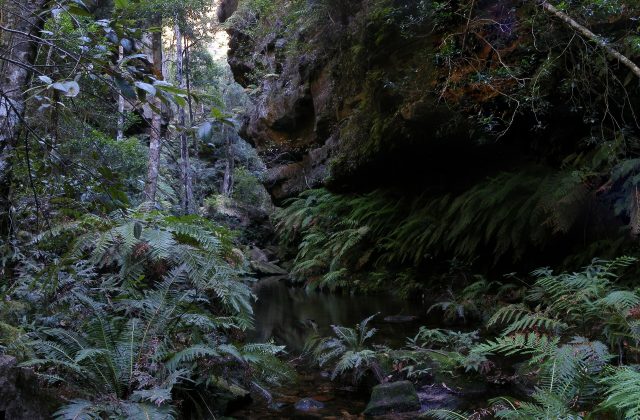
Its vegetation is a sample of everything the Sydney region has to offer, more than a thousand species of plants: on the exposed plateau a low, dense heath, which from late winter to spring is a mass of flowers, Gymea lilies with scarlet heads on stalks four metres tall, waratahs, banksias, wattles, boronias, grass trees and Christmas bells; woodland of scribbly gum, bloodwood and angophora on the ridges; tall forest of blackbutt and turpentine on the slopes; and in the sheltered valley of the upper Hacking river, remnants of subtropical and warm temperate rainforest, with coachwood, sassafras, lilly pilly and cabbage tree palms. For thousands of years it was the country of the Dharawal people, whose engravings of whales, kangaroos, fish and a spirit figure can be seen on the rock platform at Jibbon Head, and whose shell middens line the estuary. During the depression of the 1930s, unemployed miners and their families built shacks of driftwood and scrap at the beaches of Era, Burning Palms and Little Garie, reached only on foot, and some two hundred of these cabins survive, handed down in families and now protected as heritage. The park has burned repeatedly, most destructively in January 1994, when fire consumed more than ninety per cent of it, and again in 2001, and its recovery has been closely studied. Some three hundred species of birds have been recorded, among them the superb lyrebird, in the rainforest gullies, the sulphur-crested cockatoo, the New Holland honeyeater, the sea eagle and the little penguin, with swamp wallabies, echidnas, possums, gliders and goannas, and humpback whales pass close under the cliffs from May to November.
The park is open daily, the gates closing at dusk, and it is closed completely on days of extreme fire danger, which occur mainly from October to March. Late winter and spring, from August to October, are the best time, when the heath is in flower, the days are mild, 17 to 23 degrees, and the whales are returning south; autumn is settled and clear, and winter is cool, sunny and ideal for the longer walks. Summer is hot, humid and crowded at Wattamolla and Garie, where the car parks fill by mid-morning at weekends and the gates are then closed, so that an early start or the train is advisable.
The Figure Eight pools can be visited safely only at low tide and in a calm sea, a risk forecast being published by the parks service, and several people have been swept off the rock shelf and injured; Wedding Cake Rock is fenced off because it is liable to collapse. There is no drinking water on the Coast Track, the cliffs are unfenced, and the surf beaches have dangerous rips, so swim only where lifeguards are on duty. Allow a day, two for the Coast Track. Cronulla and Wollongong are the nearest towns.
Yes. GetYourGuide lists 5 tickets and tours for Royal National Park, with live dates and prices and free cancellation on most of them.
Motorists pay a daily fee per vehicle; walkers and cyclists enter free.
The park is open daily, the gates closing at dusk, and it is closed completely on days of extreme fire danger, which occur mainly from October to March.
Allow a day, two for the Coast Track.
Late winter and spring, from August to October, are the best time, when the heath is in flower, the days are mild, 17 to 23 degrees, and the whales are returning south; autumn is settled and clear, and winter is cool, sunny and ideal for the longer walks.
Royal National Park covers 151 km².
Royal National Park was established in 1879.
Royal National Park is in New South Wales, Australia. The map on this page shows the exact spot.
New South Wales, Australia
The Blue Mountains begin about sixty kilometres west of the centre of Sydney, and their national park, a vast…
92 tickets & tours
New South Wales, Australia
Sydney Harbour National Park is not one place but a scatter of headlands, beaches and islands around Port Jackson, and…
19 tickets & tours
New South Wales, Australia
Ku-ring-gai Chase is a large park of sandstone bushland and drowned river valleys on the northern edge of Sydney, only…
2 tickets & tours
New South Wales, Australia
Worimi National Park forms part of the Worimi Conservation Lands, which protect the Stockton Bight dunes, an immense…
1 ticket or tour
New South Wales, Australia
Budderoo lies on and beneath the sandstone escarpment of the Illawarra, on the south coast of New South Wales, about…
No online ticket
New South Wales, Australia
Morton is a very large park of sandstone plateaus, deep forested gorges and waterfalls on the escarpment of the…
No online ticket