Royal National Park
145 km away
The Royal National Park lies on the southern edge of Sydney, its northern boundary only about thirty kilometres, under…
5 tickets & tours
Canyon Park · New South Wales · Australia

Photo: Maksym Kozlenko, CC BY-SA 4.0
Morton is a very large park of sandstone plateaus, deep forested gorges and waterfalls on the escarpment of the Southern Highlands of New South Wales, between Sydney and Canberra, about two hours by road from either, and although most of it is trackless wilderness, its northern edge offers one of the most famous and most accessible waterfall views in Australia. That is Fitzroy Falls, on the road between the highland town of Moss Vale and Kangaroo Valley, where the park has its principal visitor centre, with a cafe, shop, exhibits on the wildlife and the Aboriginal heritage, picnic grounds and a large car park, for which a fee is charged, the rest of the park being free. From the centre a level boardwalk, suitable for wheelchairs, leads in five minutes to a platform perched directly beside the lip of the falls, where the Yarrunga creek drops eighty-one metres in a single leap into a vast, blue-hazed, forest-filled valley.
Two easy rim walks lead on from there: the West Rim track, three and a half kilometres return, passes a succession of lookouts over the falls, the Twin Falls and the gorge, and the East Rim track, six and a half kilometres return, is quieter and richer in wild flowers and birds. Half an hour's drive away, near the village of Bundanoon, which has a railway station on the line from Sydney, a second entrance gives access to a network of short walks to lookouts over the gorge of Bundanoon creek, to the Fairy Bower falls, and to Glow Worm Glen, which is visited after dark. Belmore Falls, reached by a gravel road from Robertson, and the Tianjara Falls, beside the road from Nowra to Braidwood, are further viewpoints. In the south, near Milton and Ulladulla on the coast, the climb of Pigeon House mountain, five kilometres return with ladders at the top, is one of the classic half-day walks of the state, and beyond it lie the Budawang ranges, for experienced bushwalkers only.
Live prices from GetYourGuide for tours whose route includes this park. Free cancellation on most of them.
The park originated in a reserve created round Fitzroy Falls and Bundanoon in the 1930s, was dedicated as a national park in 1967, named after Mark Morton, a local member of parliament who had campaigned for the reserve, and has been enlarged to about 2,000 square kilometres, one of the largest in New South Wales, most of it declared wilderness. It occupies a dissected tableland of horizontally bedded sandstone, some 250 million years old, at six to eight hundred metres, resting on older, softer rocks, into which the Shoalhaven river and its tributaries, the Kangaroo river among them, and the Clyde river have cut a maze of gorges, canyons and valleys up to six hundred metres deep, walled by lines of ochre cliffs. The streams that gather on the swampy surface of the plateau reach its edge and fall over these cliffs in a series of waterfalls, which after heavy rain are tremendous and in drought may nearly cease. Fitzroy Falls was named in 1850 after the governor of the colony, who visited it; in the nineteenth century there was a plan to build a town there, and in the twentieth the waters above the falls were dammed, as part of a scheme to supply Sydney and to generate power, which is why the flow over the falls is to some extent regulated.
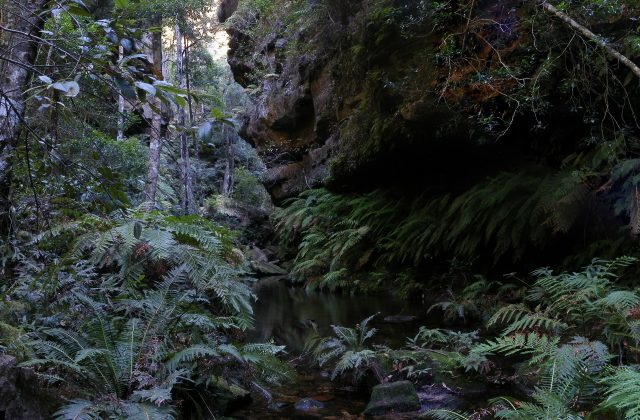
The tops of the plateaus carry heath, sedge swamp and low, open eucalypt woodland, which in spring are brilliant with the flowers of waratahs, banksias, boronias, wattles, pea flowers and ground orchids, while the sheltered gorges below the cliffs hold tall wet eucalypt forest and pockets of warm and cool temperate rainforest, with coachwood, sassafras, lilly pilly, cabbage tree palms and tree ferns. In the south, the Budawang range is a strange country of flat-topped sandstone mesas, natural arches, slot-like ravines and domes, of which Pigeon House mountain, a sharp cone with a rocky cap, is the landmark; Captain Cook, sailing up the coast in April 1770, noted in his journal a remarkable peaked hill which resembled a square dovehouse with a dome on top, and gave it its name, while to the Yuin people it is Didthul, a woman's breast, and a place of significance. The park's wildlife includes eastern grey kangaroos, swamp and red-necked wallabies, wombats, which are common in Kangaroo Valley, platypuses in the creeks, the brush-tailed rock-wallaby, which survives in small colonies on the cliffs, the spotted-tailed quoll, the greater glider, the superb lyrebird, which is often seen beside the rim tracks at Fitzroy Falls, the eastern bristlebird, the ground parrot, the glossy black cockatoo, the gang-gang cockatoo, the wedge-tailed eagle and the peregrine. In the summer of 2019 to 2020 the Currowan fire and others burned the greater part of the park, more than four fifths of its area, and although the eucalypts resprouted from their trunks within months, the scars, and the closure of some remote tracks, persist.
The park is open all year, the visitor centre at Fitzroy Falls daily. Spring, from September to November, is the best season, with wild flowers on the plateau, comfortable temperatures of 15 to 22 degrees and usually a good flow of water; autumn, from March to May, is mild, clear and settled. Summer can be hot, above 30 degrees, with a serious risk of bushfire, when the park may be closed at short notice, and with the most dramatic falls after thunderstorms; winter is cold on the highlands, with frost, fog and occasional sleet, but often brilliantly clear.
The falls are most impressive after a period of rain and disappointing in drought, and mist sometimes fills the gorge completely in the early morning. Keep behind the fences on the rim tracks, since the cliffs are sheer and unstable. Remote walks in the Budawangs require navigation skills, a registered trip intention and self-sufficiency. Allow half a day for Fitzroy Falls. Kangaroo Valley, with its historic suspension bridge, is twenty minutes away, Bowral half an hour, and the beaches of Jervis Bay an hour.
145 km away
The Royal National Park lies on the southern edge of Sydney, its northern boundary only about thirty kilometres, under…
5 tickets & tours
161 km away
The Blue Mountains begin about sixty kilometres west of the centre of Sydney, and their national park, a vast…
92 tickets & tours
187 km away
Sydney Harbour National Park is not one place but a scatter of headlands, beaches and islands around Port Jackson, and…
19 tickets & tours
Yes. GetYourGuide sells tickets and guided tours whose route includes Morton National Park; live prices are shown on this page.
The park is open all year, the visitor centre at Fitzroy Falls daily.
Allow half a day for Fitzroy Falls.
Spring, from September to November, is the best season, with wild flowers on the plateau, comfortable temperatures of 15 to 22 degrees and usually a good flow of water; autumn, from March to May, is mild, clear and settled.
Morton National Park covers 1 996 km².
Morton National Park was established in 1967.
Morton National Park is in New South Wales, Australia. The map on this page shows the exact spot.
New South Wales, Australia
The Blue Mountains begin about sixty kilometres west of the centre of Sydney, and their national park, a vast…
92 tickets & tours
New South Wales, Australia
Sydney Harbour National Park is not one place but a scatter of headlands, beaches and islands around Port Jackson, and…
19 tickets & tours
New South Wales, Australia
The Royal National Park lies on the southern edge of Sydney, its northern boundary only about thirty kilometres, under…
5 tickets & tours
New South Wales, Australia
Ku-ring-gai Chase is a large park of sandstone bushland and drowned river valleys on the northern edge of Sydney, only…
2 tickets & tours
New South Wales, Australia
Worimi National Park forms part of the Worimi Conservation Lands, which protect the Stockton Bight dunes, an immense…
1 ticket or tour
New South Wales, Australia
Budderoo lies on and beneath the sandstone escarpment of the Illawarra, on the south coast of New South Wales, about…
No online ticket