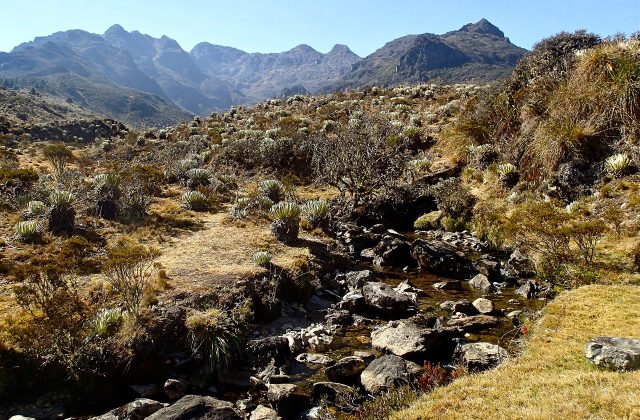
Sierra Nevada National Park, Venezuela
Venezuela
Sierra Nevada National Park protects the highest mountains of the Venezuelan Andes above the city of Mérida, and it…
No online ticket
Waterfall & Lake Park · Venezuela

Photo: Tyraelux, CC BY-SA 3.0
Canaima, in the south-east of Venezuela, is the park of the tepuis, the sheer-sided table mountains of the Guiana highlands, and of Angel Falls, the highest waterfall on earth. Before anything else it must be said that for some years most foreign governments have advised against travel to Venezuela, on account of violent crime, shortages, the unreliability of flights and the difficulty of obtaining consular help, and that anyone who goes should do so only through an established operator and after reading the current advice. The park has two quite separate sectors. The western one, where the falls are, has no road access at all: visitors fly in light aircraft from Ciudad Bolivar or Puerto Ordaz, or on charters from Caracas, to the airstrip of Canaima, a Pemon village with several lodges beside a lagoon into which a line of broad waterfalls pours water the colour of strong tea, fringed by a beach of pale pink sand.
Packages of three days are the norm, and include boat trips on the lagoon, a walk along a ledge behind the thundering curtain of the Sapo falls, and the expedition to Angel Falls itself: four to five hours upstream in a motorised dugout canoe, up the Carrao and then the Churun river, through rapids, into the canyon in the heart of Auyan-tepui, followed by a walk of an hour through the forest to the viewpoint facing the falls, and a night in hammocks at a riverside camp. Those with less time, or visiting when the rivers are too low for the boats, see the falls from the air, on a flight of forty-five minutes through the canyon. The eastern sector, the Gran Sabana, is crossed by a paved highway from Ciudad Guayana to the Brazilian border, along which lie waterfalls and viewpoints, and from which the six-day trek to the summit of Mount Roraima sets out, with Pemon guides and porters.
The national park was created in 1962, doubled in size in 1975 to about 30,000 square kilometres, the area of Belgium, and inscribed as a World Heritage Site in 1994. Some two thirds of it are occupied by tepuis, the word being Pemon for mountain. They are the remnants of a vast plateau of sandstone and quartzite laid down as sediments about 1.7 to 2 billion years ago, when South America and Africa were one, on top of a still older granite shield, among the most ancient rocks exposed anywhere on earth; over hundreds of millions of years the plateau was uplifted, cracked and eroded away, leaving more than a hundred isolated blocks, their flat summits standing a thousand metres and more above the forest and savanna, ringed by vertical cliffs and often wrapped in cloud. The summits, drenched by rain, swept by wind, with almost no soil, are worlds apart, each an island in the sky on which plants and animals have evolved in isolation: a third or more of the plant species on some summits grow nowhere else, among them carnivorous pitcher plants, sundews and bladderworts that make up for the lack of nutrients by trapping insects, strange bromeliads and orchids, and small black toads that cannot hop or swim and escape by rolling into a ball. Reports of the first ascent of Roraima, by the botanist Everard im Thurn in 1884, inspired Conan Doyle's novel The Lost World, in which dinosaurs survive on such a plateau.
Auyan-tepui, the mountain of the evil spirit, is the largest, some seven hundred square kilometres on top, and from a cleft in its northern rim the Churun river leaps 979 metres, of which 807 are a single uninterrupted drop, nearly twenty times the height of Niagara, so far that in the dry season much of the water turns to mist before reaching the bottom. The Pemon call it Kerepakupai Meru, the waterfall of the deepest place. Its other name commemorates Jimmie Angel, an American bush pilot and gold prospector, who saw it from the air in 1933 and on 9 October 1937 attempted to land his monoplane on top of the tepui; the wheels sank into the bog, and he, his wife and two companions took eleven days to climb down through the jungle. The aircraft remained on the summit for thirty-three years, and now stands outside the airport at Ciudad Bolivar. Below the cliffs, the park is a mosaic of rainforest and, in the east, the Gran Sabana, a rolling open grassland of unknown origin, with gallery forest and moriche palms along the streams, and rivers running over beds of red jasper. Jaguars, giant anteaters, giant otters, tapirs, harpy eagles and the cock-of-the-rock inhabit it. The Pemon, some twenty to thirty thousand people, live throughout the park and provide its guides and boatmen. Illegal gold mining, with its mercury and its armed gangs, has penetrated the park in recent years and is the gravest threat to it.
The seasons decide what is possible. The rainy season runs from about May to November, and only from June to November or early December are the rivers normally deep enough for the canoes to reach Angel Falls, which is then at its most powerful, though the summit is often hidden in cloud and the falls may show themselves only for moments; August and September have the most water and the most rain, and October and November are often the best compromise.
In the dry season, from December to April, the skies are clearer and the flights more rewarding, but the falls shrink to a thin ribbon, may nearly dry up in March and April, and the boat trip is usually impossible. The Roraima trek is done all year, with the driest and clearest conditions from December to March. Bring rain gear, insect repellent, a torch, quick-drying clothes, and cash in dollars. Small biting flies, called puri-puri, are a torment on the savanna. Allow three days for Canaima and Angel Falls, a week for Roraima.
No online tour for Canaima National Park is listed on GetYourGuide; entry, where it is charged, is paid at the gate or through the park authority. Nearby parks with bookable tours are listed on this page.
Allow three days for Canaima and Angel Falls, a week for Roraima.
Canaima National Park covers 30 000 km².
Canaima National Park was established in 1962.
Canaima National Park is in Venezuela. The map on this page shows the exact spot.
Venezuela
Sierra Nevada National Park protects the highest mountains of the Venezuelan Andes above the city of Mérida, and it…
No online ticket