Bukhansan National Park
South Korea
Bukhansan is the granite mountain range inside the northern city limits of Seoul, reached by the underground and a…
6 tickets & tours
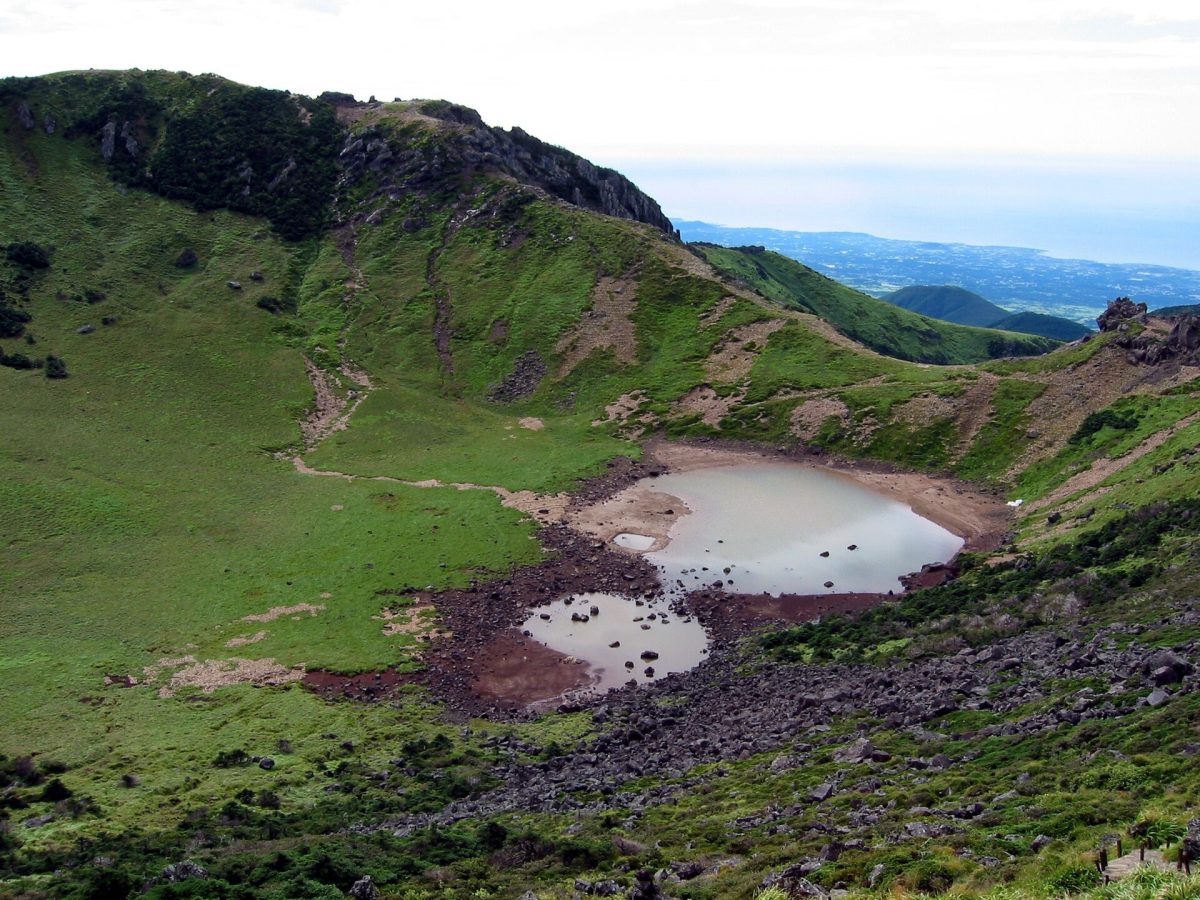
Hallasan is the volcano that forms the island of Jeju, off the southern tip of the Korean peninsula, an hour by air from Seoul on what is said to be the busiest air route in the world, and climbing it is the principal outdoor activity of the island. The park is free, and the trails are superbly made, of boardwalk, wooden steps and basalt paving, so that no guide is required; but only two of its trails reach the summit, and since 2021 both require an advance reservation, made on the national park's website, free of charge, for a named person, a date and a starting time, with daily limits of a thousand walkers on the Seongpanak trail and five hundred on the Gwaneumsa trail; a QR code is scanned at the gate, and the quotas for weekends, the autumn and snowy winter days go quickly. Seongpanak, on the eastern side, is the longer and gentler, 9.6 kilometres each way, about four and a half hours up, mostly through forest;
Gwaneumsa, on the north, is 8.7 kilometres, steeper, harder and far more scenic, through a gorge; many walkers go up one and down the other, which makes a day of eight to nine hours. Strict cut-off times apply: walkers must pass the shelters at Jindallaebat or Samgakbong by about noon or half past, varying with the season, and leave the summit by early afternoon. For those without a reservation or the legs, the Yeongsil trail, 5.8 kilometres each way, and the Eorimok trail climb to the Witse Oreum shelter at 1,700 metres, beneath the sheer southern wall of the summit, without reaching it, and Yeongsil is widely thought the most beautiful walk on the mountain. Buses run from Jeju City and Seogwipo to all the trailheads. Guided winter hikes, with crampons and lunch supplied, are sold for the snow season.
Live dates and prices from GetYourGuide. Free cancellation on most tickets.
Hallasan was designated a national park in 1970 and covers about 153 square kilometres, the upper part of the mountain; it became a UNESCO biosphere reserve in 2002, part of the World Heritage Site of Jeju Volcanic Island and Lava Tubes in 2007, and a global geopark in 2010, which makes Jeju one of the few places to hold all three designations. The mountain is a shield volcano, broad and gently sloping, built up by eruptions over the last million years or so, the most recent recorded in the early eleventh century, and at 1,947 metres it is the highest mountain in South Korea. Its summit is a crater about 550 metres across and a little over a hundred deep, holding a shallow lake, Baengnokdam, the white deer lake, where, in legend, immortals came down from heaven to ride white deer and drink the water; the lake fills after the summer rains and may be nearly dry at other times. Around the mountain's flanks rise some 360 small parasitic cones, called oreum, each the product of a single eruption, which give the Jeju landscape its distinctive profile.
The vegetation climbs through distinct belts, from warm-temperate evergreen forest near the coast through deciduous forest of oak, maple and hornbeam to a subalpine zone above 1,400 metres, and the park holds some 1,800 plant species, many of them endemic to the island or stranded here since the ice age. The most famous is the Korean fir, Abies koreana, described from this mountain by the plant hunter Ernest Wilson in 1920 and now grown as an ornamental and Christmas tree across the world; the forest of it on Hallasan, the largest in existence, has been dying back alarmingly since the 1990s, with a third or more of the trees lost to warming, typhoons and drought, their grey skeletons standing along the upper trails. Royal azaleas colour the high meadows of Seonjakjiwat pink in late May and June. The Jeju roe deer, once nearly exterminated, is now so common as to be a pest; the Yeongsil cliffs are known as the five hundred generals, from a legend of five hundred sons turned to stone.
The park is open all year, with entry to the trails from about 5 or 6 am and cut-off times that vary by month. Spring, from late April to June, brings azaleas; autumn, from mid-October to early November, brings the colours, clear skies and the heaviest demand for reservations; winter, from December to February, covers the upper mountain in deep snow and the firs in rime, the snow flowers that Koreans come in thousands to see, and requires slip-on crampons, gaiters and warm, windproof clothing;
summer is hot, humid and wet, with the rainy season in late June and July and typhoons until September. The weather on the summit bears little relation to that on the coast, and the trails are closed in storms and heavy snow. Carry all food and water, since the shelters sell nothing. Allow a full day. Jeju City and Seogwipo are forty minutes from the trailheads, the Manjanggul lava tube and the Seongsan sunrise peak on the east of the island.
Yes. GetYourGuide lists 2 tickets and tours for Hallasan National Park, with live dates and prices and free cancellation on most of them.
The park is open all year, with entry to the trails from about 5 or 6 am and cut-off times that vary by month.
Hallasan National Park covers 153 km².
Hallasan National Park was established in 1970.
Hallasan National Park is in South Korea. The map on this page shows the exact spot.
South Korea
Bukhansan is the granite mountain range inside the northern city limits of Seoul, reached by the underground and a…
6 tickets & tours
South Korea
Naejangsan is a compact mountain park in the south-west of South Korea, on the border of North and South Jeolla…
3 tickets & tours
South Korea
Seoraksan is the most celebrated mountain park in South Korea, a mass of jagged granite peaks on the north-east coast,…
3 tickets & tours

