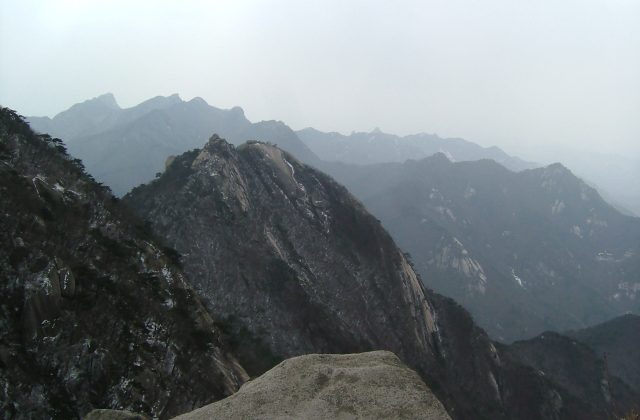
Bukhansan National Park
South Korea
Bukhansan is the granite mountain range inside the northern city limits of Seoul, reached by the underground and a…
6 tickets & tours

Photo: Tung Thanh Dang, CC BY-SA 3.0
Naejangsan is a compact mountain park in the south-west of South Korea, on the border of North and South Jeolla provinces, and it is famous for one thing above all others: by common consent it has the finest autumn foliage in the country, and for about three weeks each year it is one of the most visited places in Korea. It is reached from the town of Jeongeup, which the KTX high-speed trains from Seoul's Yongsan station reach in about an hour and forty minutes, and from which city bus 171 or a taxi covers the remaining twelve kilometres to the park's entrance village in twenty to thirty minutes; express buses also run from Seoul, Gwangju and Jeonju.
In the foliage season, the one-day tours by coach from Seoul, leaving at six or seven in the morning and returning late at night, and from Busan, are much the simplest way to come, since trains sell out, the road to the park jams for kilometres and parking is impossible; they give four or five hours in the park, which is enough. A shuttle bus runs from the ticket office along the valley road towards the temple for a small fare, saving half an hour's walk, and a cable car, from near the upper end of that road, lifts passengers in five minutes to a station high on the mountainside, from which a viewing pavilion is a ten-minute walk; queues for it in late October can exceed two hours. The park itself no longer charges admission, though the temple collects a cultural heritage fee from those who pass its gate. Walkers with a full day can make the circuit of the ridge and its eight peaks, a strenuous seven hours.
Live dates and prices from GetYourGuide. Free cancellation on most tickets.
Naejangsan was designated in 1971, the eighth national park of Korea, and covers about 81 square kilometres; it takes its name, which means the mountain of many secrets or inner treasures, from the main massif, a horseshoe of nine rocky peaks of volcanic tuff and rhyolite, the highest of them Sinseonbong, 763 metres, enclosing a deep, sheltered valley, and it also includes, to the south, the separate massif of Baegamsan with the temple of Baegyangsa, entered from a different side. The mountain was counted in the Joseon period among the eight scenic wonders of Korea. Its autumn reputation rests on its maples: thirteen or so species grow here, among them a small-leaved variety, the aegi danpung or baby maple, whose leaves are no bigger than a child's palm and turn a pure, saturated crimson. The approach to the temple from the entrance, some three kilometres along the stream, is lined with them, and culminates in the so-called maple tunnel, a walk between one hundred and eight old trees, the number of the earthly desires in Buddhism, planted about a century ago, whose branches meet overhead;
halfway along stands Uhwajeong, a blue-roofed pavilion on an island in a pond, whose reflection framed in red leaves is the most reproduced image of Korean autumn. Naejangsa, the temple in the bowl of the peaks, was founded in 636 under the Baekje kingdom, and has been burned and rebuilt many times, in the Japanese invasions of the 1590s, in the Korean War, when the area was a guerrilla stronghold, and most recently in March 2021, when its main hall was destroyed in a fire set by a disgruntled monk. During the Japanese invasion of 1592 the royal annals of the Joseon dynasty, the only surviving copy, were hidden for more than a year in a cave hermitage on the mountain, and so preserved. The Dodeok and Geumseon waterfalls, the hermitages of Wonjeogam and Byeongnyeonam, and a forest of nutmeg-yew trees that is a natural monument lie on the paths. Spring brings cherry blossom and summer deep green shade.
The park is open from before sunrise to sunset, with trail entry closing in mid-afternoon. The foliage generally begins in mid-October on the peaks and reaches its height in the valley between the last days of October and about 10 November, a week or two later than in the mountains around Seoul, and the national park service publishes forecasts each year;
on the peak weekends more than a hundred thousand people a day have been counted, so that a weekday visit and arrival by eight in the morning make all the difference. At any other season the park is peaceful. Winter snow on the temple roofs and the bare ridge is a quieter beauty. Allow four to five hours, a full day for the ridge. Jeongeup is the gateway, the Baegyangsa temple on the southern side half an hour away, Jeonju's hanok village an hour north, and Gwangju forty minutes south.
Yes. GetYourGuide lists 3 tickets and tours for Naejangsan National Park, with live dates and prices and free cancellation on most of them.
The park is open from before sunrise to sunset, with trail entry closing in mid-afternoon.
Allow four to five hours, a full day for the ridge.
Naejangsan National Park covers 81.7 km².
Naejangsan National Park was established in 1971.
Naejangsan National Park is in South Korea. The map on this page shows the exact spot.
South Korea
Bukhansan is the granite mountain range inside the northern city limits of Seoul, reached by the underground and a…
6 tickets & tours
South Korea
Seoraksan is the most celebrated mountain park in South Korea, a mass of jagged granite peaks on the north-east coast,…
3 tickets & tours
South Korea
Hallasan is the volcano that forms the island of Jeju, off the southern tip of the Korean peninsula, an hour by air…
2 tickets & tours

