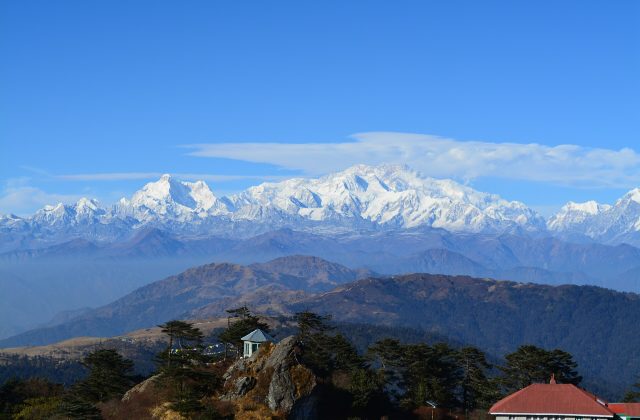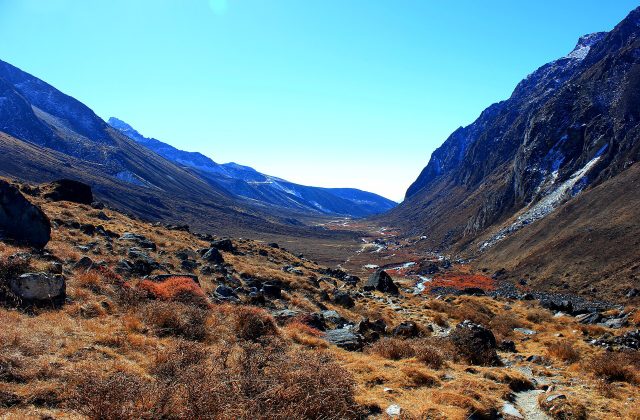
Khangchendzonga National Park
119 km away
Khangchendzonga National Park occupies the whole north-western quarter of the small Indian state of Sikkim, in the…
2 tickets & tours

Photo: A. J. T. Johnsingh, WWF-India and NCF, CC BY-SA 3.0
Jigme Dorji is the great mountain park of north-western Bhutan, stretching along the Tibetan frontier from the valley of Paro to beyond Gasa, and it contains the country's most famous treks, which are the only means of seeing it, since no road penetrates beyond its southern edges. Travel in Bhutan is regulated: all foreign visitors, except Indians and a few others, pay a daily sustainable development fee, and trekking can be undertaken only through a licensed Bhutanese tour operator, who supplies the guide, cook, tents, food and the horses or yaks that carry the baggage, so that the choice to be made is of route and season. One arrives by air at Paro, the only international airport, served by the two national airlines from Delhi, Kathmandu, Bangkok and a few other cities.
The classic route is the Jomolhari trek, which starts at the end of the road up the Paro valley and follows the Paro river for three days through forest and yak pastures to the camp of Jangothang, at 4,080 metres, directly beneath the ice wall of Jomolhari, where a rest day is spent; from there one either returns by a loop over a pass to the south, six or seven days in all, or crosses the Nyile La, 4,870 metres, to the remote fortress of Lingshi and continues over further passes to the road above Thimphu, eight or nine days. Longer routes continue north-east from Lingshi to the villages of Laya and the hot springs and fortress of Gasa, twelve to fourteen days, and the legendary Snowman trek, some twenty-five days over eleven high passes to Lunana and beyond, which begins in the same way, is reckoned among the hardest in the Himalaya. For those who do not trek, a road now reaches Gasa, five hours from Punakha, from which the springs are a short walk.
The park was established in 1974, as a sanctuary, and named after the third king of Bhutan, Jigme Dorji Wangchuck, the father of the modern country, who had died two years before; it covers 4,316 square kilometres, in the districts of Gasa, Thimphu, Paro and Punakha, and is on the country's tentative list for World Heritage. It rises from subtropical broadleaved forest at 1,400 metres, through forests of blue pine, oak, maple, hemlock, fir and thirty species of rhododendron, juniper scrub and alpine meadow, to ice at over seven thousand metres, and it holds the sources of four of Bhutan's principal rivers, on whose hydroelectric power the national economy depends. On the frontier stand Jomolhari, 7,326 metres, the abode of one of the five sister goddesses who protect Tibet and Bhutan, first climbed in 1937 by a small British party with the permission of the Bhutanese and now, like all the high peaks of the country, closed to mountaineers out of respect for the deities; the elegant fluted pyramid of Jichu Drake; and Tsherimgang. The park has the distinction of containing all four of the national emblems of Bhutan: the takin, the national animal, a heavy, golden-brown, goat-antelope with a swollen nose, which gathers in herds of a hundred and more on the summer pastures above Gasa; the blue poppy, the national flower, which blooms on the high screes in the monsoon; the Himalayan cypress, the national tree;
and the raven, the national bird, whose head adorns the king's crown. It is also one of the very few places on earth where the ranges of the tiger and the snow leopard overlap: cameras have recorded tigers here above four thousand metres, higher than anywhere else, a discovery made known to the world by a television expedition in 2010. Blue sheep, in large flocks, musk deer, the Himalayan black bear, the red panda, the serow, the wild dog, the marmot, the blood pheasant, the monal, the satyr tragopan and the lammergeier are among the other inhabitants. About 6,500 people live within the park, which is managed on the principle that they belong there. The most distinctive are the Layaps, a community of yak herders in the villages of Laya, at 3,800 metres, whose women wear conical hats of woven bamboo with a spike on top, long black yak-hair skirts and quantities of silver, and who, since the government allowed it in 2004, earn much of their income from collecting cordyceps, a caterpillar fungus worth more than its weight in gold in Chinese medicine; a royal highland festival is held there each October. The hot springs of Gasa, where Bhutanese families camp for weeks in winter to cure their ailments, were swept away by a flood in 2009 and have been rebuilt. In 1994 a glacial lake in the adjoining highlands burst, sending a flood down the Pho Chhu that damaged the great fortress of Punakha, and the monitoring of such lakes has been a national concern ever since.
There are two trekking seasons. Spring, from late March to May, is mild and coloured by the flowering of the rhododendrons and magnolias, with some haze and cloud in the afternoons and snow lingering on the high passes early in the season. Autumn, from late September to mid-November, after the monsoon, offers the clearest skies and the finest views of the peaks, cold nights and the greatest demand, October being the busiest month, for which flights and operators should be booked many months ahead.
The monsoon, from June to early September, brings heavy rain, leeches, mud and cloud, though the alpine flowers, including the blue poppy, are then at their best; in winter, from December to March, the passes are closed by snow, and only the lower valleys and Gasa are accessible. Altitude sickness is the principal hazard, since the treks spend days above four thousand metres, and itineraries should include acclimatisation days. Bring a warm sleeping bag and down jacket. Allow a week to two weeks, in addition to Paro and Thimphu.
119 km away
Khangchendzonga National Park occupies the whole north-western quarter of the small Indian state of Sikkim, in the…
2 tickets & tours
159 km away
Singalila is a high forested ridge on the frontier between India and Nepal, in the Darjeeling hills of West Bengal, and…
3 tickets & tours
278 km away
Sagarmatha National Park, in the Khumbu region of north-eastern Nepal, contains Mount Everest and several others of the…
121 tickets & tours
No online tour for Jigme Dorji National Park is listed on GetYourGuide; entry, where it is charged, is paid at the gate or through the park authority. Nearby parks with bookable tours are listed on this page.
Allow a week to two weeks, in addition to Paro and Thimphu.
Jigme Dorji National Park covers 4 316 km².
Jigme Dorji National Park was established in 1974.
Jigme Dorji National Park is in Bhutan. The map on this page shows the exact spot.