Thingvellir National Park
Iceland
Thingvellir lies forty-five kilometres, about three quarters of an hour by a good road, north-east of Reykjavik, and it…
176 tickets & tours

Photo: Eysteinn Guðni Guðnason, CC BY-SA 4.0
Skaftafell is the visitor hub on the south side of the Vatnajökull ice cap, four hours east of Reykjavík on the ring road, and it was a national park in its own right until 2008, when it became part of the Vatnajökull park that now covers the whole ice cap; the name survives on the visitor centre, the campground and the glacier tours, which are the reason most people stop. The glacier hikes on the Falljökull and Svínafellsjökull outlet glaciers leave from the Skaftafell car park several times a day in small groups with a guide, crampons, a helmet and an ice axe provided, in versions of two to six hours, with the longer ones reaching the ice falls and the blue crevasses and the ice-climbing add-ons for the fit;
they run all year and are among the best-run glacier walks in Iceland, and the winter ice-cave tours from the same base go into the blue caves that form under the ice from November to March. The scenic flights from the Skaftafell airstrip fly over the ice cap, the Grímsvötn volcano and the Laki craters in clear weather. The park itself is free to enter; the car park charges a fee, and the tours are booked online in the season. Independent visitors walk the Svartifoss trail and the paths to the glacier snouts without a guide, and the day tours from Reykjavík that include Skaftafell with the Jökulsárlón lagoon are a very long day of driving.
Live dates and prices from GetYourGuide. Free cancellation on most tickets.
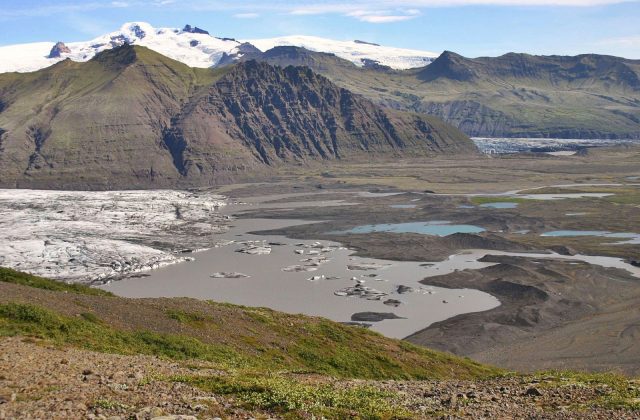
The Skaftafell area, a national park from 1967 to 2008 and now a district of Vatnajökull National Park, which at 14,000 square kilometres is the largest in Europe, lies between the ice cap and the black sands of the Skeiðarársandur, an outwash plain that the glacial floods called jökulhlaups have spread to the sea, the last great one in 1996 when the Grímsvötn eruption under the ice sent a flood that took the ring road's bridges; it is a green oasis of birch woods, wildflowers and sunshine in a rain-soaked coast, sheltered by the mountains and famous for its climate. The Svartifoss waterfall, a twenty-metre fall over a wall of black basalt columns that inspired the Reykjavík cathedral, is the walk everyone does in an hour and a half from the visitor centre;
the trail continues to the Sjónarnípa viewpoint over the Skaftafellsjökull glacier tongue and the Kristínartindar peaks, and the longer loop to Morsárdalur reaches the Bæjarstaðarskógur birch wood and the glacier's edge. The Skaftafellsjökull and Svínafellsjökull glaciers flow down from the ice cap in tongues of crevassed ice, retreating by tens of metres a year and leaving lagoons and moraines at their snouts, and the Öræfajökull volcano rises behind them to Hvannadalshnúkur at 2,110 metres, the highest point in Iceland, climbed from Skaftafell in a long guided day. The two farms of Skaftafell, which survived the floods and eruptions that emptied the district in the Middle Ages, have kept the name, and the turf houses of Sel above the campground are the last of the old farm. Arctic foxes, snow buntings and the great skua on the sands are the wildlife; the Ingólfshöfði headland on the coast has puffins in summer.
The park is open at all times, with the visitor centre from about 9 am to 5 pm in winter and longer in summer, and the glacier hikes running daily all year. Summer from June to August has the long days, the walking trails clear of snow and the busiest car park; May and September are quieter with the risk of weather;
winter from November to March is the season for the ice caves and for the glaciers under snow, with short days, storms that close the ring road and the northern lights on clear nights. Book the glacier walks ahead in summer and the ice caves ahead in winter. Allow a half-day for Svartifoss and a glacier hike, a full day with Jökulsárlón. The Jökulsárlón lagoon is an hour east, Vík two hours west, and Höfn is the town beyond the lagoon.
Yes. GetYourGuide lists 19 tickets and tours for Skaftafell (Vatnajökull National Park), with live dates and prices and free cancellation on most of them.
The park itself is free to enter; the car park charges a fee, and the tours are booked online in the season.
The park is open at all times, with the visitor centre from about 9 am to 5 pm in winter and longer in summer, and the glacier hikes running daily all year.
Allow a half-day for Svartifoss and a glacier hike, a full day with Jökulsárlón.
Independent visitors walk the Svartifoss trail and the paths to the glacier snouts without a guide, and the day tours from Reykjavík that include Skaftafell with the Jökulsárlón lagoon are a very long day of driving.
Skaftafell (Vatnajökull National Park) covers 4 807 km².
Skaftafell (Vatnajökull National Park) was established in 1967.
Skaftafell (Vatnajökull National Park) is in Iceland. The map on this page shows the exact spot.
Iceland
Thingvellir lies forty-five kilometres, about three quarters of an hour by a good road, north-east of Reykjavik, and it…
176 tickets & tours
Iceland
Fjallabak is a reserve in the uninhabited southern highlands of Iceland, a wilderness of multicoloured rhyolite…
8 tickets & tours
Iceland
Vatnajökull National Park covers the largest ice cap in Europe and a vast tract around it, some fourteen per cent of…
8 tickets & tours
Iceland
Snaefellsjokull National Park occupies the tip of the Snaefellsnes peninsula, a finger of land ninety kilometres long…
2 tickets & tours