Thingvellir National Park
Iceland
Thingvellir lies forty-five kilometres, about three quarters of an hour by a good road, north-east of Reykjavik, and it…
176 tickets & tours
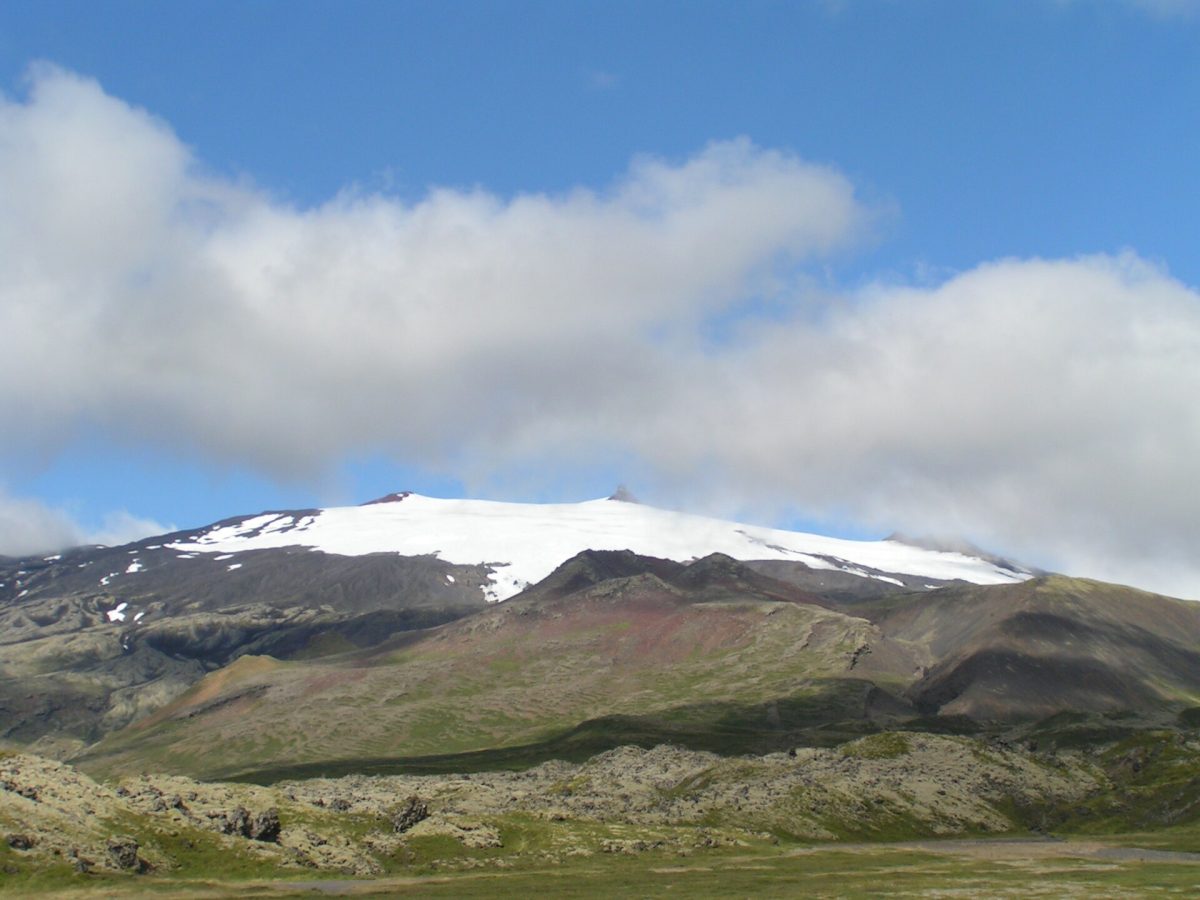
Photo: Original uploader was HansOosting at nl.wikipedia, CC BY-SA 3.0
Snaefellsjokull National Park occupies the tip of the Snaefellsnes peninsula, a finger of land ninety kilometres long that points westwards into the Atlantic from the west coast of Iceland, and its centre is the glacier-capped volcano of the same name, which on a clear day can be seen from Reykjavik, 120 kilometres away across the bay. The drive from the capital to the park takes about two and a half hours, through the tunnel under Hvalfjordur and by Borgarnes, and the coach and minibus day tours from Reykjavik make a circuit of the whole peninsula in eleven to twelve hours, which is a long day but entirely feasible in summer light; those with a hired car do better to spend a night or two at Arnarstapi, Hellnar, Hellissandur, Olafsvik or Grundarfjordur. The park is free, without gates, and its sights are strung along the road that circles the volcano, each with a car park and a short, marked path.
Going clockwise from Arnarstapi and Hellnar, which lie just outside the boundary and are joined by a splendid cliff-top walk of half an hour past basalt arches and bird cliffs, one comes to the Londrangar sea stacks and the Malarrif lighthouse, beside which is a park visitor centre; to the Vatnshellir lava cave, which is entered only on guided tours of forty-five minutes, with helmets and torches supplied, down a spiral staircase, and which should be booked; to the black pebble beach of Djupalonssandur; to the Saxholl crater, climbed by a metal stairway in ten minutes; and to the golden sands of Skardsvik and the lonely cape of Ondverdarnes. A newer visitor centre stands at Hellissandur. To go up on the glacier itself, guided hikes with crampons and ice axes, and, while the snow lasts, tours by snowcat, start from Arnarstapi; no one should venture on the ice unguided, because of crevasses.
Live dates and prices from GetYourGuide. Free cancellation on most tickets.
The park was established in June 2001, the first in Iceland to reach from the mountain top to the sea, and covers about 170 square kilometres. Snaefellsjokull is a stratovolcano, 1,446 metres high, some seven hundred thousand years old, built up by many eruptions both explosive and effusive, the last of them about eighteen hundred years ago, and the lava fields that pour from its flanks and from the small craters around its foot, rough, black and blanketed in thick grey-green moss, make up most of the park. Its ice cap, which covered more than twenty square kilometres a century ago, has lost over half its area and is now thin, and glaciologists expect it to have all but vanished by the middle of this century. The mountain owes its international fame to Jules Verne, who in 1864 chose its crater as the entrance through which Professor Lidenbrock, his nephew Axel and their Icelandic guide Hans descend in the Journey to the Centre of the Earth; and in Icelandic tradition it is the home of Bardur Snaefellsas, half man and half troll, the hero of a medieval saga, who walked into the glacier and became the guardian spirit of the peninsula, and whose giant statue in piled stone stands at Arnarstapi.
Believers in such things count it among the earth's great centres of energy, and in November 1993 several hundred people gathered at its foot to await a landing of extraterrestrials that had been announced for a precise hour. The coast is as interesting as the mountain. For centuries it was one of the chief seasonal fishing stations of Iceland, and at Dritvik, a cove an easy kilometre's walk from Djupalonssandur, sixty open boats and several hundred men once worked each spring, where there is now nothing but a refuge hut. On the path down to Djupalonssandur lie four lifting stones, the full-strong, of 154 kilograms, the half-strong, of 100, the half-carrier, of 54, and the weakling, of 23, by which a man's fitness for a place at the oars was tried, the third being the minimum; and scattered over the beach are the rusted fragments of the Grimsby trawler Epine, wrecked here in March 1948 with the loss of fourteen of her nineteen crew, which are left as a memorial and must not be moved. Londrangar, two pinnacles of basalt, seventy-five and sixty-one metres high, are the plugs of an eroded crater, with kittiwakes, fulmars, guillemots and a few puffins on the cliffs beside them. Arctic foxes, the only native land mammal, are often seen, seals haul out on the skerries, and killer whales and, in some years, sperm whales are watched from boats out of Olafsvik and Grundarfjordur.
The park is open all year, and the ring road round the volcano is kept clear in winter, though the mountain tracks across the peninsula's spine, including the one over the shoulder of the glacier, are open only from about late June to September. Summer, from June to August, brings endless daylight, nesting seabirds, arctic terns that dive at anyone near their colonies, and the most reliable weather; glacier hikes run roughly from spring to late summer, according to the snow.
Winter offers northern lights, low golden light for a few hours and empty car parks, but also gales, ice and sudden road closures, which should be checked on the road authority's website each morning. The waves at Djupalonssandur are dangerous at any season, so stay well back from the water. Bring windproof and waterproof clothing in every month. Allow a full day, better two. Kirkjufell mountain at Grundarfjordur is forty minutes from Hellissandur, the black church of Budir and the seals of Ytri Tunga on the south coast, and Stykkisholmur an hour and a quarter east.
Yes. GetYourGuide lists 2 tickets and tours for Snaefellsjokull National Park, with live dates and prices and free cancellation on most of them.
The park is open all year, and the ring road round the volcano is kept clear in winter, though the mountain tracks across the peninsula's spine, including the one over the shoulder of the glacier, are open only from about late June to September.
Allow a full day, better two.
Snaefellsjokull National Park covers 170 km².
Snaefellsjokull National Park was established in 2001.
Snaefellsjokull National Park is in Iceland. The map on this page shows the exact spot.
Iceland
Thingvellir lies forty-five kilometres, about three quarters of an hour by a good road, north-east of Reykjavik, and it…
176 tickets & tours
Iceland
Skaftafell is the visitor hub on the south side of the Vatnajökull ice cap, four hours east of Reykjavík on the ring…
19 tickets & tours
Iceland
Fjallabak is a reserve in the uninhabited southern highlands of Iceland, a wilderness of multicoloured rhyolite…
8 tickets & tours
Iceland
Vatnajökull National Park covers the largest ice cap in Europe and a vast tract around it, some fourteen per cent of…
8 tickets & tours