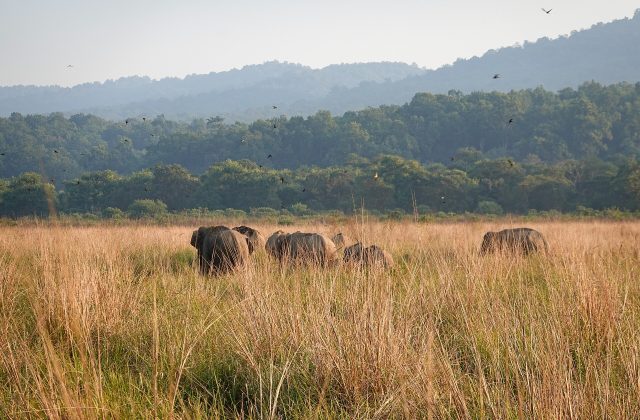
Jim Corbett National Park
Uttarakhand, India
Corbett is India's oldest tiger reserve, five to six hours from Delhi in the Himalayan foothills of Uttarakhand,…
16 tickets & tours
Mountain Park · Uttarakhand · India
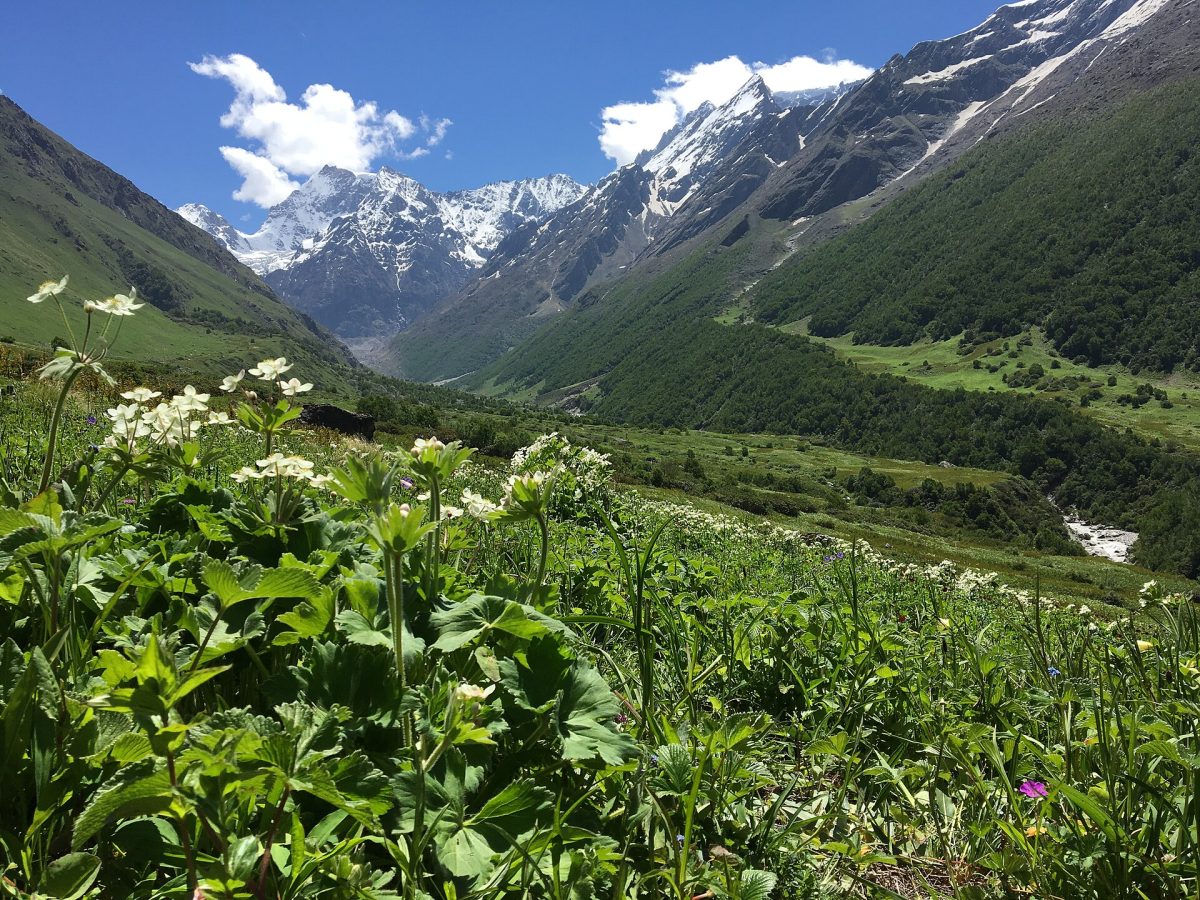
Photo: Naresh Chandra, CC BY-SA 4.0
The Valley of Flowers is a high hanging valley in the Garhwal Himalaya, in the Chamoli district of the Indian state of Uttarakhand, and it cannot be reached by road, so that to see it requires a trek of four to six days in all, which is, however, among the easier and the best supported in the Himalaya, because it shares its route with a great Sikh pilgrimage. The journey begins with a long day's drive, ten to eleven hours, some 270 kilometres up the gorge of the Alaknanda from Rishikesh or Haridwar, which are themselves five to six hours from Delhi, by way of Devprayag, Rudraprayag and Joshimath, on the road to the temple of Badrinath, to the roadside settlement of Govindghat; a night in Joshimath breaks it.
From Govindghat a road now continues four kilometres to the village of Pulna, from which a well-made, paved and stepped mule track climbs ten kilometres, a steady ascent of about 1,200 metres, taking five to six hours, up the wooded gorge of the Lakshman Ganga to Ghangaria, at 3,050 metres, a seasonal village of lodges, tented camps, a gurdwara that shelters pilgrims and simple eating houses, where everyone stays, since camping and overnight stays in the park are forbidden. Mules, porters with baskets and a helicopter shuttle, in fair weather, are available for the ascent. The park's checkpost is just above Ghangaria, where the entry fee, valid for three days, is paid, and from it a path of about four kilometres leads over a bridge and up through birch and rhododendron into the valley, whose floor then stretches a further five kilometres or more; entry is from seven in the morning until early afternoon, and all must be out by five. Most treks allow a day, or two, in the valley and one for Hemkund. The packaged treks from Delhi and Rishikesh, with a guide, transport and lodging, save a good deal of trouble.
Live dates and prices from GetYourGuide. Free cancellation on most tickets.
The national park was created in 1982 and covers 87.5 square kilometres; in 2005 it was added to the World Heritage Site of Nanda Devi, of which it forms the gentler counterpart, and both are the core of a biosphere reserve. The valley proper, that of the Pushpawati river, is about eight kilometres long and two wide, running east to west between 3,350 and 3,650 metres, a broad trough carved by a glacier, floored with meadows and walled by peaks of six thousand metres, with the glacier of Tipra at its head and the snow pyramid of Rataban closing the view. The people of the Bhyundar valley below had always known it, grazed their flocks in it, and believed it inhabited by fairies, but it came to the notice of the world in 1931, when six British mountaineers, among them Frank Smythe, Eric Shipton and the botanist R. L. Holdsworth, coming down in mist and rain from the first ascent of Kamet, lost their way, crossed a pass and descended into a valley that was, as Smythe wrote, a sheet of flowers. He returned in 1937 to spend the summer collecting, and his book of the following year gave the valley its name and its fame. In 1939 the botanic gardens at Kew sent Joan Margaret Legge to continue the work; she slipped while gathering plants on a slope and was killed, and her grave, set up by her sister, with a line from the Psalms, lies in the valley and is visited by every walker.
More than five hundred species of flowering plants grow here, and because they flower in succession, the colour of the valley changes every few weeks: after the snow melts in June come primulas, irises, marsh marigolds, anemones and fritillaries; in July and August the high tide, with potentillas, geraniums, the pink Himalayan balsam in sheets, asters, pedicularis, campanulas, ligularias, cobra lilies, orchids, the Himalayan blue poppy, among the rocks, and many plants used in the traditional medicine of the hills; by September the meadows turn gold and russet. The brahma kamal, the sacred lotus-like flower of the high screes, is seen more readily on the way to Hemkund. Grazing has been banned since the park's creation, which, in the view of some botanists, has allowed tall knotweed to spread at the expense of the smaller flowers, and it is now cut by hand. Asiatic black bears, musk deer, blue sheep, serow, the Himalayan tahr, red foxes, pikas and, in the heights, the snow leopard inhabit the park, with the Himalayan monal, the iridescent state bird. Hemkund Sahib, a Sikh shrine beside a glacial lake at 4,329 metres, associated with the tenth guru, is a steep climb of six kilometres from Ghangaria, made each summer by hundreds of thousands of pilgrims.
The park is open only from 1 June to early or mid-October, and is under snow for the rest of the year. The flowers are at their best from the middle of July to the middle of August, which is precisely the height of the monsoon, so that a visit means rain most days, cloud hiding the peaks, leeches lower down and, the chief hazard, landslides that regularly block the road from Rishikesh for hours or days; spare days should be built into any plan.
June has clearer weather, snow bridges and fewer flowers, and is the busiest month of the Sikh pilgrimage; September is drier and clearer, with the flowers fading to seed. Floods in June 2013 destroyed much of the route, which has been rebuilt. Bring good waterproofs, a rucksack cover, walking poles, warm layers and cash. Set out from Ghangaria at seven to have time in the valley. Allow six days from Rishikesh. Badrinath temple and the village of Mana are an hour beyond Govindghat, Auli and Joshimath an hour below.
Yes. GetYourGuide lists 2 tickets and tours for Valley of Flowers National Park, with live dates and prices and free cancellation on most of them.
The park is open only from 1 June to early or mid-October, and is under snow for the rest of the year.
Allow six days from Rishikesh.
Valley of Flowers National Park covers 87.5 km².
Valley of Flowers National Park was established in 1982.
Valley of Flowers National Park is in Uttarakhand, India. The map on this page shows the exact spot.
Uttarakhand, India
Corbett is India's oldest tiger reserve, five to six hours from Delhi in the Himalayan foothills of Uttarakhand,…
16 tickets & tours
Uttarakhand, India
Rajaji is the tiger reserve that lies on the doorstep of the holy towns of Haridwar and Rishikesh, in the foothills of…
3 tickets & tours
Uttarakhand, India
Nanda Devi National Park, in the Garhwal Himalaya of the Indian state of Uttarakhand, protects the mountain sanctuary…
No online ticket

