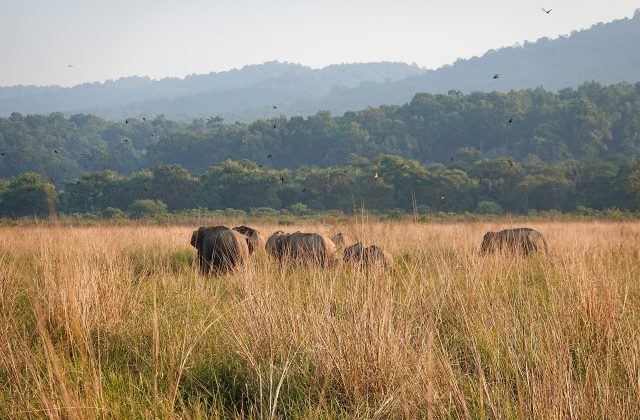
Jim Corbett National Park
Uttarakhand, India
Corbett is India's oldest tiger reserve, five to six hours from Delhi in the Himalayan foothills of Uttarakhand,…
16 tickets & tours
Safari Park · Uttarakhand · India
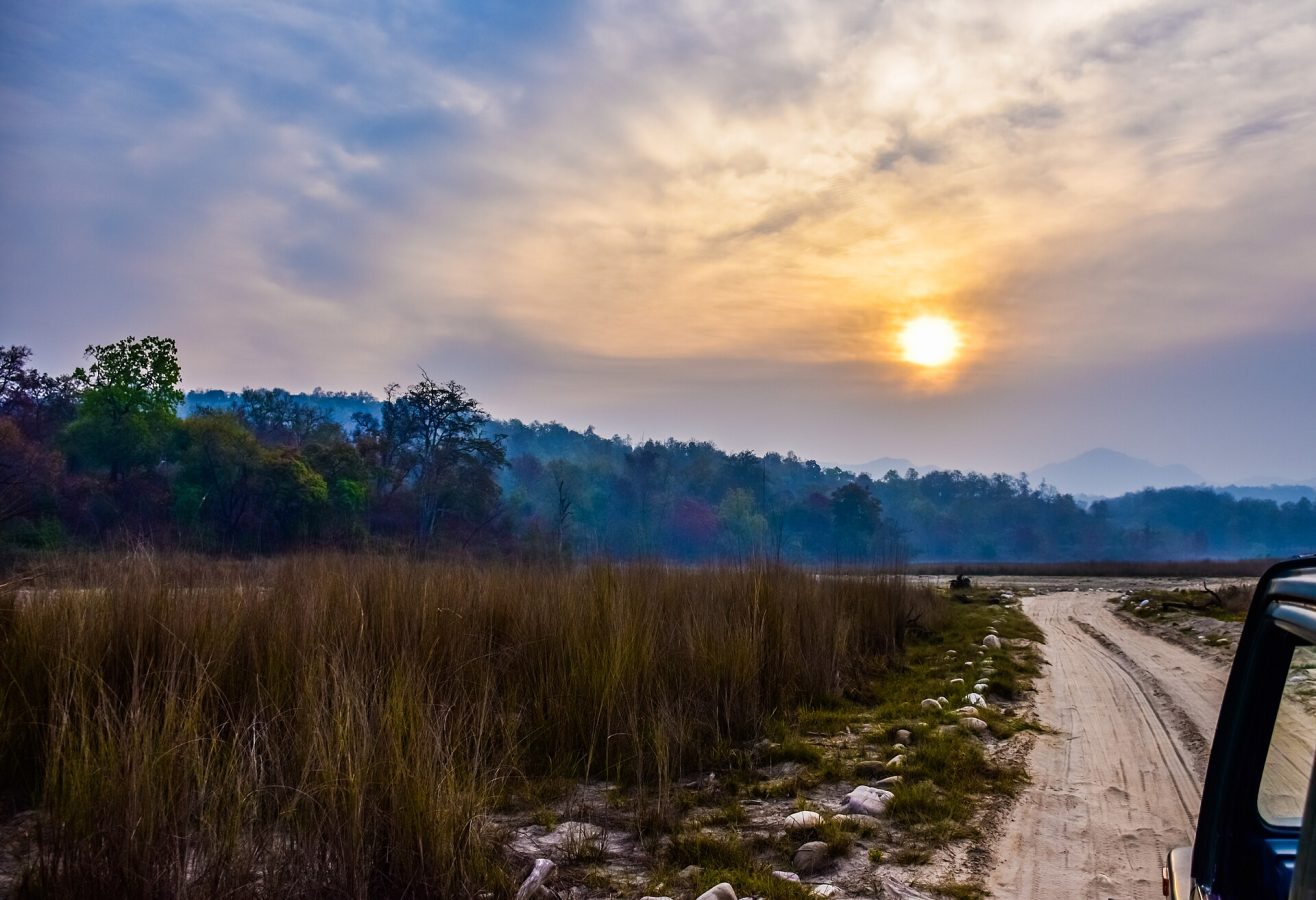
Photo: Tarun802, CC BY-SA 4.0
Rajaji is the tiger reserve that lies on the doorstep of the holy towns of Haridwar and Rishikesh, in the foothills of the Himalaya in the Indian state of Uttarakhand, about five to six hours by road or four and a half by the fast trains from Delhi, and for the great numbers of travellers who come to Rishikesh for yoga, rafting and the Ganges, it offers a wildlife safari within half an hour of their guesthouse. The park has several gates and ranges, of which the one that matters to visitors is Chilla, on the eastern bank of the Ganges, nine kilometres from Haridwar and about eighteen from Rishikesh, which has the best track network, the most water and the most animals; Motichur and Ranipur, on the western side near Haridwar, and Mohand and Asarori, near Dehradun, are the alternatives.
Safaris are made in open jeeps, called gypsies after the Maruti model, along a fixed circuit of about thirty-five kilometres, in two sessions a day, from sunrise for about three hours and again from mid-afternoon to sunset; permits and jeeps are obtained at the gate or, more reliably, through the Uttarakhand forest department's online booking or a local operator, and the cost, which includes the entry fee, with a higher rate for foreigners, the vehicle and the compulsory nature guide, is shared among up to six passengers. The half-day tours from Rishikesh and Haridwar add the transfer and take care of the paperwork; the same-day trips from Chandigarh or Delhi are very long. A forest rest house and a tourism corporation bungalow at Chilla, and private camps near the gates, allow a night and a dawn safari. Elephant rides are no longer offered.
Live dates and prices from GetYourGuide. Free cancellation on most tickets.
The park was created in 1983 by merging three wildlife sanctuaries, Rajaji, founded in 1948, Motichur and Chilla, and named after Chakravarti Rajagopalachari, Rajaji, the scholar and statesman who was the last Governor-General of India; it covers about 820 square kilometres in the districts of Dehradun, Haridwar and Pauri Garhwal, and was declared a tiger reserve in 2015, with a buffer that brings it to more than a thousand. It lies in the Shivalik hills, the outermost and youngest range of the Himalaya, soft, crumbling ridges of sandstone and conglomerate rising to a little over a thousand metres, cut by raos, broad stony torrent beds that are dry for nine months and rage in the monsoon, and across the alluvial flats, the bhabar, at their foot, with the Ganges running through the middle for some twenty-four kilometres after it leaves the mountains at Rishikesh. The forest is dominated by sal, a tall, straight hardwood, with khair and sissoo along the rivers, bamboo, and grassland in the valleys.
Rajaji is, above all, elephant country: it holds some four to five hundred wild Asian elephants, the north-westernmost population of the species on earth, which move along the foothills between here and Corbett, two hundred kilometres to the east; the corridors they use, above all the Chilla-Motichur corridor across the Ganges, cut by a canal, a highway, an army depot, an ashram town and a railway on which many elephants have been killed, are among the most studied and fought-over in Indian conservation. Tigers are established on the eastern side, about forty or more, and had all but died out on the western side, to which several have been translocated from Corbett since 2020. Leopards are common and often seen; there are sloth bears and Himalayan black bears, striped hyenas, goral on the steep slopes, sambar, chital in large herds, barking deer, nilgai, wild boar, king cobras and pythons, and more than three hundred species of birds, including the great hornbill, among the Himalayan foothill specialities. The Van Gujjars, a community of Muslim buffalo herders who lived in the forest, were largely resettled outside it.
The park is open from 15 November to 15 June and closed during the monsoon. November to February is cool and clear, cold on an open jeep at dawn, with good birdwatching including winter visitors on the Ganges; March to mid-June grows steadily hotter, reaching 40 degrees in May, and gives the best chances of elephants and tigers at the waterholes and the river.
Morning safaris are generally more productive than afternoon ones. Haridwar and Rishikesh are extremely crowded during the great bathing festivals and, in July, the Kanwar pilgrimage, when roads are closed. Allow a half-day from Rishikesh. Haridwar's evening aarti at Har-ki-Pauri is twenty minutes from Chilla, Rishikesh half an hour, Dehradun and Mussoorie an hour and more, and Corbett five hours east.
Yes. GetYourGuide lists 3 tickets and tours for Rajaji National Park, with live dates and prices and free cancellation on most of them.
The park is open from 15 November to 15 June and closed during the monsoon.
Allow a half-day from Rishikesh.
Rajaji National Park covers 820 km².
Rajaji National Park was established in 1983.
Rajaji National Park is in Uttarakhand, India. The map on this page shows the exact spot.
Uttarakhand, India
Corbett is India's oldest tiger reserve, five to six hours from Delhi in the Himalayan foothills of Uttarakhand,…
16 tickets & tours
Uttarakhand, India
The Valley of Flowers is a high hanging valley in the Garhwal Himalaya, in the Chamoli district of the Indian state of…
2 tickets & tours
Uttarakhand, India
Nanda Devi National Park, in the Garhwal Himalaya of the Indian state of Uttarakhand, protects the mountain sanctuary…
No online ticket

