Shiretoko National Park
106 km away
Shiretoko is a narrow, mountainous peninsula, seventy kilometres long, at the north-eastern extremity of Hokkaido and…
1 ticket or tour

Photo: Miya.m, CC BY-SA 3.0
Akan-Mashu is a park of volcanoes, caldera lakes, forests and hot springs in the east of Hokkaido, the northern island of Japan, and its sights are spread over two separate areas some fifty kilometres apart, so that a car, hired at Kushiro airport, an hour to the south, or at Memanbetsu airport, an hour to the north, is much the best way to see it; trains on the Senmo line stop at Mashu and Kawayu-Onsen, but the buses from them are few and seasonal. The Akan area, in the south-west, is centred on the hot-spring resort of Akanko Onsen, on the shore of Lake Akan, a strip of large hotels with baths, where one finds the Ainu village, a street of craft shops and restaurants run by Ainu families, with a theatre that stages traditional dances and puppet plays every day; sightseeing boats make a circuit of the lake of about eighty-five minutes, landing on a small island where the famous marimo are displayed in tanks;
and an easy nature trail leads from the eco-museum centre through the forest to bubbling mud pools on the shore. Walkers can climb the active volcano Mount Meakan, three to four hours up and down, from the hot spring of the same name or from the beautiful small lake of Onneto on its western side. The eastern area contains two great lakes. Lake Mashu is seen only from above, from the first and third observation platforms on its western rim, reached by road from the town of Teshikaga, the first with a large car park that charges a fee, and from a quieter platform on the far side. Lake Kussharo, the larger, has a lakeside road with free open-air hot-spring pools, a beach at Sunayu where hot water seeps up through the sand, and the wooded Wakoto peninsula, circled by a path of an hour. Between them, at the steaming sulphur mountain of Iozan, one walks among roaring yellow vents, and the pass of Bihoro gives the classic panorama.
The park was designated on 4 December 1934, which makes it, with Daisetsuzan, the oldest in Hokkaido, and it was called simply Akan until 2017, when the name of Mashu was added; it covers about 914 square kilometres. It consists essentially of three large calderas, the basins left when volcanoes emptied their magma chambers in cataclysmic eruptions and collapsed, with the younger cones that have grown up inside and beside them. The Kussharo caldera, twenty-six kilometres by twenty, is the largest in Japan, and its lake, of nearly eighty square kilometres, the largest caldera lake in the country; the water is slightly acid, from the hot springs that enter it, which also keep a strip of the shore free of ice in winter, where several hundred whooper swans from Siberia gather among the steam. Lake Mashu occupies a much smaller, younger caldera, formed about seven thousand years ago, with walls that fall two hundred metres and more, almost sheer, to the water, so that nobody may go down to it; no stream enters or leaves it, it is 212 metres deep, and its water is among the clearest in the world, a measurement of 41.6 metres of transparency made in 1931 being the greatest ever recorded in a lake, though it has since declined. Its colour, on a clear day, is an intense dark blue, known as Mashu blue, with a tiny island, the tip of a lava dome, in the middle; the Ainu called it the lake of the gods.
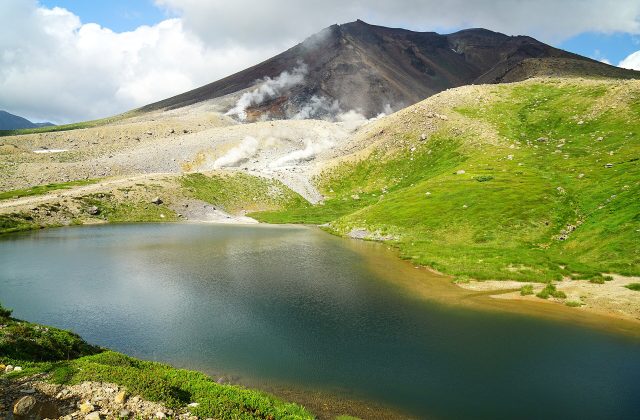
It is also notorious for fog, which in summer fills the crater on more days than not, and a popular saying warns that those who see the lake clearly at their first visit will marry late. Lake Akan lies in the third caldera, between the extinct cone of Mount Oakan, the male mountain, and the active complex of Mount Meakan, the female, 1,499 metres, which erupts ash from time to time and whose summit has several craters, one with a green pond. In its cold, clean, shallow bays grows the marimo, a filamentous green alga which here, through the gentle rolling action of the waves, forms itself into perfect velvety spheres, some as large as a football, that rise and sink with the light; such large balls are found almost nowhere else in the world, it was declared a special natural monument in 1952, and having been nearly destroyed by collectors and by the lowering of the lake for hydroelectricity, it is the object of a festival each October at which the Ainu ceremonially return the balls to the water. The forests are of Sakhalin spruce, Sakhalin fir, oak, birch and maple, inhabited by brown bears, large numbers of Yezo sika deer, red foxes, sables, flying squirrels, the black woodpecker, and Blakiston's fish owl, and the streams hold the kokanee, a landlocked salmon native to Lake Akan. The Ainu settlement at Akanko, of some thirty-six households, is the largest in Hokkaido, and its carvers and performers have done much to keep the culture of Japan's indigenous people alive.
The park is open all year, and the main roads are kept clear in winter, though the road between the first and third platforms at Mashu and that over the Bihoro pass close or become difficult after heavy snow. Summer, from June to August, is mild and green, 18 to 25 degrees, with fog over Lake Mashu on the majority of mornings, the chances of a clear view being better in the afternoon and much better from September. The autumn colours, from late September at Onneto and Meakan to mid-October round the lakes, are the finest in eastern Hokkaido.
Winter, from December to March, is very cold, down to minus twenty and below, and very beautiful: Lake Akan freezes and carries ice fishing, skating and snowmobiles, delicate frost flowers form on the new ice on windless mornings, the air glitters with diamond dust, the swans gather at Kussharo, and Lake Mashu, which seldom freezes entirely, is at its clearest. Mount Meakan is climbed from June to October, and closes when the volcanic alert rises. Allow two to three days. The Kushiro marshes and their red-crowned cranes are an hour south, and Shiretoko two hours north-east.
106 km away
Shiretoko is a narrow, mountainous peninsula, seventy kilometres long, at the north-eastern extremity of Hokkaido and…
1 ticket or tour
115 km away
Daisetsuzan is the mountainous heart of Hokkaido, Japan's northern island, a park the size of a small prefecture,…
3 tickets & tours
338 km away
Onuma is a small park of lakes and islets at the foot of a volcano in the south of Hokkaido, the northern island of…
1 ticket or tour
No online tour for Akan-Mashu National Park is listed on GetYourGuide; entry, where it is charged, is paid at the gate or through the park authority. Nearby parks with bookable tours are listed on this page.
The park is open all year, and the main roads are kept clear in winter, though the road between the first and third platforms at Mashu and that over the Bihoro pass close or become difficult after heavy snow.
Allow two to three days.
Akan-Mashu National Park covers 905 km².
Akan-Mashu National Park was established in 1934.
Akan-Mashu National Park is in Japan. The map on this page shows the exact spot.
Japan
Nikko is the mountain park two hours north of Tokyo whose shrines are a World Heritage Site and whose lakes and…
24 tickets & tours
Japan
Daisetsuzan is the mountainous heart of Hokkaido, Japan's northern island, a park the size of a small prefecture,…
3 tickets & tours
Japan
Fuji-Hakone-Izu is the most visited national park in Japan, and it is not one place but four, scattered across four…
2 tickets & tours
Japan
Iriomote-Ishigaki National Park covers the Yaeyama islands, the southernmost inhabited islands of Japan, which lie in…
1 ticket or tour
Japan
The Kerama islands are a cluster of some three dozen small, steep, green islands, only four of them inhabited, lying…
1 ticket or tour
Japan
Onuma is a small park of lakes and islets at the foot of a volcano in the south of Hokkaido, the northern island of…
1 ticket or tour