Triglav National Park
148 km away
Triglav is Slovenia's only national park, the Julian Alps between Bled, Kranjska Gora and Bovec, and it is sold…
16 tickets & tours
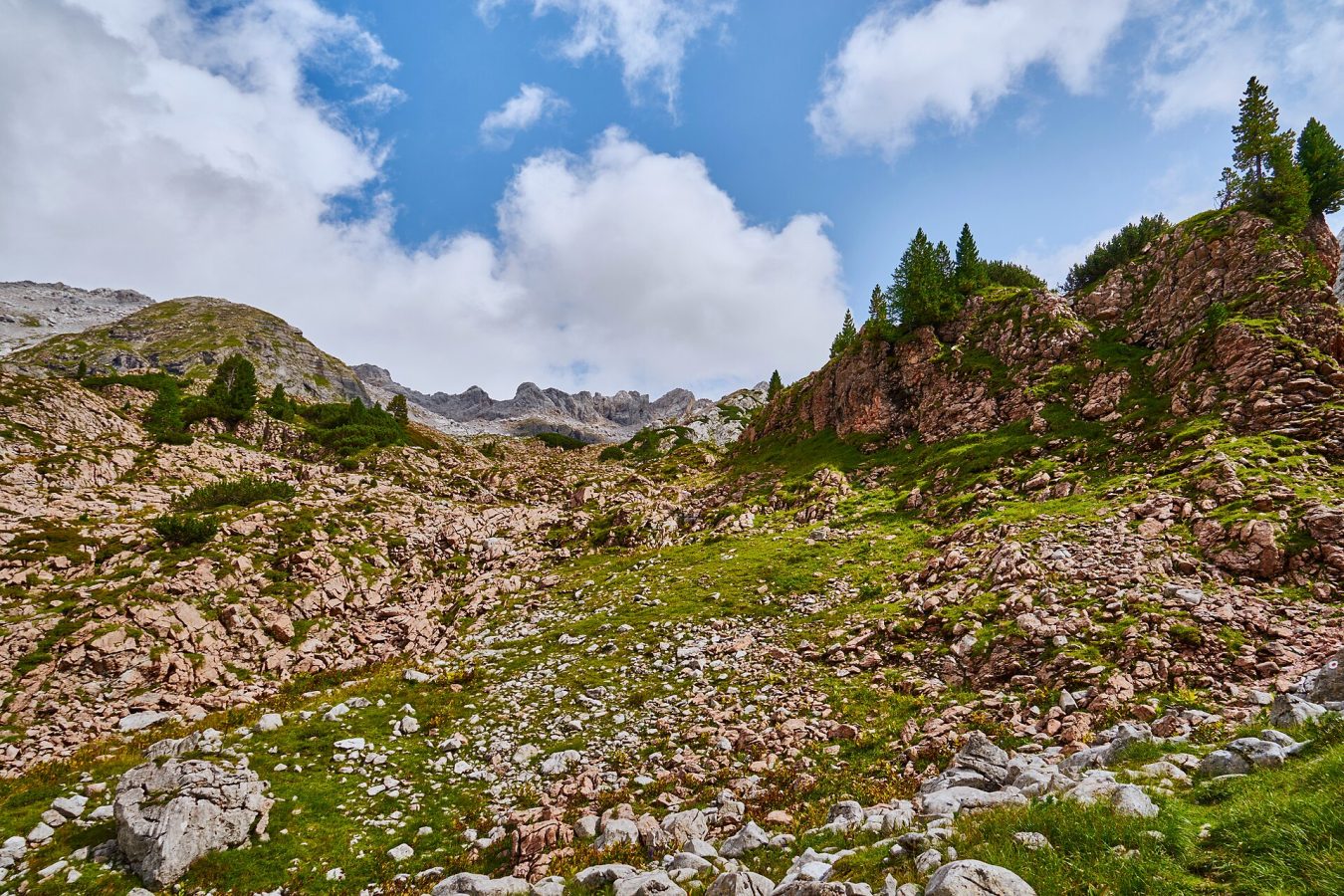
Photo: Günter Seggebäing, Coesfeld, CC BY-SA 3.0
Berchtesgaden National Park occupies the south-eastern tip of Bavaria, a wedge of high limestone mountains thrust into Austrian territory, and it is the only national park in the German Alps. The market town of Berchtesgaden, at its edge, is half an hour by road or bus from Salzburg, whose airport is the nearest, and two to two and a half hours from Munich by road or by train, and visitors holding the local guest card travel free on the district's buses, which serve all the entry points. The park itself is free. Its great sight is the Konigssee, a narrow, fjord-like lake eight kilometres long between rock walls, five kilometres south of the town, where there is a very large paying car park at the village of Schonau. No road or path follows the shores, and the lake is seen from the electric passenger boats that have plied it since 1909, which run all year unless it is frozen; tickets are sold at the quay, and in summer the queue can exceed an hour by mid-morning.
The boat goes in thirty-five minutes to St Bartholoma, the pilgrimage church with red onion domes on a peninsula under the east face of the Watzmann, stopping on the way while a boatman plays a flugelhorn to the echo, and in summer continues, in another twenty minutes, to Salet, at the head of the lake, from which a level walk of fifteen minutes leads to the smaller and lovelier Obersee, and an hour more along its shore to the Fischunkel pasture and a view of the Rothbach waterfall. From St Bartholoma a path of about an hour leads up to the ice chapel, a permanent snowfield at the foot of the Watzmann, which must not be entered. Away from the lake, the Jenner cable car climbs to 1,800 metres for the view; the Wimbach gorge, near Ramsau, is a short walk on boardwalks with a small fee, leading into a wild valley of scree; and the Hintersee and its enchanted forest, and the Klausbach valley beyond, with a long suspension footbridge, offer easy family walking.
Live prices from GetYourGuide for tours whose route includes this park. Free cancellation on most of them.
The national park was founded in 1978, on the basis of a plant protection district of 1910 and a nature reserve of 1921, among the oldest in the Alps, and covers about 210 square kilometres, forming with its foreland a UNESCO biosphere reserve since 1990. For seven hundred years, from 1102 to 1803, this small mountain territory was an independent ecclesiastical state, ruled by the prince-provosts of the Augustinian monastery of Berchtesgaden, who grew rich on its salt, which is still mined, and it passed to Bavaria only in 1810, when the Wittelsbach kings made it their favourite hunting ground and the monastery's lodge at St Bartholoma their base. The mountains are of pale Triassic limestone and dolomite, forming high, barren karst plateaus, the Steinernes Meer, the sea of stone, and the Hagengebirge, riddled with caves, between which the Konigssee lies in a trench that a glacier deepened along a fault, its surface at 603 metres and its bed 190 metres lower, its water a clear emerald green and clean enough to drink. Above it rises the Watzmann, 2,713 metres, the emblem of the region, a family of peaks in which legend sees a cruel king, his wife and their seven children, turned to stone for their wickedness; its east face, falling eighteen hundred metres from the summit almost to the lake, is the highest rock wall in the eastern Alps, first climbed in 1881 by the local guide Johann Grill, and more than a hundred climbers have since died on it.
The Rothbach waterfall, which drops 470 metres over the cliffs at the head of the Obersee, is the highest in Germany. The church of St Bartholoma was founded in 1134 and given its present baroque form, with a plan of three apses modelled on Salzburg cathedral, at the end of the seventeenth century, and a pilgrimage on foot over the mountains from Austria reaches it each August, as it has since 1688, in memory of a disaster in which seventy pilgrims drowned. Every autumn the cattle from the alpine pastures at the head of the lake, garlanded if the summer has passed without misfortune, are brought home on boats. The park's forests are of spruce, fir, beech and larch, with Swiss stone pine and dwarf pine higher up, and they shelter red deer, chamois, a herd of ibex, which were introduced in the 1930s, marmots, mountain hares, black grouse, capercaillie, ptarmigan and several pairs of golden eagles, which can be watched in the Klausbach valley; since 2021 young bearded vultures, the largest bird of the Alps, exterminated in Germany more than a century ago, have been released there each summer. The mountain retreat that Hitler and his circle built on the Obersalzberg, with the tea house on the Kehlstein, lies just outside the park, above the town, and has a documentation centre.
The park is open all year. The main season runs from May to October: the boats to Salet, and thus access to the Obersee, operate from about late April to mid-October, while the service to St Bartholoma continues through the winter unless ice prevents it, the lake having last frozen firmly enough to walk across in 2006. June and July bring alpine flowers and the fullest waterfalls; July and August are warm, 20 to 25 degrees in the valley, and extremely busy, so that one should be at the quay before nine or go in the late afternoon;
September and early October offer the most stable weather, clear air, the return of the cattle and autumn colour. The high huts are open from about June to early October. Winter brings snow, ski touring, tobogganing and horse-drawn sleigh rides to the feeding of the red deer in the Klausbach valley. Thunderstorms build quickly on summer afternoons. Allow two to three days. Salzburg is half an hour away, the salt mine and the Obersalzberg are in Berchtesgaden itself, and Bad Reichenhall is twenty minutes north.
148 km away
Triglav is Slovenia's only national park, the Julian Alps between Bled, Kranjska Gora and Bovec, and it is sold…
16 tickets & tours
223 km away
The Stelvio is the largest national park in the Italian Alps and one of the largest in the whole range, a great block…
1 ticket or tour
237 km away
The Swiss National Park lies in the Lower Engadine in the far east of the country, around the village of Zernez in…
1 ticket or tour
Yes. GetYourGuide sells tickets and guided tours whose route includes Berchtesgaden National Park; live prices are shown on this page.
The park is open all year.
Allow two to three days.
Berchtesgaden National Park covers 208 km².
Berchtesgaden National Park was established in 1978.
Berchtesgaden National Park is in Germany. The map on this page shows the exact spot.
Germany
Saxon Switzerland is the sandstone park on the Elbe south-east of Dresden, forty minutes from the city by train and two…
13 tickets & tours
Germany
The Hainich is a long, low, wooded ridge in the west of Thuringia, almost exactly in the geographical centre of…
1 ticket or tour
Germany
The Spreewald is a wooded inland delta about a hundred kilometres south-east of Berlin, in the state of Brandenburg,…
1 ticket or tour
Germany
The Eifel National Park lies in the hills of the northern Eifel, in the far west of Germany near the Belgian border,…
No online ticket
Germany
The Muritz National Park lies in the lake district of Mecklenburg, in the north-east of Germany, roughly midway between…
No online ticket