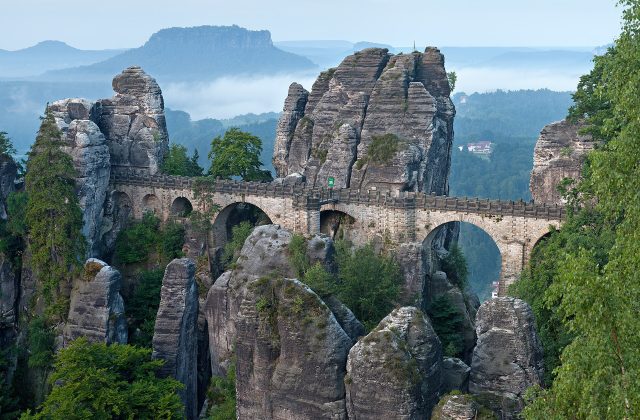
Saxon Switzerland National Park
Germany
Saxon Switzerland is the sandstone park on the Elbe south-east of Dresden, forty minutes from the city by train and two…
13 tickets & tours

Photo: Dietmar Rabich, CC BY-SA 4.0
The Hainich is a long, low, wooded ridge in the west of Thuringia, almost exactly in the geographical centre of Germany, between the towns of Eisenach, Muhlhausen and Bad Langensalza, and its southern part is a national park protecting what is promoted, with some justice, as the primeval forest in the middle of Germany. Erfurt, the state capital, is about an hour away by road, and Eisenach and Bad Langensalza have railway stations, from which buses, some of them seasonal services for walkers, run to the main entry points; a car or a bicycle is, however, much the more convenient. Entry to the park is free, and it has no gates, only a ring of car parks at the forest edge, each the start of one or more waymarked circular trails, of which there are nearly twenty, mostly of five to fifteen kilometres and nearly all on easy, gently rolling ground.
The one attraction with a ticket, and the one that draws most visitors, is the treetop walk at the Thiemsburg, near Bad Langensalza, beside the national park centre: a wooden and steel walkway more than five hundred metres long winds through and above the crowns of the beeches at heights of up to twenty-four metres, with rope bridges and information points on the way, to a tower forty-four metres high with a view over the unbroken canopy; it is accessible with pushchairs and wheelchairs by a lift. On the southern side, at Hutscheroda, the wildcat village keeps European wildcats and lynx in large, natural enclosures with feeding times, and is the start of the wildcat trail. Families like the fairy trail and the adventure trails with riddles to solve, such as the puzzle hikes that begin at Mulverstedt and Weberstedt; ranger-led walks are offered at weekends throughout the year.
Live dates and prices from GetYourGuide. Free cancellation on most tickets.
The park was founded on 31 December 1997, the only national park in Thuringia, and covers about seventy-five square kilometres at the southern end of the Hainich, which with some 160 square kilometres is the largest continuous area of deciduous forest in Germany. In 2011 five German beech forests, the Hainich among them, were added to the World Heritage Site of the ancient and primeval beech forests of the Carpathians and other regions of Europe, the reasoning being that the European beech, which since the last ice age has spread from a few refuges in the south to dominate the natural vegetation of the continent, exists nowhere else in the world, and that Germany, which would by nature be two-thirds beech forest, has a special responsibility for what little of it remains in anything like a natural condition. The Hainich owes its state to the army. The ridge consists of shell limestone covered with loess, and had for centuries been managed by village cooperatives by a system of selective felling that kept a mixture of ages and species. From the 1930s the southern part became a military training ground, first of the Wehrmacht and then, from 1945 and more extensively from the 1960s, of the Soviet forces and the East German army, who cleared large areas at Kindel and Weberstedt for tank and artillery ranges and closed the rest, so that for decades no forester or walker entered and the trees were simply left to grow, fall and rot.
When the troops withdrew in 1991, conservationists found a forest well on the way to wilderness, and the former ranges, now reverting to scrub and young woodland through natural succession, make up a good part of the park and are themselves of scientific interest. The forest is remarkable for its diversity: with the beech grow ash, sycamore, Norway maple, hornbeam, lime, wych elm, wild cherry, the rare wild service tree and, in places, oak, and the quantity of standing and fallen dead wood supports an extraordinary fauna of beetles, more than two thousand species, and of fungi, some sixteen hundred. In spring, before the leaves open, the ground is covered successively with spring snowflakes, hepatica, wood anemones, corydalis, and then with sheets of wild garlic, whose scent fills the whole forest in May. The European wildcat, shy and seldom seen, has one of its strongholds here, and the park is the centre of a project to link its scattered populations across Germany by corridors of woodland; there are fifteen species of bats, among them Bechstein's bat, seven of woodpeckers, including the middle spotted, with black storks, red kites, fire salamanders and yellow-bellied toads.
The park is open at all times; the treetop walk is open daily, from about 10 am to 7 pm in summer and until 4 pm in winter, and the wildcat village likewise with shorter winter hours. The two great seasons are spring and autumn. From March to May the succession of woodland flowers, culminating in the wild garlic in late April and May, is the finest spectacle the forest offers, and the fresh green of the beeches in early May is famous; in October the canopy turns gold and copper, best seen from the tower in the second and third weeks.
Summer is shady, cool and quiet, though the forest floor is then bare, and winter, with hoar frost or snow on the ridge, has its own charm and no crowds. The treetop walk is busy on fine weekends and in school holidays. Keep to the paths, since old munitions may remain in the former ranges. Allow a day. Bad Langensalza, with its spa and ten themed gardens, is ten minutes from the Thiemsburg, Eisenach and the Wartburg castle half an hour, Muhlhausen twenty minutes, and Erfurt an hour.
Yes. GetYourGuide lists one ticket or tour for Hainich National Park, with live dates and prices and free cancellation on most of them.
Entry to the park is free, and it has no gates, only a ring of car parks at the forest edge, each the start of one or more waymarked circular trails, of which there are nearly twenty, mostly of five to fifteen kilometres and nearly all on easy, gently rolling ground.
The park is open at all times; the treetop walk is open daily, from about 10 am to 7 pm in summer and until 4 pm in winter, and the wildcat village likewise with shorter winter hours.
Hainich National Park covers 75.1 km².
Hainich National Park was established in 1997.
Hainich National Park is in Germany. The map on this page shows the exact spot.
Germany
Saxon Switzerland is the sandstone park on the Elbe south-east of Dresden, forty minutes from the city by train and two…
13 tickets & tours
Germany
The Spreewald is a wooded inland delta about a hundred kilometres south-east of Berlin, in the state of Brandenburg,…
1 ticket or tour
Germany
Berchtesgaden National Park occupies the south-eastern tip of Bavaria, a wedge of high limestone mountains thrust into…
No online ticket
Germany
The Eifel National Park lies in the hills of the northern Eifel, in the far west of Germany near the Belgian border,…
No online ticket
Germany
The Muritz National Park lies in the lake district of Mecklenburg, in the north-east of Germany, roughly midway between…
No online ticket


