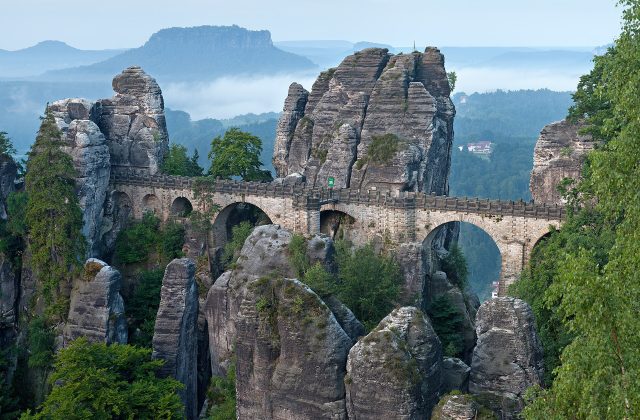
Saxon Switzerland National Park
Germany
Saxon Switzerland is the sandstone park on the Elbe south-east of Dresden, forty minutes from the city by train and two…
13 tickets & tours

Photo: Derzno, CC BY-SA 4.0
The Spreewald is a wooded inland delta about a hundred kilometres south-east of Berlin, in the state of Brandenburg, where the river Spree divides into hundreds of small channels, and it has been the favourite day excursion of Berliners since the railway arrived in the 1860s. Regional trains from the centre of Berlin reach the two main towns, Lubben and Lubbenau, in about an hour, and the motorway to Dresden and Cottbus passes both; the third centre, Burg, a village of scattered farmsteads spread over a wide area in the upper Spreewald, is reached by bus from the station at Vetschau or by car. There is no fee for the reserve itself. The one thing that every visitor does is to take a trip in a punt, the traditional flat-bottomed boat of the district, now fitted with benches and tables for twenty or thirty passengers, which a ferryman propels and steers from the stern with a single long ash pole, no motors being allowed;
the punts leave from harbours in all three places, that of Lubbenau being the largest, on round trips of between two and eight hours, the longer ones stopping for lunch at waterside inns, and in summer there are evening cruises and tours through the quietest reaches of the high forest from Burg. The favourite destination from Lubbenau is Lehde, a hamlet on islands where every house has its own landing stage and an open-air museum shows old farmsteads. Those who prefer their own pace can hire canoes and kayaks by the hour or day at dozens of landing places, following signposted water trails through locks that one works oneself, or bicycles, the country being perfectly flat and crossed by a long-distance cycle route named after the gherkin. A thermal bath at Burg, fed by brine, is the resort for wet days.
Live dates and prices from GetYourGuide. Free cancellation on most tickets.
The Spreewald was recognised as a UNESCO biosphere reserve in 1991, shortly after German reunification, and covers about 475 square kilometres, with a core zone of untouched forest, a larger zone of managed nature, and the inhabited, farmed landscape round them, the purpose of such a reserve being to protect a countryside shaped by people along with the way of life that keeps it so. It owes its form to the last ice age: when the ice retreated, the Spree, entering a broad, almost level valley left by the meltwaters, lost its force, dropped its sand and split into a braid of streams, which settlers over the centuries supplemented with canals, until the network reached some fifteen hundred kilometres of waterways, large and small, of which nearly three hundred are navigable by punt. Until the twentieth century there were no roads to many farms, and everything went by water, the harvest, the cattle, the coffin, the bride and the fire brigade; the postwoman of Lehde still delivers the mail by punt in summer, the only such round in Germany. The original inhabitants were Slavs, and the Spreewald remains the homeland of the Lower Sorbs, or Wends, one of the four recognised national minorities of Germany, whose language, close to Polish, appears beside German on every signpost and is taught in schools, though few speak it daily.
Their culture is seen in the women's festival costume, with a great winged headdress of starched and embroidered linen, in Easter eggs decorated with wax in minute patterns, in customs such as the cock-plucking at harvest and the carnival procession, and in the crossed snakes' heads with crowns carved on the gables of the log houses, in honour of the snake king of local legend, who brings luck to the house that shelters him. The economy rested on vegetables grown on plots reached only by boat, and the Spreewald gherkin, pickled with dill, mustard seed or garlic, has a protected designation and a devoted following, which famously survived the disappearance of nearly every other East German product; horseradish, and linseed oil eaten with curd cheese and potatoes, are the other specialities. The landscape is a patchwork of alder carr, the trees standing in black water, wet meadows dotted with haystacks built round a pole, and small fields, and it shelters otters, beavers, which have returned, white storks on the village roofs, black storks, white-tailed eagles, cranes, kingfishers, the rare fire-bellied toad and a great many dragonflies. The opencast lignite mines to the south, now closing, lowered the water table for decades, and their flooding releases iron that has at times turned the feeder streams rusty brown.
The punt season runs from about the beginning of April to the end of October, with the main harbours operating daily. May and June are the freshest months, with the alder woods in new leaf and the meadows in flower; July and August are warm and very crowded at Lubbenau and Lehde at weekends, when the channels near the harbours become a procession of boats, so that a weekday, an early start, or Burg, which is quieter, is preferable, and mosquitoes are then at their worst, particularly in the evening;
September and October bring calm, gold-tinted days and the gherkin and pumpkin harvest. In winter a few ferrymen offer trips with blankets and mulled wine, and when the channels freeze, which is now rare, people skate from village to village. The Sorbian carnival falls in January and February and Easter customs in spring. Bring insect repellent and a jacket for the water. Allow a day, better two. Berlin is an hour away, Cottbus and the landscape park of Branitz half an hour, and Dresden an hour and a quarter.
Yes. GetYourGuide lists one ticket or tour for Spreewald Biosphere Reserve, with live dates and prices and free cancellation on most of them.
Allow a day, better two.
Spreewald Biosphere Reserve covers 475 km².
Spreewald Biosphere Reserve was established in 1991.
Spreewald Biosphere Reserve is in Germany. The map on this page shows the exact spot.
Germany
Saxon Switzerland is the sandstone park on the Elbe south-east of Dresden, forty minutes from the city by train and two…
13 tickets & tours
Germany
The Hainich is a long, low, wooded ridge in the west of Thuringia, almost exactly in the geographical centre of…
1 ticket or tour
Germany
Berchtesgaden National Park occupies the south-eastern tip of Bavaria, a wedge of high limestone mountains thrust into…
No online ticket
Germany
The Eifel National Park lies in the hills of the northern Eifel, in the far west of Germany near the Belgian border,…
No online ticket
Germany
The Muritz National Park lies in the lake district of Mecklenburg, in the north-east of Germany, roughly midway between…
No online ticket


