Wolin National Park
124 km away
Wolin is the largest island of Poland, lying in the far north-western corner of the country between the Baltic and the…
1 ticket or tour

Photo: Bybbisch94, Christian Gebhardt, CC BY-SA 4.0
The Muritz National Park lies in the lake district of Mecklenburg, in the north-east of Germany, roughly midway between Berlin and the Baltic port of Rostock, about an hour and a half to two hours by road or rail from either, and it is a gentle, flat country of forests, marshes and more than a hundred lakes, made for cycling, canoeing and watching birds. It takes its name from the Muritz, the largest lake lying wholly within Germany, along whose eastern shore the main part of the park extends; a second, smaller part, round the village of Serrahn, lies forty kilometres to the east beyond the town of Neustrelitz. The chief gateway is Waren, a pretty harbour town on the northern tip of the Muritz, with a railway station on the line from Berlin to Rostock, a large natural history centre with aquariums, and every kind of accommodation; Neustrelitz serves the eastern side. Entry is free.
Private cars are kept out of most of the park, and the way to get about is by bicycle, which can be hired everywhere, on a network of several hundred kilometres of signposted paths, supplemented in the season by a special national park bus, which carries bicycles on a trailer and runs on a circuit from Waren through the villages of Federow, Speck and Boek, and by passenger boats on the lake between Waren, Klink, Robel and Boek, so that one can combine the three. Information houses stand at each of the main entrances. At Federow, a few kilometres from Waren, a camera trained on an osprey's nest relays pictures to a screen, and observation hides and towers are placed at the best bird lakes, notably at the fishponds of Boek and on the Rederang lake. The tower on the Kaflingsberg, fifty-five metres high, gives the one wide view over the forest. Canoes are hired for tours of a day or a week along the upper Havel, which rises in the park.
The national park was founded on 1 October 1990, as part of the programme by which the last government of East Germany, in its final weeks, placed large areas of the country under protection, and covers 322 square kilometres, of which seventy-two per cent is forest, thirteen per cent water and eight per cent bog. Its landscape was left by the last ice sheet, which retreated from here some fifteen thousand years ago, leaving a rolling terminal moraine in the east and, in the west, a flat plain of outwash sand, dotted with lakes and hollows where blocks of buried ice melted. The Muritz itself, 117 square kilometres and mostly shallow, takes its name from a Slavic word for a little sea; only its eastern shore belongs to the park, a wide belt of reed beds, fen, wet meadow and alder swamp, created when the level of the lake was lowered by nearly two metres in the 1830s. Much of the forest is a monotonous plantation of Scots pine, the legacy of Prussian and later forestry, and of the period when a large part of the present park was a private state hunting ground, reserved from the 1960s for the prime minister of East Germany and his guests, and closed to the public; since 1990 it has been left, step by step, to develop on its own, and the pine is gradually giving way to birch, oak and beech. The Serrahn section is different.
There, round a former grand-ducal hunting lodge, stands an old beech forest, which has not been managed for half a century and in parts for much longer, with trees of great age and a wealth of dead wood, and in 2011 it was inscribed, with four other German forests, as part of the World Heritage Site of the ancient and primeval beech forests of the Carpathians and other regions of Europe. The park is one of the best places in central Europe for large birds. It has the densest population of ospreys in Germany, which build their nests on the tops of electricity pylons, specially adapted for them, as well as on trees, together with white-tailed eagles, more than a dozen pairs, lesser spotted eagles, cranes, which breed in the wet alder woods and gather in autumn in thousands on the Rederang lake before flying south, bitterns, black storks, goldeneyes and red kites. Red deer are very numerous, fallow deer, wild boar, otters, beavers, which have returned, and the European pond terrapin are present, and the bogs shelter sundews, cotton grass and marsh orchids. The park also contains the sources of the river Havel, which flows from here to Berlin. A number of villages lie within it, with thatched cottages, brick churches and manor houses, and the traditional cuisine is of freshwater fish, above all smoked vendace and eel.
The park is open all year, though the bus, the boats and most information houses operate from about April or May to October. May and June are the finest months, with the forest in fresh leaf, birds nesting, ospreys feeding their young, and long, light evenings; July and August are warm, 20 to 25 degrees, the season for swimming in the lakes, canoeing and family holidays, with mosquitoes in the wet woods. From mid-September to the end of October the cranes assemble, the red deer rut, and the beeches of Serrahn turn gold, and guided evening excursions to watch the cranes fly in to roost, for which places are limited, should be booked ahead.
Winter is quiet, grey and often frosty, with wintering geese and swans on the lakes and white-tailed eagles easy to see. Large areas of the core zone may be entered only on the marked paths. Bring binoculars, insect repellent and a waterproof. Allow two to three days. Waren's natural history centre, the castle town of Neustrelitz and the baroque palace of Mirow are the cultural sights, and Berlin is two hours away.
124 km away
Wolin is the largest island of Poland, lying in the far north-western corner of the country between the Baltic and the…
1 ticket or tour
148 km away
The Spreewald is a wooded inland delta about a hundred kilometres south-east of Berlin, in the state of Brandenburg,…
1 ticket or tour
297 km away
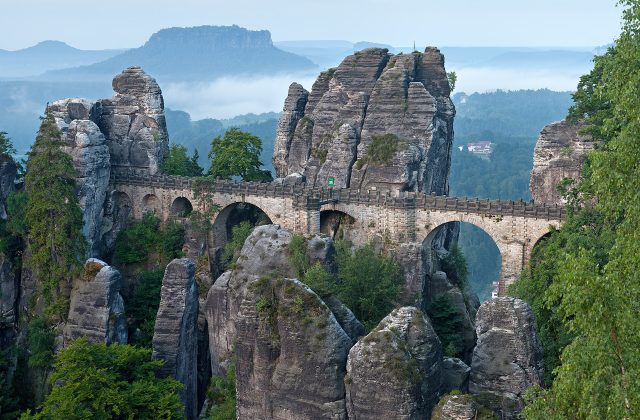
Saxon Switzerland is the sandstone park on the Elbe south-east of Dresden, forty minutes from the city by train and two…
13 tickets & tours
No online tour for Muritz National Park is listed on GetYourGuide; entry, where it is charged, is paid at the gate or through the park authority. Nearby parks with bookable tours are listed on this page.
The park is open all year, though the bus, the boats and most information houses operate from about April or May to October.
Allow two to three days.
Muritz National Park covers 318 km².
Muritz National Park was established in 1990.
Muritz National Park is in Germany. The map on this page shows the exact spot.
Germany
Saxon Switzerland is the sandstone park on the Elbe south-east of Dresden, forty minutes from the city by train and two…
13 tickets & tours
Germany
The Hainich is a long, low, wooded ridge in the west of Thuringia, almost exactly in the geographical centre of…
1 ticket or tour
Germany
The Spreewald is a wooded inland delta about a hundred kilometres south-east of Berlin, in the state of Brandenburg,…
1 ticket or tour
Germany
Berchtesgaden National Park occupies the south-eastern tip of Bavaria, a wedge of high limestone mountains thrust into…
No online ticket
Germany
The Eifel National Park lies in the hills of the northern Eifel, in the far west of Germany near the Belgian border,…
No online ticket