De Hoge Veluwe National Park
169 km away
De Hoge Veluwe, in the province of Gelderland in the east-central Netherlands, is an unusual national park in three…
3 tickets & tours
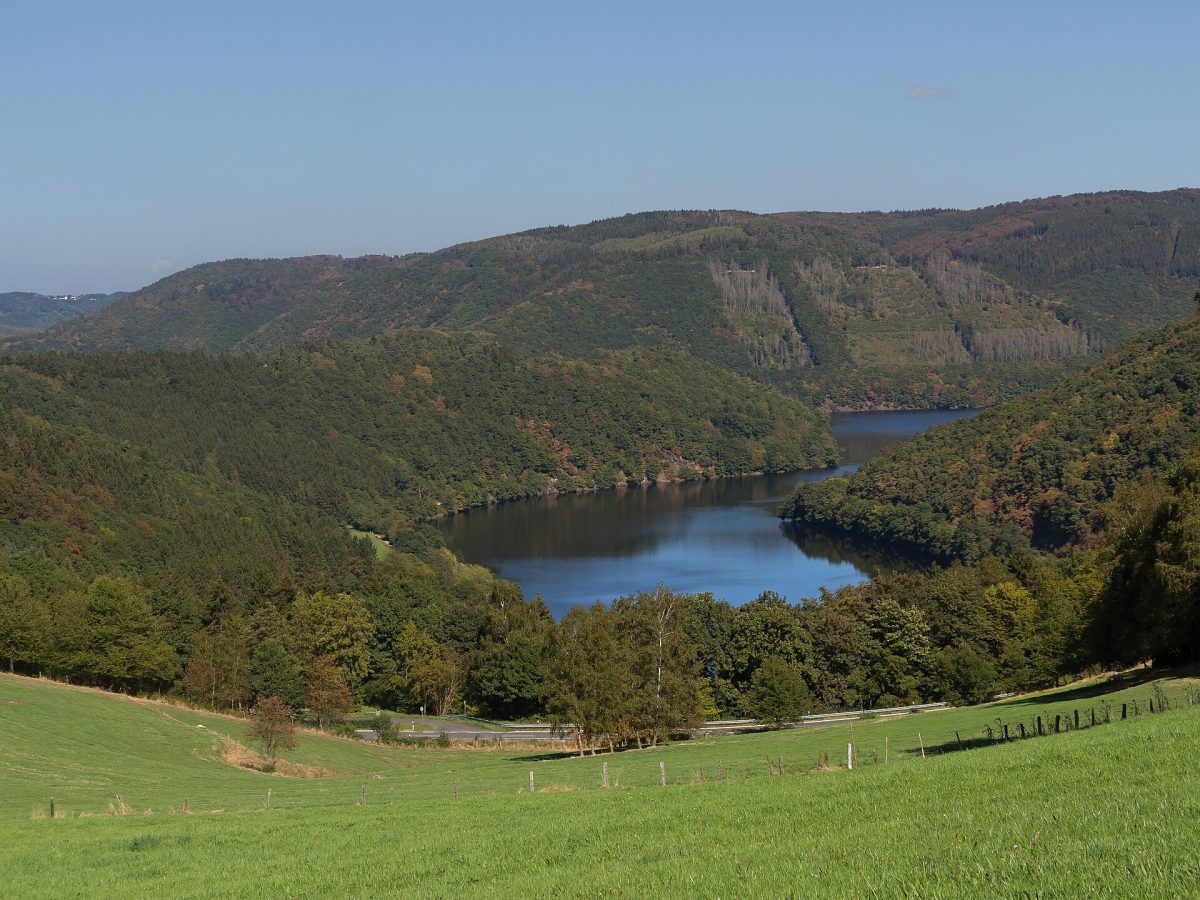
Photo: Michielverbeek, CC BY-SA 4.0
The Eifel National Park lies in the hills of the northern Eifel, in the far west of Germany near the Belgian border, about sixty-five kilometres, an hour by road, south-west of Cologne and much the same from Aachen and Bonn, and it combines forest, reservoir lakes and one of the most thought-provoking historical sites in the country. Regional trains run from Cologne to Kall and from Duren to Heimbach, at the park's edge, from which buses, including a national park shuttle and lines that carry bicycles, serve the main entry points; the park is free and has no gates. Five small information centres, called gates, stand in the surrounding villages, at Rurberg, Gemund, Heimbach, Hofen and Nideggen, each with an exhibition on one aspect of the park, but the principal visitor centre is at Vogelsang, on a hill in the middle of the park above the Urft reservoir, where a large exhibition on wilderness shares the restored buildings of a Nazi training college with a documentation centre on the history of the site, a restaurant, a tower with a wide view and guided tours of the grounds.
More than two hundred and forty kilometres of marked paths are open to walkers, and a good part of them to cyclists and riders. The flagship route is the Wilderness Trail, eighty-five kilometres in four daily stages from Hofen, near the old town of Monschau, across the whole park to Zerkall. For a short visit, the favourites are the barrier-free Wild Kermeter trail, through old beech forest to a viewpoint over the lake; the walk across the open Dreiborn plateau to the abandoned village of Wollseifen; and the path along the Urft reservoir to its dam. Boats ply the Rursee and its upper arm, linking Rurberg, Woffelsbach, Schwammenauel and Heimbach, which makes possible walks in one direction. The rangers lead free guided walks every day of the year from different starting points.
Live prices from GetYourGuide for tours whose route includes this park. Free cancellation on most of them.
The national park was founded on 1 January 2004, the first in the state of North Rhine-Westphalia, and covers about 110 square kilometres. It describes itself frankly as a national park in development: most of its forest was, at the time of its creation, managed woodland, including large plantations of spruce, which is not native to these hills, and the aim, over a period of thirty years, is to remove the foreign conifers, withdraw step by step from all management, and allow the natural vegetation, a beech forest of the kind that would cover most of western Germany if left alone, to re-establish itself over at least three quarters of the area, under the motto of letting nature be nature. Remnants of old beech and oak wood on the steep slopes of the Kermeter, above the lakes, show what is intended, and more than eleven thousand species of animals, plants and fungi have already been recorded, among them a strong population of the European wildcat, the black stork, the eagle owl, the middle spotted woodpecker, the beaver, which has recolonised the streams, the wall lizard on the sunny rocks, and herds of red deer, which can be watched from a viewing stand on the Dreiborn plateau, above all during the rut. The park owes its existence to the army.
At its centre lies the Dreiborn plateau, thirty-three square kilometres of open heath and grassland, which the British forces requisitioned in 1946 as a training area, expelling the five hundred inhabitants of the village of Wollseifen at three weeks' notice, and which the Belgian army used from 1950 until the end of 2005; shelling kept it treeless, and in late May and June it is covered with the yellow flowers of the broom, called Eifel gold. The shell of Wollseifen's church and school and the mock houses built for street-fighting practice still stand. Beside the plateau rises Vogelsang, one of the largest surviving building complexes of the Nazi period, erected between 1934 and 1936 to the designs of the Cologne architect Clemens Klotz as one of three so-called order castles, in which selected young party members were to be formed, through sport, ideology and drill, into the future leadership of the regime; its massive stone ranges, tower, parade grounds and sports fields, with their heroic reliefs, step down the hillside above the lake in a calculated display of power, and the exhibition in its halls examines how ordinary men were turned into a self-styled master race. The lakes are themselves historic: the Urft dam, completed in 1905, created what was then the largest reservoir in Europe, and its Art Nouveau power station at Heimbach still works. In 2014 the park was recognised as an international dark sky park, and an astronomy workshop at Vogelsang offers evenings under the Milky Way.
The park is open all year, and Vogelsang daily. Spring comes late to these hills: in April the wild daffodils flower in millions in the meadows of the Perlenbach and Fuhrtsbach valleys, near Hofen at the park's south-western edge, a famous sight; the beeches come into leaf in early May, and the broom on the Dreiborn plateau blazes from mid-May to mid-June. Summer is mild, 18 to 24 degrees, and the season of the lake boats, which run from about April to October, and of swimming at Rurberg and Einruhr.
From mid-September to mid-October the red deer rut, and the viewing platform is thronged at dusk, followed by fine autumn colour in the beech woods. Winter brings mist, some snow and quiet, and clear winter nights are the best for stars. On the Dreiborn plateau and at Wollseifen walkers must keep strictly to the marked paths, since unexploded munitions remain in the ground. Allow one to three days. Monschau, a town of half-timbered houses, is fifteen minutes from Hofen, Aachen forty-five minutes, and Cologne an hour.
169 km away
De Hoge Veluwe, in the province of Gelderland in the east-central Netherlands, is an unusual national park in three…
3 tickets & tours
243 km away
Weerribben-Wieden is a watery landscape of lakes, canals, reed beds, quaking bog and swamp forest in the north-west of…
1 ticket or tour
283 km away
The Hainich is a long, low, wooded ridge in the west of Thuringia, almost exactly in the geographical centre of…
1 ticket or tour
Yes. GetYourGuide sells tickets and guided tours whose route includes Eifel National Park; live prices are shown on this page.
More than two hundred and forty kilometres of marked paths are open to walkers, and a good part of them to cyclists and riders.
Allow one to three days.
Eifel National Park covers 108 km².
Eifel National Park was established in 2004.
Eifel National Park is in Germany. The map on this page shows the exact spot.
Germany
Saxon Switzerland is the sandstone park on the Elbe south-east of Dresden, forty minutes from the city by train and two…
13 tickets & tours
Germany
The Hainich is a long, low, wooded ridge in the west of Thuringia, almost exactly in the geographical centre of…
1 ticket or tour
Germany
The Spreewald is a wooded inland delta about a hundred kilometres south-east of Berlin, in the state of Brandenburg,…
1 ticket or tour
Germany
Berchtesgaden National Park occupies the south-eastern tip of Bavaria, a wedge of high limestone mountains thrust into…
No online ticket
Germany
The Muritz National Park lies in the lake district of Mecklenburg, in the north-east of Germany, roughly midway between…
No online ticket