Rajaji National Park
192 km away
Rajaji is the tiger reserve that lies on the doorstep of the holy towns of Haridwar and Rishikesh, in the foothills of…
3 tickets & tours
Mountain Park · Himachal Pradesh · India

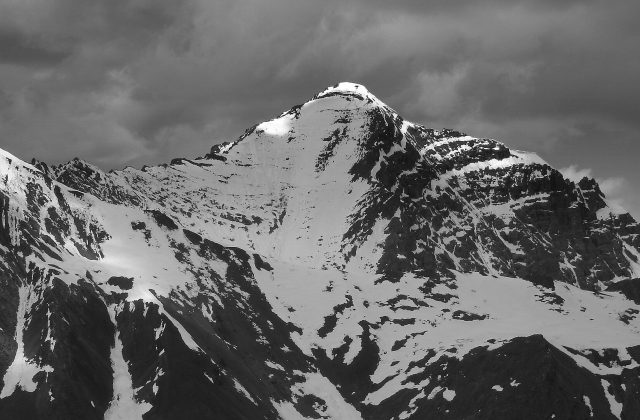
Photo: Samir Azad, CC BY-SA 4.0
The Great Himalayan National Park lies in the Kullu district of Himachal Pradesh, in the western Himalaya of northern India, in the upper valleys of four rivers that drain to the Beas, and it is a park for walkers only, since no road enters it and everything within it is reached on foot, generally over several days. The gateways are the quiet side valleys of Tirthan and Sainj, which leave the main Kullu valley road near the Aut tunnel, about an hour south of Kullu town and its small airport at Bhuntar, which has occasional flights from Delhi; most people come by overnight bus from Delhi or Chandigarh to Aut, ten to twelve hours, and then by taxi for an hour to the villages of Gushaini or Banjar in the Tirthan valley or Neuli in the Sainj.
The Tirthan valley has developed a pleasant scatter of homestays and small riverside guesthouses, which makes it an agreeable base in itself, with trout fishing, by licence, and day walks in the buffer zone, to the waterfall at Chhoie, to village temples, and to the park gate at Rolla, eight or nine kilometres from the roadhead at Gushaini along the river. To go further, a permit is required, issued for a fee by the park offices at Shamshi, near Kullu, and at Sai Ropa in the Tirthan valley, where there is a small interpretation centre, and visitors must be accompanied by a registered local guide and porters, arranged through the community cooperatives or the homestays, who supply tents and food. The classic treks are those up the Tirthan to its glacial source at Tirath, seven to eight days, up the Sainj to the meadows of Dhel and the Raktisar glacier, and the crossing between the two valleys by the high pastures, five to six days; shorter walks of two or three days reach Shilt hut and Rakhundi top for a view of the snow peaks.
The park was constituted in 1984 and formally declared in 1999, covering 755 square kilometres, and with the adjoining Sainj and Tirthan sanctuaries and a buffer zone in which some fifteen thousand people live in 160 villages, it forms a conservation area of 1,171 square kilometres, which was inscribed as a World Heritage Site in 2014. It lies at the junction of two of the great biological realms of the earth, the Indomalayan to the south and the Palearctic to the north, on the southern, monsoon-drenched face of the main Himalaya, and rises from about 1,500 metres to summits of more than 6,000, so that within a few days' walk one passes through every zone of the mountain: forests of blue pine, deodar cedar and horse chestnut, then oak, fir, spruce and yew, with thickets of bamboo and rhododendron, then birch at the tree line, and above about 3,500 metres the thach, flower-filled alpine meadows that herders have used for centuries, and finally moraine, glacier and rock. It was chosen for protection after an international survey in the early 1980s identified these valleys as among the least disturbed in the western Himalaya, and they remain so because they are steep, trackless and were never logged on a large scale. The park is celebrated among ornithologists for its pheasants.
The western tragopan, a bird of the dense undergrowth of the upper forest, the male crimson and black spotted with white, with a blue throat wattle that he displays in spring, is one of the rarest pheasants in the world, confined to a narrow strip of the western Himalaya, and this park holds its largest protected population; with it live the Himalayan monal, of iridescent green, copper and purple, the state bird, the koklass, the kalij and the cheer pheasant. The mammals include the Himalayan tahr and the goral on the cliffs, the blue sheep and the ibex higher up, the musk deer, the serow, the Himalayan brown bear on the high pastures, the black bear in the forest, the common leopard, and, above the tree line, a small number of snow leopards, photographed regularly by camera traps. When the park was finally notified, the traditional rights of the surrounding villagers to graze sheep and goats on its meadows in summer and to collect medicinal herbs and the valuable morel mushroom were extinguished, with compensation, a decision that caused lasting resentment and that the park has tried to soften by training local men and women as guides, cooks and craftworkers. Every village has its own deity, housed in a carved wooden temple with a pagoda roof, who is carried in procession to festivals, and several of the high lakes and summits are sacred to them.
The park is open all year in principle, but the trekking seasons are two. From mid-April to the end of June the snow retreats up the mountains, the rhododendrons flower, the pheasants call and display, which makes April and May the time for birdwatchers, and the high meadows open by June. The monsoon, from July to mid-September, brings heavy rain, leeches, swollen rivers, landslides on the approach roads, which in recent years have caused severe damage in the Kullu valley, and cloud over the peaks, though the alpine meadows are then in full flower.
From mid-September to mid-November the weather is settled, the air clear, the forests turn gold and red, and this is the best season for the high routes. From December to March the upper park is under deep snow, and only the lower valley is accessible, when the animals come down and are easier to see. Carry warm and waterproof clothing, and allow time to acclimatise above three thousand metres. Allow three to eight days. The Jalori pass and Serolsar lake, the hot springs of Manikaran and the town of Manali are the other sights of the region.
192 km away
Rajaji is the tiger reserve that lies on the doorstep of the holy towns of Haridwar and Rishikesh, in the foothills of…
3 tickets & tours
198 km away
The Valley of Flowers is a high hanging valley in the Garhwal Himalaya, in the Chamoli district of the Indian state of…
2 tickets & tours
247 km away
Hemis is a high-altitude park in Ladakh, in the far north of India, across the Indus from the town of Leh, which is…
1 ticket or tour
No online tour for Great Himalayan National Park is listed on GetYourGuide; entry, where it is charged, is paid at the gate or through the park authority. Nearby parks with bookable tours are listed on this page.
The park is open all year in principle, but the trekking seasons are two.
Allow three to eight days.
From mid-September to mid-November the weather is settled, the air clear, the forests turn gold and red, and this is the best season for the high routes.
Great Himalayan National Park covers 755 km².
Great Himalayan National Park was established in 1984.
Great Himalayan National Park is in Himachal Pradesh, India. The map on this page shows the exact spot.