Teide National Park
Canary Islands, Spain
Teide is the volcano at the centre of Tenerife and the most visited national park in Spain, and it is reached from…
48 tickets & tours
Desert Park · Canary Islands · Spain

Photo: dronepicr, CC BY 2.0
Jandía is the mountainous peninsula that forms the south-western tail of Fuerteventura in the Canary Islands, joined to the rest of the island by a low, sandy isthmus, and the natural park covers nearly all of it except the hotel strip of Costa Calma and Morro Jable along its sheltered southern shore, which is where most visitors are staying. The park has no gates or fees. Its famous destination is Cofete, a wild beach on the windward, northern side, reached from Morro Jable by about twenty kilometres of unpaved road that climbs over a pass in the mountains with a viewpoint, the Degollada de Agua Oveja, from which the whole empty coast appears at once;
the track is rough, narrow and unfenced in places, rental agreements for ordinary cars generally exclude it, and for that reason the 4×4 jeep safaris sold in all the resorts, a half-day or a full day with a driver-guide, are the usual way of going, taking in Cofete, the Villa Winter, and the lighthouse at Punta de Jandía at the peninsula's tip, with the fishing hamlet of El Puertito beside it, where lunch is fried fish. A rugged public bus, a converted 4×4 lorry, also runs from Morro Jable to Cofete and the lighthouse twice a day. Buggy tours use the tracks at the western end. Walkers can cross the range on foot by the old path from the Gran Valle to Cofete, about three hours each way, or climb the Pico de la Zarza, the island's summit, from Morro Jable, five to six hours return, shadeless and easy underfoot. Guided treks cross the dunes of the isthmus. The long lagoon beaches of Sotavento, on the southern side, are world-famous for windsurfing and kitesurfing.
Live dates and prices from GetYourGuide. Free cancellation on most tickets.
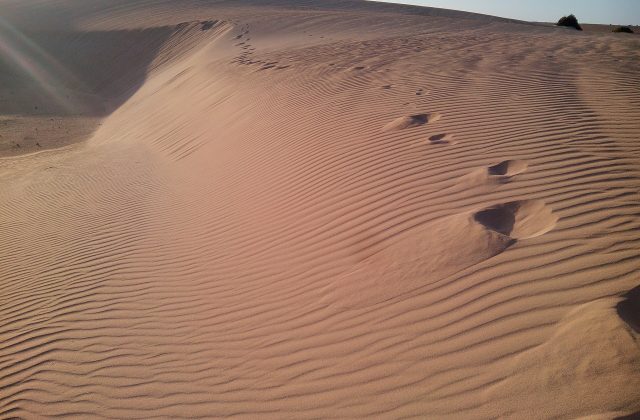
The natural park was declared in 1987 and covers about 145 square kilometres. The Jandía massif is the remains of one of the three great shield volcanoes that built Fuerteventura some twenty million years ago, the oldest of the Canary Islands: half of the volcano has disappeared, probably in a gigantic landslide into the ocean, leaving a curved ridge of dark basalt, the Pico de la Zarza, 807 metres, its highest point and the highest on the island, which drops on its northern side in a great concave wall of cliffs and ravines straight down to the beach, and on its southern side slopes more gently in a series of parallel dry valleys. The isthmus that links it to the rest of the island, the Istmo de la Pared, is a field of pale, shifting sand, the ground-up shells of marine creatures, blown across from the windward coast to feed the beaches of Sotavento on the other side; tradition says a wall once crossed it, dividing the island's two pre-Hispanic kingdoms.
Cofete beach, with the adjoining Barlovento, is some fourteen kilometres of golden sand under the mountain wall, pounded by Atlantic surf, with treacherous currents that make swimming unsafe, a handful of shacks, a tiny cemetery half buried in the sand, and one incongruous building on the slope above: the Villa Winter, a turreted house built in the 1940s by the German engineer Gustav Winter, who leased the whole peninsula in 1937, around which a thicket of legends has grown, of U-boat bases, tunnels and fugitive Nazis, none of them proved. The cloud that catches on the summit ridge sustains the rarest plant of the Canaries, the cardón de Jandía, a cactus-like spurge found only on this peninsula and the botanical symbol of the island, along with a number of other endemics. Houbara bustards, cream-coloured coursers, Egyptian vultures, the Canary Islands stonechat, which lives only on Fuerteventura, and Barbary ground squirrels inhabit the park, goats roam it half wild, and loggerhead turtles are being reintroduced on the beach at Cofete.
The park is open at all times. Fuerteventura has a dry desert climate, with 20 to 23 degrees in winter and 27 to 30 in summer, and the trade wind, which blows hardest from May to September and is the reason for the windsurfing world cup held at Sotavento each July; the windward coast at Cofete is always rougher and cooler than the resorts.
Winter and spring are the best seasons for walking, with the mountains briefly tinged green after rain, and the summit of La Zarza is often capped in cloud by midday, so start early. There is no water, shade or mobile coverage on the trails, and no fuel beyond Morro Jable. Allow a half-day to a full day for Cofete and the lighthouse. Morro Jable is the base, Costa Calma and Sotavento's lagoons half an hour north-east, and Betancuria and Ajuy's caves in the centre of the island.
Yes. GetYourGuide lists 4 tickets and tours for Jandía Natural Park, with live dates and prices and free cancellation on most of them.
The park is open at all times.
Allow a half-day to a full day for Cofete and the lighthouse.
Jandía Natural Park covers 150 km².
Jandía Natural Park was established in 1987.
Jandía Natural Park is in Canary Islands, Spain. The map on this page shows the exact spot.
Canary Islands, Spain
Teide is the volcano at the centre of Tenerife and the most visited national park in Spain, and it is reached from…
48 tickets & tours
Canary Islands, Spain
Timanfaya is the lava field of south-western Lanzarote, half an hour from the island's resorts, and it is a park…
13 tickets & tours
Canary Islands, Spain
The Corralejo dunes lie immediately south of the resort town of Corralejo at the northern tip of Fuerteventura in the…
7 tickets & tours
Canary Islands, Spain
The Caldera de Taburiente is an enormous, pine-clad crater-like depression that occupies the centre of the northern…
1 ticket or tour
Canary Islands, Spain
Garajonay occupies the summit plateau of La Gomera, the small, round, deeply ravined island that lies within sight of…
1 ticket or tour
Canary Islands, Spain
The Corona Forestal, the forest crown, is the great ring of pine woods that encircles the high central part of…
No online ticket