
Teide National Park
Canary Islands, Spain
Teide is the volcano at the centre of Tenerife and the most visited national park in Spain, and it is reached from…
48 tickets & tours
Desert Park · Canary Islands · Spain
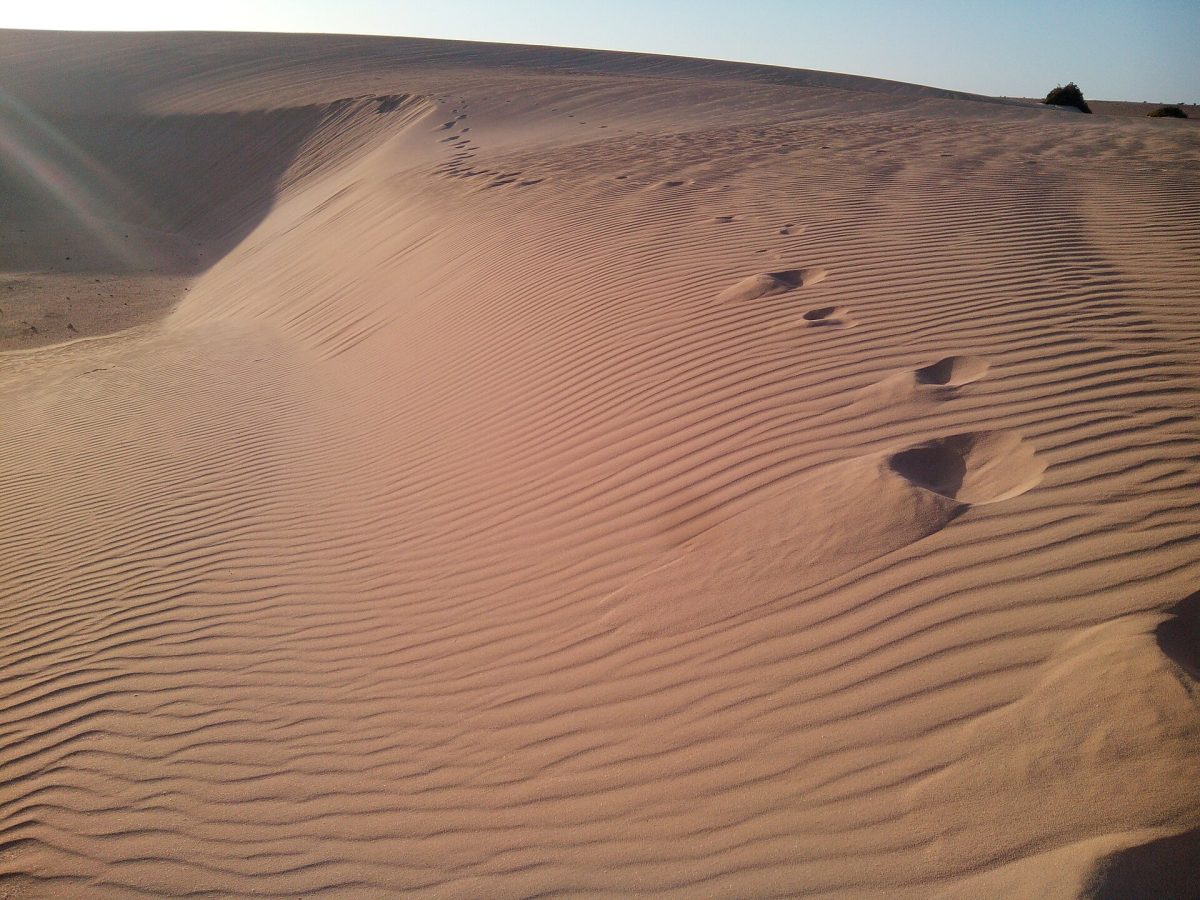
Photo: Benjamín Núñez González, CC BY-SA 4.0
The Corralejo dunes lie immediately south of the resort town of Corralejo at the northern tip of Fuerteventura in the Canary Islands, and they are the rare natural park that requires no planning whatever: the coast road, the FV-1, runs straight through the middle of them for ten kilometres, there is no gate and no fee, cars pull onto the sandy verges, and the local bus between Corralejo and Puerto del Rosario stops at the two big hotels that stand, by a planning decision of the 1970s long regretted, on the beach inside the park. Most people simply walk into the dunes from the road or spend the day on the beaches on the other side of it.
What is sold around the park is mostly beside the point: the quad and buggy tours, from Corralejo and for day-trippers from Lanzarote, must by law keep out of the dunes and run on dirt tracks through the volcanic badlands inland; the water park is in the town. The things worth paying for are the guided walks, with a naturalist who explains the dunes and climbs the Montaña Roja for the panorama; bicycle hire, since a cycle path follows the road; kitesurfing and windsurfing lessons on Flag Beach, one of the best learning beaches in Europe; and above all the little ferry from Corralejo harbour to Isla de Lobos, fifteen minutes across the strait, for which a free permit from the island council, limited in number and booked online a few days ahead, is required and is often bundled with the boat ticket.
Live dates and prices from GetYourGuide. Free cancellation on most tickets.
The natural park was declared in 1982, together with Lobos, and given its present boundaries in 1994; it covers about 26 square kilometres along the north-east coast of Fuerteventura. The northern two thirds is the largest dune field in the Canary Islands, some eight kilometres long and two and a half wide, of pale, almost white sand that is not, as visitors suppose, blown over from the Sahara a hundred kilometres away, but made on the spot, of the ground-up shells of marine molluscs and other organisms, carried ashore by currents and heaped by the trade wind into barchans and ridges that creep southwards year by year and now and then bury the road. Against the black lava, the red volcanic cones and a sea of several improbable blues, with Lobos and the mountains of Lanzarote across the water, the effect is very fine, above all early and late in the day.
The southern third of the park is quite different, a malpaís of dark, broken lava and ochre earth around the Montaña Roja, a red cinder cone 312 metres high, climbed in forty minutes. The Grandes Playas, the great beaches, run for kilometres along the edge of the dunes, wide, clean and backed by low stone windbreaks, called corralitos, built by bathers against the constant breeze; the currents can be strong, and the flags should be heeded. Little grows but saltbush, sea-spurge and other specialists of sand and salt, and the wildlife is sparse and special: the houbara bustard and the cream-coloured courser, which run on the stony plains, stone curlews, Berthelot's pipits, Barbary ground squirrels, which are introduced and beg at the car parks, and the Atlantic lizard. Lobos, six square kilometres, has a lagoon, a ruined lighthouse path, a volcano to climb and once had the monk seals, the sea wolves, that named it.
The park is open at all times. Fuerteventura's climate is dry and mild all year, 20 to 22 degrees in winter and 27 to 30 in summer, and the one variable is the wind, which blows hardest from April to September, to the delight of kitesurfers and the annoyance of sunbathers, whose sandblasted legs explain the corralitos; the calima, a hot wind laden with Saharan dust, occasionally yellows the sky for a few days.
Sunrise and the hour before sunset give the dunes their shadows and their colour, and the midday glare flattens them. There is no shade and no water in the dunes. Allow a half-day, a full day with Lobos. Corralejo town is five minutes away, El Cotillo's lagoons half an hour west, and Lanzarote's Playa Blanca twenty-five minutes by ferry.
Yes. GetYourGuide lists 7 tickets and tours for Corralejo Natural Park, with live dates and prices and free cancellation on most of them.
The park is open at all times.
Allow a half-day, a full day with Lobos.
Corralejo Natural Park covers 26.2 km².
Corralejo Natural Park was established in 1982.
Corralejo Natural Park is in Canary Islands, Spain. The map on this page shows the exact spot.
Canary Islands, Spain
Teide is the volcano at the centre of Tenerife and the most visited national park in Spain, and it is reached from…
48 tickets & tours
Canary Islands, Spain
Timanfaya is the lava field of south-western Lanzarote, half an hour from the island's resorts, and it is a park…
13 tickets & tours
Canary Islands, Spain
Jandía is the mountainous peninsula that forms the south-western tail of Fuerteventura in the Canary Islands, joined to…
4 tickets & tours
Canary Islands, Spain
The Caldera de Taburiente is an enormous, pine-clad crater-like depression that occupies the centre of the northern…
1 ticket or tour
Canary Islands, Spain
Garajonay occupies the summit plateau of La Gomera, the small, round, deeply ravined island that lies within sight of…
1 ticket or tour
Canary Islands, Spain
The Corona Forestal, the forest crown, is the great ring of pine woods that encircles the high central part of…
No online ticket


