Budj Bim National Park
151 km away
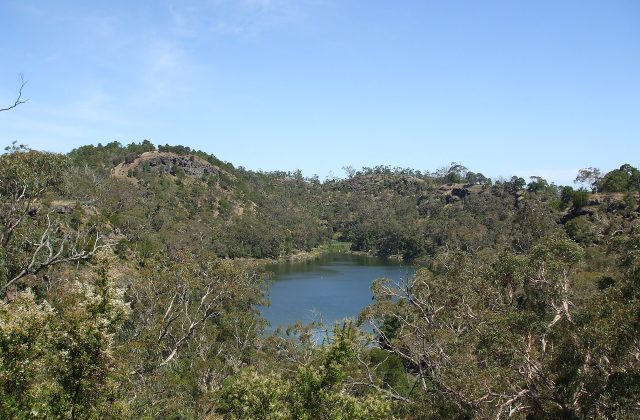
Budj Bim, known until 2017 as Mount Eccles, is a small park round an extinct volcano in the basalt plains of…
1 ticket or tour
Forest Park · South Australia · Australia

Photo: Feral Arts, CC BY 2.0
The Naracoorte Caves lie in the south-east of South Australia, in the wine and farming country called the Limestone Coast, about 340 kilometres, three and a half to four hours by road, from Adelaide, and rather more from Melbourne, so that they make a natural overnight stop on the inland route between the two cities; the country town of Naracoorte, ten kilometres to the north, has accommodation, and the park has its own campground and bunkhouse. There is no public transport. Entry to the park, its picnic grounds and surface walks is free, and one pays for each cave visited, with combined tickets for those who want to see several, bookings being advisable in school holidays. Everything starts from the Wonambi fossil centre, the visitor centre, where a walk-through display recreates, with life-size moving models in a simulated forest, the extinct animals whose bones have been found in the caves, which is the best preparation for what follows and delights children.
Four caves are open. The Stick-Tomato cave, close to the centre, is small and is visited without a guide. The Alexandra cave, on a guided tour of half an hour, is the prettiest, with delicate stalactites, straws, columns and a reflecting pool. The Victoria Fossil cave, the reason for the park's fame, is seen on a guided tour of about an hour, which passes through decorated chambers to the fossil chamber itself, where the guide explains the bone bed and reconstructed skeletons stand among the sediments. The Blanche cave, the first to be discovered, a succession of three large chambers open to the daylight, with thick columns, is included in other tours. From November to February a further tour visits the bat observation centre, where infra-red cameras relay pictures from inside the maternity cave, and at dusk the bats can be watched streaming out. Adventure caving, crawling and squeezing through undeveloped caves with helmet and lamp, is offered at several levels.
Live prices from GetYourGuide for tours whose route includes this park. Free cancellation on most of them.
The caves were reserved in the nineteenth century, became a conservation park in 1972 and a national park in 2001, the date of 2011 sometimes quoted being an error, and cover about six hundred hectares; in 1994 they were inscribed as a World Heritage Site, together with the fossil beds of Riversleigh in distant Queensland, as the Australian fossil mammal sites, the two between them documenting the evolution of the continent's unique fauna. The caves lie in a low ridge, an old line of coastal dunes stranded far inland, beneath which is a bed of soft limestone laid down on a sea floor some two hundred million years after the dinosaurs had gone; groundwater dissolved it into chambers, and over the last half a million years and more, holes opened in their roofs. Those holes were pitfall traps. Animals wandering through the scrub at night fell in and could not get out, owls roosting in the entrances dropped the remains of their prey, predators used the caves as dens, and layer upon layer of sand washed in over the bones, preserving them in dry, stable, alkaline conditions. In 1969 two cavers, Grant Gartrell and Rod Wells, squeezing through a narrow passage in what was then called Victoria cave, came upon a chamber whose floor was a carpet of bones, and excavation, which still continues, has since recovered from this and other caves in the park the remains of more than 130 species of mammals, birds, reptiles and frogs, in a nearly continuous record covering the last five hundred thousand years, one of the richest and best dated deposits of ice-age animals in the world.
They include the whole cast of the vanished Australian megafauna: Thylacoleo, the marsupial lion, a leopard-sized predator with slicing cheek teeth and the most powerful bite, for its size, of any known mammal; Diprotodon, the largest marsupial that ever lived, the size of a rhinoceros; Zygomaturus, a swamp-dwelling relative; giant short-faced kangaroos that stood more than two metres tall and browsed from trees; the giant echidna; Wonambi, a constricting snake five or six metres long; and a huge monitor lizard, together with species that survive, such as the Tasmanian devil and the thylacine, which show that these lived on the mainland until a few thousand years ago. Because the sequence spans several swings of climate between glacial and warm periods, and continues after the arrival of people in Australia, it bears directly on the great unresolved question of what killed the giant animals, some forty-five thousand years ago, climate or human hunters. The park has a living rarity too: the Bat cave is one of only two maternity sites of the critically endangered southern bent-wing bat, to which tens of thousands of females come each spring to give birth, the warmth of their massed bodies raising the temperature of the chamber. Blanche cave was found in 1845 by a settler looking for lost sheep, and was for decades a fashionable place for picnics and balls by candlelight.
The park is open every day except Christmas Day, with tours at fixed times from mid-morning to mid-afternoon, fewer in winter. Since the caves remain at about 17 degrees throughout the year, the visit is as good in any season, and the choice depends on the surface weather and on the bats: the southern bent-wing bats are present in the maternity cave from about September to March, and the evening flight and the bat tour operate in the warmer months, best from November to February.
The south-east of South Australia has mild, dry summers of 25 to 30 degrees, with the occasional very hot day, and cool, wet winters of about 14 degrees. School holidays and long weekends are the busy times, when tours should be booked ahead. The Victoria Fossil cave tour involves steps and some stooping, and is not suitable for pushchairs. Bring a light jacket and closed shoes. Allow half a day. The vineyards of Coonawarra, famous for red wine from its strip of terra rossa soil, are half an hour south, the Bool lagoon wetlands twenty minutes, and the volcanic blue lake of Mount Gambier an hour and a quarter.
151 km away
Budj Bim, known until 2017 as Mount Eccles, is a small park round an extinct volcano in the basalt plains of…
1 ticket or tour
268 km away
Port Campbell National Park is a narrow strip of cliff-top heath along the south-west coast of Victoria, Australia, and…
1 ticket or tour
272 km away
The Twelve Apostles are the limestone sea stacks on the south-west coast of Victoria that serve as the climax of the…
5 tickets & tours
Yes. GetYourGuide sells tickets and guided tours whose route includes Naracoorte Caves National Park; live prices are shown on this page.
The park is open every day except Christmas Day, with tours at fixed times from mid-morning to mid-afternoon, fewer in winter.
The Stick-Tomato cave, close to the centre, is small and is visited without a guide.
Naracoorte Caves National Park covers 6.6 km².
Naracoorte Caves National Park was established in 2001.
Naracoorte Caves National Park receives about 90 812 a year (2022).
Naracoorte Caves National Park is in South Australia, Australia. The map on this page shows the exact spot.
South Australia, Australia
The Flinders Ranges are the great mountain chain of South Australia, a line of rugged, purple and ochre ridges running…
3 tickets & tours
South Australia, Australia
Coffin Bay National Park occupies a long, hooked peninsula on the western side of the southern Eyre Peninsula in South…
1 ticket or tour
South Australia, Australia
The Coorong is a long, narrow, shallow lagoon on the coast of South Australia, running for some 130 kilometres…
No online ticket
South Australia, Australia
Flinders Chase occupies the wild western end of Kangaroo Island, the third largest island of Australia, which lies off…
No online ticket