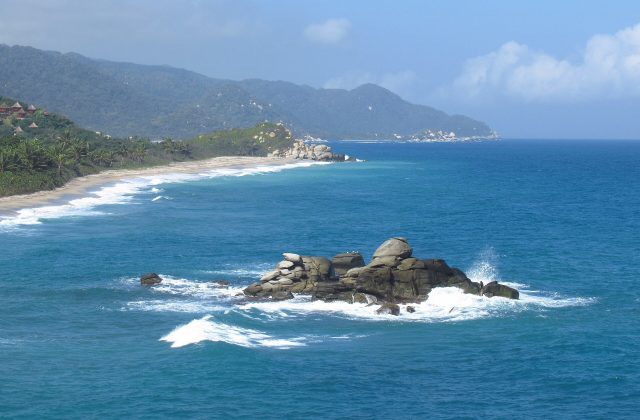
Tayrona National Natural Park
Colombia
Tayrona is the park of jungle-backed beaches east of Santa Marta on Colombia's Caribbean coast, an hour from the…
19 tickets & tours

Photo: Ulughmuztagh, CC BY-SA 3.0
The Corales del Rosario y San Bernardo is a marine park off the Caribbean coast of Colombia, protecting the coral reefs round two small archipelagos south-west of the walled city of Cartagena, and the day trip by boat to the Rosario islands is the most popular excursion from that city, taken by hundreds of thousands of people a year. The Rosario islands, some twenty-eight of them, low, green and fringed with mangroves, lie about forty-five kilometres from Cartagena, an hour by speedboat. Boats leave each morning, between about eight and nine, from the Muelle de la Bodeguita, the tourist pier opposite the old city, and from private jetties, and a port tax, which includes the park's entrance fee, is paid there.
The standard excursion, sold by countless agencies and touts, is a day of boat travel: a circuit among the islands, a stop at the small oceanarium on the island of San Martin de Pajarales, for which a separate ticket is sold, where sharks, turtles and dolphins are kept in sea pens, and then several hours, with a fish lunch, at Playa Blanca, a long white beach on the peninsula of Baru, which is not in the park at all and is heavily commercialised and crowded. It is much better to book a day pass, or a night or two, at one of the small hotels and beach clubs on the islands themselves, above all on Isla Grande, the largest, which has footpaths through dry forest, an Afro-Colombian village, inland lagoons, one of which glows at night with bioluminescent plankton, and snorkelling and diving over the reefs near by, or to charter a private boat. The San Bernardo islands, ten of them, lie much further south, off the town of Tolu, and are reached either from Tolu in under an hour or from Cartagena in about two hours by fast boat; they are quieter, with hostels and eco-lodges on Tintipan and Mucura, and excursions past the tiny, densely built islet of Santa Cruz.
Live dates and prices from GetYourGuide. Free cancellation on most tickets.
The national natural park was created in 1977 and enlarged in 1988 and 1996 to take in the San Bernardo archipelago, and covers about 1,200 square kilometres, almost all of it under water, which makes it one of the few Colombian national parks that is essentially marine. It protects the most extensive and best developed coral reef platform on the continental coast of the Colombian Caribbean, which has grown up over several thousand years on a series of submerged banks pushed upwards by mud diapirs, domes of pressurised mud rising from deep below the sea bed, and the islands themselves are of fossil coral limestone, a few metres high, raised by the same movements. The reefs include fringing reefs, patch reefs, steep outer slopes that drop to thirty metres and more, and wide shallow terraces, with some fifty-two species of hard corals, brain, star, pillar, lettuce and fire corals, and formerly great thickets of elkhorn and staghorn, together with sea fans, sponges and anemones; between and behind them lie meadows of turtle grass and forests of four kinds of mangrove, which shelter the young of the reef fish, and the three habitats depend on one another. Some 215 species of fish have been listed, angelfish, parrotfish, snappers, grunts, barracuda, moray eels and rays among them, with hawksbill and green turtles, spiny lobsters, queen conch, and, on the islands, frigatebirds, brown pelicans, herons, iguanas and boas. It must be said frankly that the reefs are in a poor state compared with what they were.
The Canal del Dique, a channel first dug by the Spaniards in the sixteenth century to connect Cartagena with the Magdalena river, and repeatedly enlarged in the twentieth, discharges into the bay of Barbacoas, just to the east, enormous quantities of fresh water, silt and agricultural chemicals, which the currents carry over the reefs, clouding the water and smothering the coral; to this have been added diseases, the bleaching caused by warm years, the die-off of the long-spined sea urchin, overfishing, the anchors and propellers of tourist boats, and the building of holiday houses, many of them on artificially extended islets and of doubtful legality. Live coral cover on many reefs has fallen to a small fraction of its former extent, though healthy patches remain, particularly on the deeper and more distant banks, and nurseries of coral fragments are being cultivated and replanted by the park and by local organisations. The islands were granted in colonial times and later used by fishermen from Baru; the Afro-descendant community of Orika, on Isla Grande, won collective title to its land in 2014, and offers guided walks, canoe trips through the mangrove tunnels and lodging. In San Bernardo, the islet of Santa Cruz del Islote, about a hectare in extent and with more than five hundred inhabitants, living in houses that cover every square metre of it, is often described as the most densely populated island on earth.
The park can be visited all year, the air at 28 to 32 degrees and the sea at 27 to 29. The dry season, from December to April, brings reliably sunny weather, but also the strong trade winds, which from late December to March make the crossing from Cartagena rough and wet, especially on the return in the afternoon, and stir up the water; the calmest seas and the best visibility for snorkelling and diving are generally from about May to November, in spite of this being the rainier half of the year, with short, heavy showers, mostly in the afternoon, and the heaviest rain in October.
Colombian holidays, above all Christmas, Easter week and the long weekends, bring great crowds. Choose an operator who uses moorings, supplies life jackets and does not overload the boat, use sunscreen that is safe for reefs or a swimming shirt, never stand on coral, and do not buy coral, shells or turtle products. Carry cash in pesos. Allow a day, better a night or two. Cartagena's walled city is the base.
Yes. GetYourGuide lists 97 tickets and tours for Rosario and San Bernardo Corals National Park, with live dates and prices and free cancellation on most of them.
Boats leave each morning, between about eight and nine, from the Muelle de la Bodeguita, the tourist pier opposite the old city, and from private jetties, and a port tax, which includes the park's entrance fee, is paid there.
Allow a day, better a night or two.
Rosario and San Bernardo Corals National Park covers 1 235 km².
Rosario and San Bernardo Corals National Park was established in 1977.
Rosario and San Bernardo Corals National Park is in Colombia. The map on this page shows the exact spot.
Colombia
Tayrona is the park of jungle-backed beaches east of Santa Marta on Colombia's Caribbean coast, an hour from the…
19 tickets & tours
Colombia
Chicamocha National Park, universally known by its acronym Panachi, is not a national park in the conservation sense at…
4 tickets & tours
Colombia
Chingaza is the high páramo in the eastern Andes just behind Bogotá, only about fifty kilometres from the city by way…
4 tickets & tours
Colombia
Chicaque is a privately owned cloud-forest reserve on the south-western rim of the high plateau on which Bogotá stands,…
3 tickets & tours
Colombia
Los Nevados is the high volcanic crest of the Cordillera Central of Colombia, rising directly above the coffee region,…
2 tickets & tours
Colombia
Los Katios lies in the far north-western corner of Colombia, against the border of Panama, on the left bank of the…
No online ticket


