Torres del Paine National Park
Chile
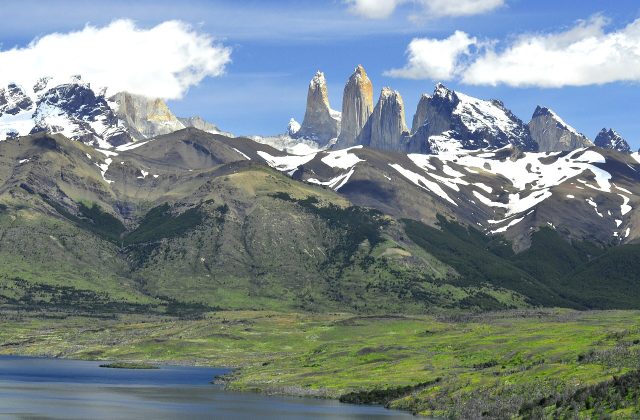
Torres del Paine is the great park of Chilean Patagonia, two hours north of Puerto Natales and five from Punta Arenas,…
59 tickets & tours

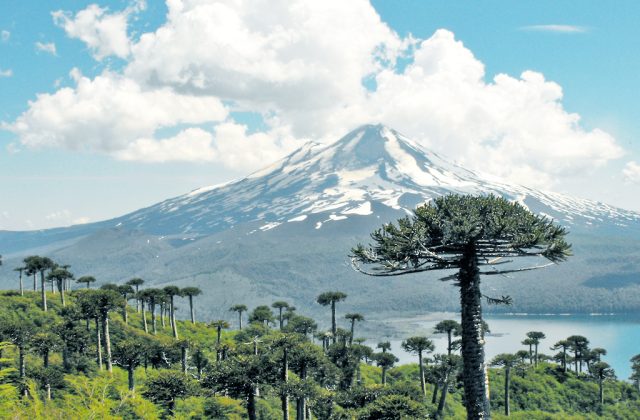
Photo: Ruben Lohaus Brito, CC BY-SA 2.5
Vicente Perez Rosales is the oldest national park of Chile and one of the most visited, a landscape of snow-capped volcanoes, emerald lake and rainforest in the lake district of the south, and it is reached by a good paved road along the southern shore of Lake Llanquihue from the pretty German-founded town of Puerto Varas, sixty-four kilometres and about an hour away, which is itself twenty minutes from the regional capital and airport of Puerto Montt; frequent minibuses run from Puerto Varas to the road's end at Petrohue. Three things make up the classic day. At the Saltos del Petrohue, a few kilometres inside the park, where a modest fee is charged, short, easy paths and walkways lead to viewing platforms over a series of chutes and cascades that the river has cut through a bed of black basalt, the turquoise water foaming between rounded walls of lava with the cone of Osorno behind, a sight that draws every tour coach in the region.
At Petrohue itself, a hamlet with a hotel, a campsite, a ranger station and a jetty at the western end of Lake Todos los Santos, boats make trips of an hour on the lake, and the catamaran leaves each morning for Peulla, at the far end, two hours away, from where the celebrated combined crossing of the Andes by lake and bus continues to Bariloche in Argentina. The third is the Osorno volcano: a road climbs from Ensenada to a ski centre at about 1,240 metres on its flank, where chairlifts run in summer too, carrying visitors up towards the ice for the view over Lake Llanquihue. For walkers, the best day hike is the Paso Desolacion trail, which starts at Petrohue and climbs across the black sand and lava of Osorno's eastern slope to a saddle at 1,100 metres, twelve kilometres each way, with guided versions offered from the towns. The ascent of Osorno requires a guide, crampons and ice axe.
Live dates and prices from GetYourGuide. Free cancellation on most tickets.
The park was created in 1926 and named after the agent who in the 1850s organised the settlement of this region by German immigrants; it covers 2,536 square kilometres of the Andes between Lake Llanquihue and the Argentine frontier, where it adjoins the Nahuel Huapi park, and with the Puyehue park to the north forms one of the largest protected areas of the southern temperate forest. Three volcanoes command it. Osorno, 2,652 metres, is a cone of such symmetry that it is constantly compared with Fuji, sheathed in glaciers and ringed by some forty small craters on its lower slopes, from which the lavas of its historical eruptions came; the young Charles Darwin, from the deck of the Beagle off Chiloe, watched it erupt on a January night in 1835, and its last activity was in 1869. Tronador, the thunderer, 3,491 metres, on the border, is an old, deeply eroded, extinct volcano, the highest mountain of the region, named after the roar of the ice falling from its glaciers; and Puntiagudo, 2,493 metres, is a needle-sharp volcanic plug. The Calbuco volcano, just outside the southern boundary, erupted violently and without warning in April 2015, covering Ensenada in ash. Lake Todos los Santos, 178 square kilometres, was formed when lava flows from Osorno and Calbuco blocked a valley that the glaciers had excavated, separating it from Lake Llanquihue;
the Jesuits, who crossed it in the seventeenth century on their way between their missions on Chiloe and on Lake Nahuel Huapi, gave it its name, and its colour, an opaque emerald caused by glacial sediment and algae, gives it its other, the emerald lake. Theodore Roosevelt crossed the lakes here in 1913, and the young Ernesto Guevara, on his motorcycle journey, in 1952. The forest is the Valdivian temperate rainforest, evergreen, dense and wet, nourished by two and a half to four metres of rain a year: coihue, the dominant southern beech, ulmo, whose white flowers in late summer yield a prized honey, olivillo, tepa, the cinnamon-barked arrayan along the streams, a tangle of bamboo, fuchsia, giant rhubarb and ferns beneath, and, on high, wet ground, a few stands of alerce, the Patagonian cypress, which can live more than three thousand years. It shelters the puma, the pudu, smallest of deer, the kodkod, a tiny spotted cat, the monito del monte, a marsupial more closely related to those of Australia than to the American opossums, Darwin's frog, whose male broods the tadpoles in his vocal sac, the torrent duck, which can be watched in the rapids at the Petrohue falls, the Magellanic woodpecker and the chucao, whose loud call follows walkers through the undergrowth.
The park is open all year, and the falls and the lake can be visited in any season. The southern summer, from December to March, is the driest and warmest period, 18 to 25 degrees, and the time for walking and boat trips, with January and February the Chilean holidays, when the falls are crowded from late morning and accommodation in Puerto Varas is dear; late December and January also bring swarms of tabanos, large biting horseflies that are attracted to dark clothing and make open trails such as Paso Desolacion a trial.
March and April are calmer, with autumn colours. Winter, from June to September, is cold and very wet, with skiing on Osorno. Rain is possible on any day, and the volcanoes are often hidden, so go on the first clear morning, and see the falls early or late. Bring a waterproof, sun protection for the shadeless volcanic slopes, and plenty of water, since there is none on the Desolacion trail. Allow a day. Puerto Varas and Frutillar, on Lake Llanquihue, are the bases, and Chiloe is two hours south.
Yes. GetYourGuide lists one ticket or tour for Vicente Perez Rosales National Park, with live dates and prices and free cancellation on most of them.
The park is open all year, and the falls and the lake can be visited in any season.
Vicente Perez Rosales National Park covers 2 536 km².
Vicente Perez Rosales National Park was established in 1926.
Vicente Perez Rosales National Park is in Chile. The map on this page shows the exact spot.
Chile
Torres del Paine is the great park of Chilean Patagonia, two hours north of Puerto Natales and five from Punta Arenas,…
59 tickets & tours
Chile
Rapa Nui National Park is most of Easter Island, and the park ticket, bought online before travel or on arrival at the…
33 tickets & tours
Chile
Bernardo O'Higgins is the largest national park in Chile and one of the largest in the world, an almost…
7 tickets & tours
Chile
Villarrica National Park rises directly behind Pucón, the adventure capital of Chile's Lake District, about nine…
5 tickets & tours
Chile
Conguillío is the park of monkey-puzzle forests, lakes and fresh lava around the Llaima volcano, in the Andes of the…
3 tickets & tours
Chile
Huerquehue is a small park of ancient forest and mountain lakes thirty-five kilometres, about forty-five minutes,…
3 tickets & tours