Tijuca National Park
Brazil
Tijuca is the rainforest inside the city of Rio de Janeiro, and it is visited on half-day and full-day tours from the…
30 tickets & tours
Waterfall & Lake Park · Brazil
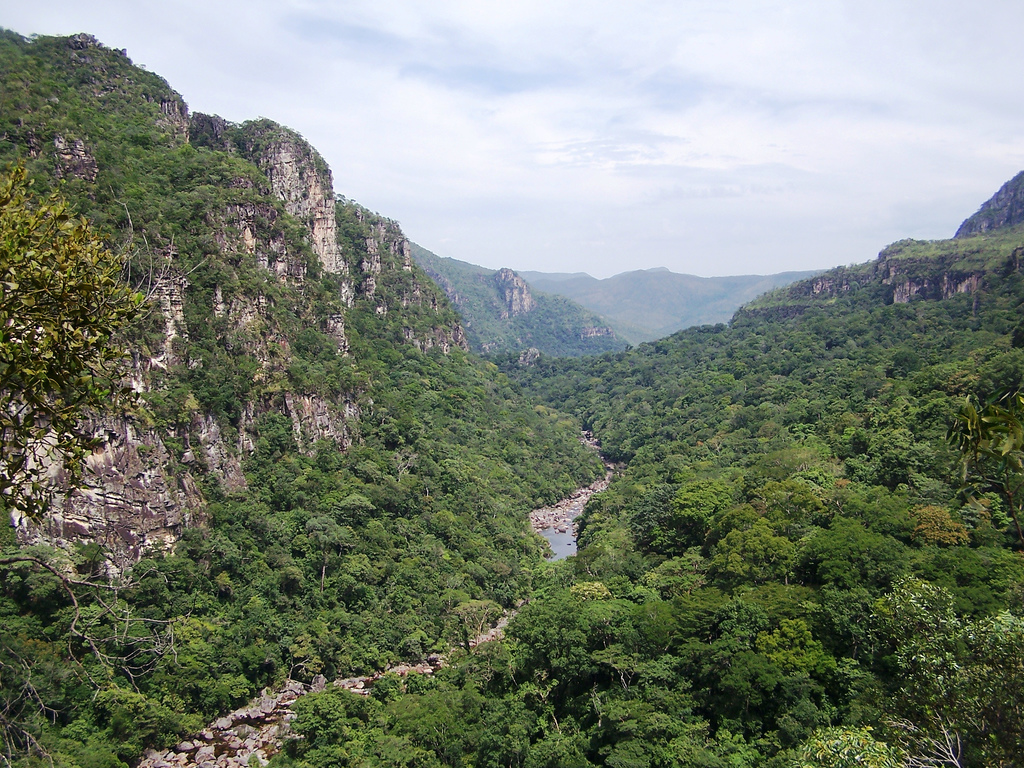
Photo: Marina Campos Vinhal, CC BY 2.0
The Chapada dos Veadeiros is a high plateau of waterfalls, canyons and crystal-clear rivers in the north of the state of Goias, in the very centre of Brazil, and it is the favourite wild escape of the inhabitants of Brasilia, the capital, which lies about 230 kilometres and three hours by road to the south and has the nearest airport. Buses run from Brasilia to the small town of Alto Paraiso de Goias, the principal base, with many guesthouses and restaurants and a marked taste for the esoteric, and on to the village of Sao Jorge, thirty-six kilometres further along a paved road, a former settlement of crystal miners with sandy streets, which stands at the gate of the national park; a car is, however, extremely useful, since many of the finest sights of the region lie outside the park on private land, scattered over a hundred kilometres.
The national park itself is entered only at Sao Jorge, where a concession operates the visitor centre, charges an entrance fee, and limits the number admitted each day, so that in holiday periods one should arrive at opening time or book ahead; guides, formerly compulsory, are now optional on the main trails, which are well marked. There are two classic day walks, each of about eleven or twelve kilometres return and taking five to six hours, over open, stony, shadeless ground with a swim as the reward. The trail of the Saltos leads to viewpoints over two great falls of the Rio Preto, of 120 and 80 metres, the second with a broad pool for bathing, and to a set of rapids. The trail of the canyons leads to two narrow gorges of the same river and to the Cariocas falls, a broad staircase of rock. A short trail suits families, and a traverse of twenty-three kilometres, with a night's camping at the Sete Quedas, must be booked.
The national park was created in 1961 by President Juscelino Kubitschek, the founder of Brasilia, with 625,000 hectares, was cut down by later governments to a tenth of that, and in 2017 was enlarged again to about 240,000; since 2001 it has been, with the Emas park, a World Heritage Site representing the cerrado, the savanna of central Brazil, which is the most biologically rich savanna in the world and has lost more than half its extent to soya and cattle within two generations. The chapada is a tableland of quartzite and other rocks among the oldest in South America, about 1.8 billion years, standing between 1,000 and 1,691 metres, the highest ground in central Brazil, from which rivers flow north to the Tocantins and the Amazon, dropping off its edges and through its fractures in a profusion of waterfalls and cutting canyons with walls of pink and grey rock. The bedrock is shot through with veins of quartz crystal, which was mined here by hand from 1912 until the 1980s, particularly during the Second World War, when it was needed for radio equipment; the old diggings are passed on the trails, and the miners' descendants became the first guides. The abundance of crystal, which is said to make the region shine when seen from space, together with its position on the same parallel of latitude as Machu Picchu, has made Alto Paraiso a centre for mystics, healers, alternative communities and watchers for flying saucers, which gives the town its particular flavour.
The vegetation is cerrado in all its forms: open grassland on the heights, studded in the dry season with the white pompons of everlasting flowers and with the strange, fire-blackened stems of the canela-de-ema, a plant like a small tree crowned with a tuft of leaves and lilac flowers; savanna with low, twisted, thick-barked trees adapted to fire; palm swamps of buriti along the streams; and gallery forest in the valleys. More than sixteen hundred plant species have been recorded, with dozens of orchids. The animals are those of the great South American grasslands, the maned wolf, tall and red on stilt-like legs, the giant anteater, the giant armadillo, the pampas deer, from which the chapada takes its name, the jaguar, the tapir, the rhea, the seriema, the king vulture, toucans and macaws, and, in a few remote clear rivers, the Brazilian merganser, one of the rarest ducks in the world. In October 2017 a fire, thought to have been started deliberately, burned more than a quarter of the enlarged park. Outside its boundaries lie the Vale da Lua, where a river has carved grey rock into smooth basins and craters like a lunar surface, the falls of Almecegas and Couros, and, near the town of Cavalcante, the turquoise pool of Santa Barbara, on the land of the Kalunga, descendants of escaped slaves, who guide visitors to it.
The park is open daily, generally from 8 am, with entry closing before noon and everyone out by late afternoon; it is closed on some Mondays outside holidays. The dry season, from May to September, is the time to come: the skies are cloudless, the days warm, 25 to 28 degrees, the nights cold, down to 10 degrees or less in June and July, the rivers clear and safe, and the flowers of the grasslands at their best in June and July; by August and September the land is parched, smoke may hang in the air, and the falls are reduced.
The rainy season, from October to April, turns everything green and fills the falls, but storms break almost daily, trails are muddy, and sudden flash floods, called water heads, can sweep down the canyons without warning from rain falling far upstream, so that bathing places are closed when the risk is high. Brazilian holidays, July, Carnival and New Year above all, fill every bed. Carry two litres of water, a hat, sunscreen and swimming things, and start early. Allow three to four days. Brasilia, with its modernist architecture, is three hours away.
No online tour for Chapada dos Veadeiros National Park is listed on GetYourGuide; entry, where it is charged, is paid at the gate or through the park authority. Nearby parks with bookable tours are listed on this page.
The park is open daily, generally from 8 am, with entry closing before noon and everyone out by late afternoon; it is closed on some Mondays outside holidays.
Allow three to four days.
Chapada dos Veadeiros National Park covers 2 400 km².
Chapada dos Veadeiros National Park was established in 1961.
Chapada dos Veadeiros National Park is in Brazil. The map on this page shows the exact spot.
Brazil
Tijuca is the rainforest inside the city of Rio de Janeiro, and it is visited on half-day and full-day tours from the…
30 tickets & tours
Brazil
Lençóis Maranhenses is the field of white dunes and rainwater lagoons on the coast of Maranhão in north-eastern Brazil,…
12 tickets & tours
Brazil
Iguaçu National Park is the Brazilian side of the falls at Foz do Iguaçu, and its visit is one walk: the entrance…
9 tickets & tours
Brazil
The Serra dos Órgãos is the mountain range that closes the northern horizon of Guanabara Bay, whose granite needles are…
5 tickets & tours
Brazil
The Chapada Diamantina is a range of table mountains, canyons, waterfalls and caves in the dry interior of the…
3 tickets & tours
Brazil
Itatiaia is the oldest national park in Brazil, in the Mantiqueira mountains on the border of the states of Rio de…
3 tickets & tours