Tijuca National Park
Brazil
Tijuca is the rainforest inside the city of Rio de Janeiro, and it is visited on half-day and full-day tours from the…
30 tickets & tours
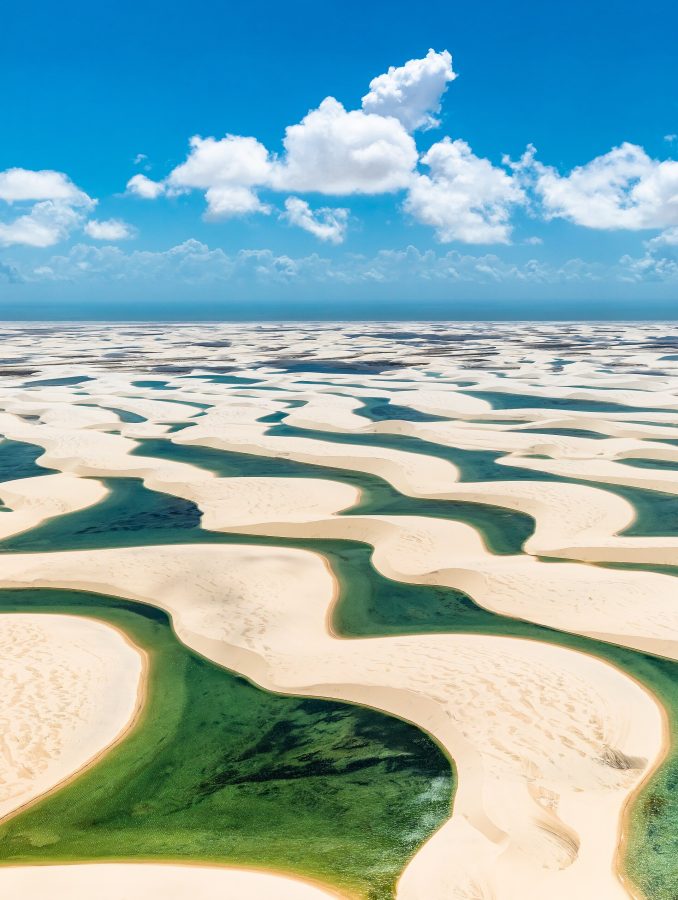
Photo: Julius Dadalti, CC BY-SA 4.0
Lençóis Maranhenses is the field of white dunes and rainwater lagoons on the coast of Maranhão in north-eastern Brazil, four hours from São Luís to the town of Barreirinhas at its gate, and it is visited on 4×4 excursions from the town: the half-day trips in open-sided Toyotas to the Lagoa Azul and the Lagoa Bonita circuits, the two most accessible groups of lagoons, with an hour or two of walking over the dunes and swimming, in the morning or the afternoon for the sunset; the full-day trips through the dunes to Atins, the village at the park's northern edge on the river mouth, and the day trips by boat down the Preguiças river to the Vassouras and Caburé beaches. The tours are booked at the agencies in Barreirinhas or through the pousadas and include the vehicle, the guide and the park permit, which is compulsory with a registered guide for the interior;
the ATV trips run the tracks at the edge. The trekking crossings of the park, two to four days from Barreirinhas or Santo Amaro to Atins with nights in the oasis villages of Queimada dos Britos and Baixa Grande, are the way to see the interior, and the multi-day packages combine them with the lodging. The stargazing tours and the boat trips with the ceremony are the evening. Santo Amaro, on the western side, has its own lagoons and fewer visitors, and Atins has the kite-surfing and the quieter access to the Lagoa Tropical. Independent visitors take the bus from São Luís to Barreirinhas and book the excursions in town; the park cannot be entered on foot without a guide.
Live dates and prices from GetYourGuide. Free cancellation on most tickets.
The park was created in 1981 and became a World Heritage Site in 2024, and it covers about 1,550 square kilometres of the Maranhão coast east of the São José bay, with seventy kilometres of beach and, behind it, a dune field of white quartz sand blown inland from the rivers by the trade winds for fifty kilometres, in barchan crescents up to forty metres high, which is the largest in Brazil and looks from the air like a bedsheet thrown over the land, the lençóis of the name. It is not a desert: 1,200 millimetres of rain fall a year, most of it from January to June, and the water collects in the valleys between the dunes above an impermeable layer, so that from June to September thousands of lagoons of clear blue, green and turquoise water lie among the white sand, some hundreds of metres long and three metres deep, warm enough to swim in, with fish that arrive from the rivers or survive as eggs in the sand;
by December they have evaporated and the field is sand alone. The Lagoa Azul and the Lagoa Bonita groups near Barreirinhas have the boardwalks and the crowds, the Lagoa da Esperança and the interior lagoons on the crossing have none, and the Queimada dos Britos oasis, a village of cattle herders and fishermen surrounded by dunes, is the crossing's night. The mangroves and the restinga scrub of the edges hold the maned wolf, the crab-eating fox and the sea turtles that nest on the beach, the scarlet ibis feeds in the estuaries, and the caboclo villages of Atins and Caburé live on the fishing and the visitors. The Preguiças river runs along the eastern edge to the sea, with the Vassouras dunes, the Mandacaru lighthouse and the Caburé sandbar on its banks.
The park is open all year, with the excursions from Barreirinhas in the morning from about 8 am and the afternoon from 2 pm, timed for the sunset. The lagoons are full from June to September, the season to come, with July and August the peak and the Brazilian holidays crowding the Lagoa Azul; the rains from January to May fill them, with cloudy days, storms and the tracks flooded, and from October to December the lagoons dry and the dunes are sand, with the wind strongest and the kite-surfers at Atins.
Walk the dunes barefoot, since the sand is soft and hot by midday, and go in the late afternoon for the light. Allow two days from Barreirinhas for the two circuits and Atins, four for the crossing. São Luís, the colonial capital, is four hours west, and the Parnaíba delta is a day east on the road to Jericoacoara.
Yes. GetYourGuide lists 12 tickets and tours for Lençóis Maranhenses National Park, with live dates and prices and free cancellation on most of them.
The park is open all year, with the excursions from Barreirinhas in the morning from about 8 am and the afternoon from 2 pm, timed for the sunset.
Allow two days from Barreirinhas for the two circuits and Atins, four for the crossing.
Independent visitors take the bus from São Luís to Barreirinhas and book the excursions in town; the park cannot be entered on foot without a guide.
Lençóis Maranhenses National Park covers 1 550 km².
Lençóis Maranhenses National Park was established in 1981.
Lençóis Maranhenses National Park is in Brazil. The map on this page shows the exact spot.
Brazil
Tijuca is the rainforest inside the city of Rio de Janeiro, and it is visited on half-day and full-day tours from the…
30 tickets & tours
Brazil
Iguaçu National Park is the Brazilian side of the falls at Foz do Iguaçu, and its visit is one walk: the entrance…
9 tickets & tours
Brazil
The Serra dos Órgãos is the mountain range that closes the northern horizon of Guanabara Bay, whose granite needles are…
5 tickets & tours
Brazil
The Chapada Diamantina is a range of table mountains, canyons, waterfalls and caves in the dry interior of the…
3 tickets & tours
Brazil
Itatiaia is the oldest national park in Brazil, in the Mantiqueira mountains on the border of the states of Rio de…
3 tickets & tours
Brazil
Jau is one of the largest protected areas of tropical rainforest in the world, in the Brazilian state of Amazonas, on…
2 tickets & tours