Tijuca National Park
Brazil
Tijuca is the rainforest inside the city of Rio de Janeiro, and it is visited on half-day and full-day tours from the…
30 tickets & tours
Waterfall & Lake Park · Brazil
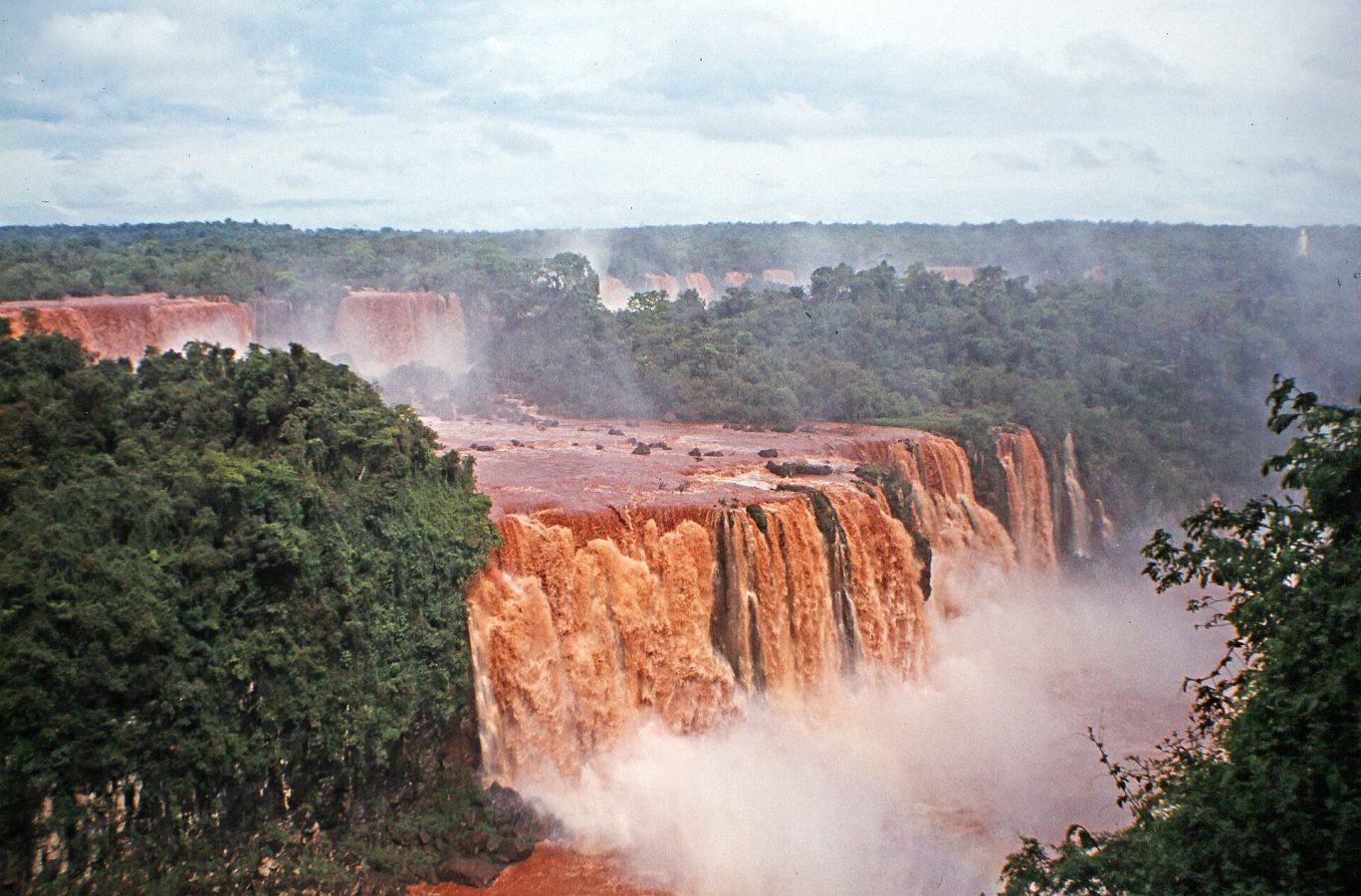
Photo: W. Bulach, CC BY-SA 4.0
Iguaçu National Park is the Brazilian side of the falls at Foz do Iguaçu, and its visit is one walk: the entrance ticket, bought online with a timed slot or at the gate, includes the park's double-decker bus to the trailhead and the 1.2-kilometre path along the gorge to the walkway that runs out over the river below the Devil's Throat, with the whole front of the falls in view from the Brazilian bank and the spray drenching the platform at the end; the walk takes two hours and needs no guide. The tours sold from Foz do Iguaçu and from Puerto Iguazú in Argentina add the transfers, the guide and the combinations: the falls with the Bird Park at the gate, the largest in Latin America, the three-borders landmark, the Itaipu dam and the helicopter flight over the falls, which is the other view and the loud one.
The Macuco Safari, run inside the park, is the boat trip up the river into the spray under the falls after a trailer ride through the forest, sold on its own or with the tours, and the Poço Preto and Bananeiras trails with a guide, a bicycle and a boat on the river above the falls are the quiet options. The night-time full-moon walks and the sunrise entries are the special slots. The Dreams Park shows and the ice bar in town are entertainment with the falls' name. Independent visitors take the city bus from Foz to the park gate and buy the ticket; the second day on the Argentine side needs a passport and the bus across the bridge.
Live dates and prices from GetYourGuide. Free cancellation on most tickets.
The park was created in 1939 and covers 1,852 square kilometres of Atlantic forest along the Iguaçu river in Paraná state, a World Heritage Site since 1986 together with the Argentine park across the river, and the largest remnant of the interior Atlantic forest in Brazil, with the falls at its south-western corner where the river drops off the basalt plateau in 275 cascades along nearly three kilometres before it joins the Paraná at the triple frontier. The Brazilian side has a fifth of the falls and all of the view: the trail from the Cataratas hotel follows the cliff opposite the Argentine falls, with the San Martín, the Bossetti and the Adam and Eve falls across the gorge in a curtain, and ends at the walkway over the river's edge below the Devil's Throat, where the Floriano fall drops beside the platform and the Garganta roars above in a permanent cloud of spray with rainbows in it;
the lift and the upper deck at the end look down on the whole horseshoe. The forest along the trail has coatis in gangs at the snack bars, capuchins, toucans, plush-crested jays, the great dusky swifts nesting behind the water and the butterflies that land on the visitors; the jaguars, the tapirs, the giant anteaters and the giant otters live in the interior, where the Poço Preto trail and the river above the falls are the only ways in. The Bird Park at the gate, a private aviary in the forest with the macaws, the toucans and the harpy eagle, is the region's most visited attraction after the falls; the Itaipu dam upstream on the Paraná, one of the largest in the world, and the marker of the three borders with Argentina and Paraguay are the other days out. André Rebouças, the engineer who proposed the park in 1876, is the park's founder in memory, and the Cataratas hotel of 1958 inside it is the one place to sleep in the park.
The park is open daily from 9 am to 5 pm, with the last entry at 4 pm and the trail walked until dusk; the timed entries and the full-moon nights are booked online. The falls are fullest from December to March and after the winter rains, when the walkway is a shower and the spray hides the view for minutes at a time; the dry southern winter from June to August is cooler and clearer, with lower water and the walkway walkable;
the spring from September to November is the balance. Summer is hot, humid and full, with the Brazilian holidays in January and July; the morning light is on the falls from the Brazilian side, so go early. Allow a half-day for the walk and the Macuco boat, a full day with the Bird Park, and a second day for Argentina. Foz do Iguaçu is the town, Puerto Iguazú is across the bridge, and Ciudad del Este in Paraguay is the third corner.
Yes. GetYourGuide lists 9 tickets and tours for Iguaçu National Park, with live dates and prices and free cancellation on most of them.
The park is open daily from 9 am to 5 pm, with the last entry at 4 pm and the trail walked until dusk; the timed entries and the full-moon nights are booked online.
Allow a half-day for the walk and the Macuco boat, a full day with the Bird Park, and a second day for Argentina.
Iguaçu National Park covers 1 853 km².
Iguaçu National Park was established in 1939.
Iguaçu National Park receives about 1.8 million a year (2023).
Iguaçu National Park is in Brazil. The map on this page shows the exact spot.
Brazil
Tijuca is the rainforest inside the city of Rio de Janeiro, and it is visited on half-day and full-day tours from the…
30 tickets & tours
Brazil
Lençóis Maranhenses is the field of white dunes and rainwater lagoons on the coast of Maranhão in north-eastern Brazil,…
12 tickets & tours
Brazil
The Serra dos Órgãos is the mountain range that closes the northern horizon of Guanabara Bay, whose granite needles are…
5 tickets & tours
Brazil
The Chapada Diamantina is a range of table mountains, canyons, waterfalls and caves in the dry interior of the…
3 tickets & tours
Brazil
Itatiaia is the oldest national park in Brazil, in the Mantiqueira mountains on the border of the states of Rio de…
3 tickets & tours
Brazil
Jau is one of the largest protected areas of tropical rainforest in the world, in the Brazilian state of Amazonas, on…
2 tickets & tours